wikiHow is a “wiki,” similar to Wikipedia, which means that many of our articles are co-written by multiple authors. To create this article, volunteer authors worked to edit and improve it over time.
This article has been viewed 41,737 times.
Learn more...
You will learn to rotate a curve around the x or y axis using calculus, and calculate volume and surface area, so long as your understanding of calculus steps is up to par (as this is not so much an article in learning calculus and deriving specific answers as it is a means of learning how to make a rotational solid or surface).
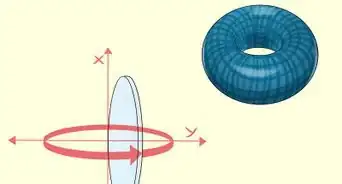
When a plane region, lying entirely on one side of a fixed line in its plane, is revolved about that line, it generates a solid of revolution. The fixed line is called the axis of the solid of revolution. As an illustration, if the region bounded by a semicircle and its diameter is revolved about that diameter, it sweeps out a spherical solid. If the region inside a right triangle is revolved about one of its legs, it generates a conical solid. When a circular disk is revolved about a line in its plane which does not intersect the disk, it sweeps out a torus (or donut). All plane sections of a solid of revolution that are perpendicular to its axis are circular disks or regions bounded by two concentric circles. We seek the volume of a solid of revolution. But first we must define what is meant by the "volume" of a solid of revolution. Just as in any discussion of a plane area in which it is assumed that the area of a rectangle is a product of its length and width, we start out investigation of volumes of solids of revolutions by assuming that the volume of a right circular cylinder is πr^2h (π=pi, r=radius, ^2=squared and h=height or altitude).

Part 1
Part 1 of 2:The Tutorial: Volume of a Solid of Revolution
-
1Start by opening a new workbook in Excel from the desktop, from the dock, or from within your Applications folder inside the Microsoft folder. Double click on Excel (either the green X on the dock or the app title in the folder) and select File New Workbook.
-
2In Preferences, set R1C1 to unchecked or Off, set Ribbon to checked or On and set Show Formula Bar to checked or On.
-
3Click in the far upper left top corner above the 1 of row 1 and to the left of column A. Doing so will select the entire worksheet. Format Cells Number Number to decimal places 2, show comma. Format Cells Alignment Center. # Title the first worksheet, "Rotate Function f(x)" and save the workbook as "Rotate Curves About An Axis" into an appropriate folder such as 'Microsoft Excel Imagery' or 'wikiHow Articles'.
-
4Enter to cell A1 the following text and then set Format Cell Alignment to Wrap Text:
- Let f be a function which is continuous on the closed interval [a,b], with f(x) ≥ 0 for a ≤ x ≤ b. You want to define the volume of the solid of revolution generated by revolving about the x-axis the region R which is bounded by the curve y = f(x), the x-axis, and the vertical lines x = a and x = b. Let f(x) = sqrt(x) and a = 1 and b = 4.
- Subdivide the interval [a,b] into n subintervals by a partition P, and choose n points wi, one in each subinterval. Draw n approximating rectangles with base [xi-1,xi] and altitude f(wi), i = 1, 2, 3, ... , n; a typical one of these rectangles is shown in the diagram as Rect HGFE.
- Revolve the region R about the x-axis to generate a solid of revolution, using the n rectangles to sweep out n right circular cylinders. The cylinders swept out by the typical rectangle, eg. Rect HGFE, is shown in the following Diagram; since the radius of its base is f(wi) and its altitude is ∆xi, its volume is ∆Vi = π*[f(wi)]^2 *∆xi.
- Note that if you want to create a washer type of form, the formula changes to π * ∫ba [f(x)^2 = g(x)^2]*dx -- so it is a definite integral of the difference of the squares of the external function, f(x), and the internal (hole) function, g(x).
- Note also that you may let f be a continuous function on [a.b] and if the region bounded by y = f(x), the x-axis, and the lines x = a and x = b lies in the first quadrant, the volume of the solid of revolution generated by revolving this region about the y-axis is V = 2π * ∫ba x*f(x)*dx, another definite integral.

Part 2
Part 2 of 2:The Tutorial: Area of a Surface of Revolution
-
1Consider a function f which is continuous on the interval [a,b], with f(x) ⊵ 0 for a ⊴ x ⊴ b, and whose first derivative f' is also continuous on [a,b]. If the arc of the curve y = f(x), from the point (a, f(a)) to the point (b, f(b)) is revolved about the x-axis, a surface of revolution S is swept out.
- Find the area of the surface of revolution by first partitioning [a,b] into n intervals [xi-1, xi], i = 1, 2, 3, ..., n.
- Let Qi be the point on the curve whose coordinates are (xi,f(xi)), and denote the point (a, f(a)) by Q0.
- Then let the broken line formed by the n chords Qi-1Qi of the curve be revolved about the x-axis; it sweeps out a surface which approximates S, and this approximation improves as the norm |P| of the partition decreases.
- Consider that the lateral area of a frustum of a cone, having slant height s and radius of its bases r1 and r2, is π*(r1 + r2)*s. Thus each chord Qi-1Qi, as it revolves about the x-axis, sweeps out the lateral surface of a frustum of a cone whose area is π*[f(xi-1) + f(xi)]*|Qi-1*Qi|.
- Consider that, because of the formula for the arc distance (see the article Approximate Arc Length Using the Distance Formula), this may be re-written and defined as follows:
- Let f and f' be continuous on [a,b] with f(x) ⩾ 0 for a ⩽ x ⩽ b. The area of the surface of revolution swept out by revolving about the x-axis the segment of the curve y = f(x), from the point (a, f(a)) to the point (b, f(b)) is: 2π * ∫ba f(x)*sqrt(1+f'(x)^2)*dx.
- Example: Find the area of the surface of revolution generated by revolving about the x-axis the segment of the curve y = sqrt(x) from (1,1) to (4,2).
- Solution: By substituting f(x) = sqrt(x) and f '(x) = 1/(2*sqrt(x)) in the above formula, you get: 2π * ∫41 x^.5 * sqrt(1+(1/(2*sqrt(x)))^2)*dx =
- π * ∫41 sqrt(4x +1) dx (by dividing by sqrt(4) =
- π/4 * ∫41 (4x +1)^.5 * d(4x +1) =
- π/4 * [(4x +1)^(3/2)]/(3/2)41 (by integration) =
- π/4 * 2/3 * (17^1.5 - 5^1.5) = π/6 * (17^1.5 - 5^1.5) = 30.8465 √

References
- "CALCULUS with Analytic Geometry, 2nd edition", Edwin J. Purcell, 1972, New York, NY 390-72069-0
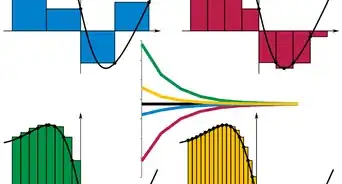
- 1http://www.mathsisfun.com/calculus/integration-rules.html
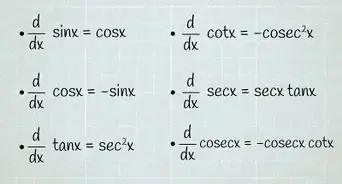
- 2http://www.mathsisfun.com/calculus/derivatives-rules.html
- The principal XL worksheet used for this article was "Use Calculus to Rotate Curves Around an Axis.xlsx" by C. Garthwaite, 2015