This article was co-authored by Courtney Copriviza. Courtney Copriviza is an Elementary School Teacher based in Maui, HI. Courtney specializes in elementary education, classroom management, and social and emotional development. She holds a BA in Communication with a minor in Urban Education and an MA in Teaching from Santa Clara University. Courtney has also taught high school in Madrid, Spain. She is a member of Kappa Delta Pi International Honors Society in Education.
There are 13 references cited in this article, which can be found at the bottom of the page.
This article has been viewed 3,594 times.
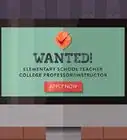
Teaching middle school science can be a rewarding job. It is well-suited for college students looking for a potential career path, retirees looking for a new occupation, or anyone in between. Most middle schools require their science teachers to have a bachelor’s degree in a science-related field and to have passed all of the required teaching certifications and licenses in that state. Some states offer alternative certification opportunities for those who wish to become middle school science teachers but have already completed their college degrees without a teacher preparation option.
Steps
Part 1
Part 1 of 3:Qualifying through a Bachelor’s Degree and Certifications
-
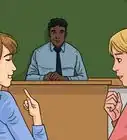
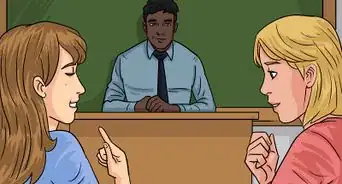
1Get a bachelor’s degree in a science-related field. Most middle schools will prefer that you hold a bachelor’s degree in some kind of science field – this could include biology, chemistry, zoology, or even physics. This will reassure your future employer that you have the necessary skills for teaching middle school science.[1]
- If possible, complete a teacher preparation program as part of your undergraduate curriculum.
- It would also be helpful to minor in (or get some kind of certification in, if possible) child psychology during your undergraduate program.
-
2Get a bachelor’s degree in education, with a minor in science. This will help prepare you for many facets of the teaching field, rather than just the science-related aspects. Most people on this career path who get a bachelor’s in education also minor in general science or in a specific science-related field, such as biology, chemistry, zoology, physics, etc.[2]
- Earning a bachelor’s degree in education rather than science may prepare you for more administrative roles later on in your career – like vice principal.
Advertisement -
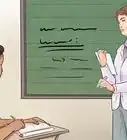
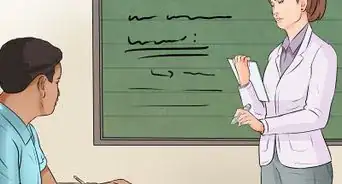
3Complete a student teaching internship in a science classroom. During your senior year of your undergraduate degree, you should participate in a student teaching program that will allow you to gain hands-on experience in a middle school science classroom. The student teaching internship will typically be organized by your undergrad program and you will be placed in an appropriate middle school with a veteran science teacher.[3]
- During this time, you’ll learn how to lead discussions, conduct classroom activities, plan lessons, motivate students, and engage with parents.
-
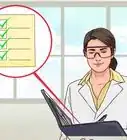
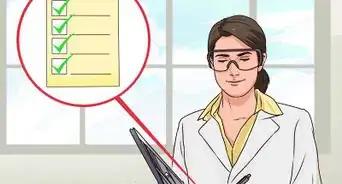
4Take all required state tests to qualify for a position as a science educator. After graduation, you’ll need to register for and pass all of the appropriate subject exams required by your state. There are several different exams to choose from, so make sure you check the regulations from the Board of Education in your specific state.[4]
- Some examples of tests that are required in some states include the Praxis Earth and Sciences Content Knowledge or Chemistry Content Knowledge exams.
-
5Apply for your teaching license. Once you have graduated with your science degree and passed the necessary exams, you should apply for your teaching license. This is a formal process that is unique to each state – each governed by different rules and regulations. In most cases, you’ll simply need to provide documentation proving that you have completed all of the required steps toward becoming a teacher in your specific state.[5]
- For example, if you want to apply for your teaching license in California as a first time teacher, you must complete the application and submit unopened, official college transcripts (directly from your university) listing your bachelor’s degree, the completion of a California-approved program for teacher preparation, and fulfillment of any field-related required courses; photocopies of your subject exam score reports; application fees; and a signed oath and affidavit for educators (that you can download online).[6]
- You can complete the application online or mail all of your documents to State of California Commission on Teacher Credentialing / Certification, Assignment ad Waivers Division / Attention: Applications / 1900 Capitol Avenue / Sacramento, CA 95811-4213.[7]
- If you want to teach in California and you have already been licensed in another state, you can simply apply for a new teaching license in California based on that state’s teacher reciprocity agreements with other states. Make sure the state from which you received your license is on the list at http://www.teaching-certification.com/teaching/california-teacher-reciprocity.html.
- Once you have sent in all of the required documents, it is usually just a matter of a few weeks before you receive the license in the mail.
Advertisement


Part 2
Part 2 of 3:Getting an Alternative Certification
-
1Take the certification tests and be assigned to a mentor teacher once you already have a bachelor’s degree. If you have a bachelor’s degree in another field, you can still become a qualified middle school science teacher without going back to school to earn another bachelor’s degree in a science-related field. These requirements vary from state to state, but the process typically involves taking subject area certification tests and being mentored by a veteran teacher in the field.[8]
- Sometimes middle schools will hire you without completing the certification process, then assign you to a veteran teacher who will mentor you and assist you in getting certified.[9]
- You can search alternative certification requirements by state here: http://www.teaching-certification.com/alternative-teaching-certification.html
-
2Register for a Post-Baccalaureate Teacher Preparation Program in Science. These kinds of programs are intended to help people with different backgrounds become certified middle school science teachers. A program like this typically takes between 2 and 3 years to complete, depending on how quickly you move through each module. [10]
- Prices for these programs vary greatly – based on how long you take to complete the curriculum, how prestigious the school is, etc. But they typically cost around $12,000 US per year.
-
3Earn a Master’s degree or PhD in the field you wish to teach. In some states, holding a Master’s or PhD in a science-related field will qualify you to teach middle school science without the necessity of completing any other training, certifications, or applying for a teaching license. Some states require certification no matter what level of degree you hold, so be sure to check your state’s requirements.[11]
- Some states (and some private schools) require all middle school science teachers to hold Master’s degrees. In this case, a PhD in a related field would be the only way to bypass that requirement.
Advertisement


Part 3
Part 3 of 3:Being a Good Middle School Science Teacher
-
1Use hands-on experience whenever possible. Studies have shown that students perform much better in science classrooms that use creative, hands-on approaches more often than simply focusing on textbook learning. Whenever possible, try to get the students involved in the learning process, rather than just reading a chapter in a book.[12]
- This means that you should try more experiments, investigations, projects, activities, learning-based games.[13]
- Consider taking your students outdoors to identify various insects or plants; let your students play around with magnets to learn how the force of repellent magnetism works; grow some tadpoles in your classroom and let the students care for them as they grow into frogs; make a battery out of a piece of fruit and connect it to a lightbulb.[14]
-
2Stay organized. Being a good teacher requires a high level of organizational skills. You’ll have lesson plans, student assignments, and daily activities to keep track of throughout the entire school year.[15]
- Create a filing system in your classroom that helps you store and easily locate any of the items you must maintain. Use different colored folders for different classes when storing hard copies, and make separate, clearly-labeled folders on your computer when organizing electronic files.
-
3Give good feedback. In order to help your students learn the material more effectively, you should provide them with timely, insightful feedback. Try to focus on specific skills and areas of knowledge that can be improved upon, rather than giving generic feedback.[16]
- For example, make comments like, “I’d like to see a more thorough step-by-step explanation of your process” instead of something like, “Vague explanation.”
-
4Learn from other teachers. Teaching is a profession that is characterized by constant sharing and swapping between fellow colleagues. Veteran teachers are usually more than happy to share lesson plans, activities, or general classroom advice with less experienced teachers who are finding their way.[17]
- If you’re struggling with a particular section or topic, ask a fellow teacher for some help or advice.
-
5Listen to your students. Middle school is a crucial age – when students often begin to excel at their studies or fall behind. It’s important that you get to know your students, monitor their progress, and listen to them if they seem to be struggling.[18] Talk to your students about what they don’t understand and come up with ways to solidify the topics in their minds.[19]
- If you see your students struggling, it might be a good idea to set up some tutoring hours where you make yourself available for extra instruction.
Advertisement


Community Q&A
-
QuestionIs it necessary to have a master's to become a school teacher?
 Courtney CoprivizaCourtney Copriviza is an Elementary School Teacher based in Maui, HI. Courtney specializes in elementary education, classroom management, and social and emotional development. She holds a BA in Communication with a minor in Urban Education and an MA in Teaching from Santa Clara University. Courtney has also taught high school in Madrid, Spain. She is a member of Kappa Delta Pi International Honors Society in Education.
Elementary School TeacherIf you have a bachelor's, you can become a school teacher. A master's degree may help you to get a higher salary. -
QuestionCan I work to get my credential while teaching?Courtney CoprivizaCourtney Copriviza is an Elementary School Teacher based in Maui, HI. Courtney specializes in elementary education, classroom management, and social and emotional development. She holds a BA in Communication with a minor in Urban Education and an MA in Teaching from Santa Clara University. Courtney has also taught high school in Madrid, Spain. She is a member of Kappa Delta Pi International Honors Society in Education.
Elementary School TeacherThere are several ways in which you can work to get your credential while you are already teaching. You can take online classes or do night classes. -
QuestionHow can I make science classes more fun?Courtney CoprivizaCourtney Copriviza is an Elementary School Teacher based in Maui, HI. Courtney specializes in elementary education, classroom management, and social and emotional development. She holds a BA in Communication with a minor in Urban Education and an MA in Teaching from Santa Clara University. Courtney has also taught high school in Madrid, Spain. She is a member of Kappa Delta Pi International Honors Society in Education.
Elementary School TeacherYou can show an experiment in class and ask the students to find how you arrived at the outcome. It is more exciting to go backward and find out how a particular chemical reaction took place. Besides this, you can encourage the students to do and learn instead of only reading textbooks.

References
- ↑ https://www.teachercertificationdegrees.com/careers/science-teacher/
- ↑ https://study.com/articles/Become_a_Science_Teacher_Education_and_Career_Roadmap.html
- ↑ https://education.cu-portland.edu/blog/teaching-careers/general-science-teacher/
- ↑ https://www.teachercertificationdegrees.com/careers/science-teacher/
- ↑ https://www.teachercertificationdegrees.com/careers/science-teacher/
- ↑ https://www.ctc.ca.gov/docs/default-source/leaflets/414.pdf?sfvrsn=24453907_6
- ↑ http://www.teaching-certification.com/california-teaching-certification.html#initial-cert
- ↑ https://education.cu-portland.edu/blog/teaching-careers/general-science-teacher/
- ↑ Courtney Copriviza. Elementary School Teacher. Expert Interview. 18 June 2021.
- ↑ https://www.wgu.edu/education/teacher_certification_science_program#
- ↑ http://www.teaching-certification.com/alternative-teaching-certification.html
- ↑ https://www.albany.edu/nykids/files/MiddleSchool_Science_FullReport.pdf
- ↑ Courtney Copriviza. Elementary School Teacher. Expert Interview. 18 June 2021.
- ↑ https://www.thoughtco.com/middle-school-science-experiments-604274
- ↑ http://blogs.edweek.org/teachers/classroom_qa_with_larry_ferlazzo/2014/05/response_practical_ideas_to_help_students_teachers_stay_organized.html
- ↑ https://www.opencolleges.edu.au/informed/features/giving-student-feedback/
- ↑ https://education.cu-portland.edu/blog/teaching-careers/junior-high-school-teacher/
- ↑ Courtney Copriviza. Elementary School Teacher. Expert Interview. 18 June 2021.
- ↑ https://education.cu-portland.edu/blog/teaching-careers/general-science-teacher/
About This Article