X
wikiHow is a “wiki,” similar to Wikipedia, which means that many of our articles are co-written by multiple authors. To create this article, volunteer authors worked to edit and improve it over time.
This article has been viewed 35,851 times.
Learn more...
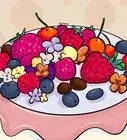
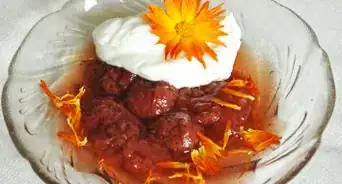
Real, sugar-coated flowers were popular in England during the reign of Queen Victoria. Today, they've made a comeback as a cake decoration. Unlike imitation flowers created from fondant or other sugar products, these lend their own herbal flavor.
Steps
-
1Choose thin-petaled, edible flowers. Violets and pansies (Johnny-jump-ups) are some of the easiest edible flowers to sugar. Other options include cherry blossoms, nasturtiums, marigold, and borage.[1] Pick the flower in the morning for lower risk of wilting. Choose blossoms that are fully opened but not wilting, for best flavor.[2]
- Edible flowers with thick petals or petals that grow in clumps may not harden into stiff shapes. They can be sugared for next-day use, but will not last much longer. These include carnations, dandelions, roses, red clover, and lilacs.
- Never use flowers that have been in contact with pesticides, that grew alongside a road, or that have any obvious damage.
-
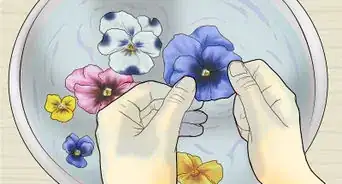
2Prepare the flowers. Shake them to remove excess dirt or any insects. Use scissors to trim off the bitter stems. Remove the stamens using tweezers, then wash under running water. Drain and let dry on paper towels in a warm spot away from direct sunlight.
- Optionally, you can gently tug apart the flower petals and sugar them individually. Individual petals are easier to work with than full flowers, especially for flowers with clumps of petals.[3]
-
3Prepare the egg white glaze. Beat one egg white with a fork until frothy, about one minute. If it's thick and difficult to brush on, add a small spoonful of water.[4]
- Eating raw egg white can cause food-borne illness. To avoid this, mix dry pasteurized egg white powder with water instead.[5] Do this if you are serving a large group, or selling the flowers.
- To separate the egg white, crack the egg gently. Move the yolk back and forth between the two eggshell halves. Repeat until the yolk and white are separated.
-
4Brush a thin layer of egg white on each flower. Hold the edge of the flower or petal with a pair of tweezers. Use a new paintbrush, that has never been used for anything but food. Use a small brush to avoid tearing the petals.
- If egg is too thick to brush on easily, stir in a few drops of water.
-
5Sprinkle superfine sugar over each flower. Use a spoon to sprinkle superfine granulated sugar completely over both sides of the flower. Once covered, gently tap the flower to remove excess sugar. A fine layer should remain, with the color of the flower visible underneath.
- Superfine sugar is also called berry sugar, caster sugar, or castor sugar.
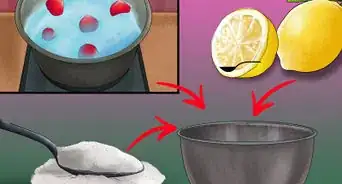
- You can make your own superfine sugar by blending regular white granulated sugar.[6]
-
6Let dry overnight. Place the flowers on a wire rack or cookie sheet covered in wax paper. Let dry at room temperature until the base is completely dry and the flower is stiff. This takes between 12 and 36 hours.[7] The sugared flowers will be brittle, so take care when handling them.
- If your oven has a pilot light, you can leave the oven "off" and keep the flowers in with the door closed for 8 hours. Alternatively, set any oven to the lowest setting (no more than 200ºF / 90ºC) and leave with the door ajar for a few hours, checking frequently to avoid burning.[8]
-
7Store the flowers. Store the flowers in an airtight container at room temperature away from direct sunlight. Separate layers with paper towels or tissue paper.
- Thin-petaled flowers that have completely dried should last for a few weeks or months this way.[9] Flowers with thick petals may only last a few days.
-
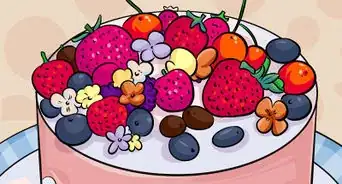
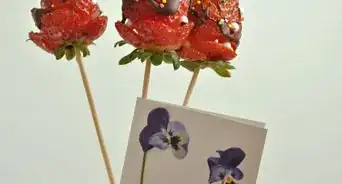
8Decorate cakes or centerpieces. Sugared flowers are often stuck onto cakes, using a dab of icing. You can even create a flower out of sugared petals this way, with a steady hand and pair of tweezers.


Community Q&A
-
QuestionCan pansies and violas be frozen for later use?
 Community AnswerThe only way to preserve flowers for later use is to dry them. Freezing them causes the water in the flower to expand, which breaks down the membranes.
 -
QuestionCan I use or eat daffodil or narcissus?
 T. ChinsenTop AnswererBoth flowers contain lycorine, which is poisonous. Any consumption can cause abdominal discomfort like nausea, vomiting and diarrhea.
Things You'll Need
- New small paint brush
- Wax paper
- Edible flowers
- Tweezers
- Egg whites, wet or dry
- Fork
- Bowl
- Superfine granulated sugar
- Spoon
- Cake rack or cookie sheet
- Wax paper
- Tissue paper or paper towel
- Airtight container
Warnings
- Never eat an unidentified flower. Never eat a flower not listed here without researching its edibility first. You can learn about some edible and poisonous flowers at What's Cooking America and Colorado State Extension, but these are not complete lists.Thanks!

References
- ↑ http://www.designsponge.com/2010/05/friday-food-how-to-sugared-flowers.html
- ↑ http://www.ext.colostate.edu/pubs/garden/07237.html
- ↑ http://www.marthastewart.com/964916/htb124-how-sugar-flowers-web-version-hi-resmov#964916
- ↑ http://www.marthastewart.com/964916/htb124-how-sugar-flowers-web-version-hi-resmov#964916
- ↑ http://www.ext.colostate.edu/pubs/garden/07237.html
- ↑ http://whatscookingamerica.net/EdibleFlowers/EdibleFlowersMain.htm
- ↑ http://whatscookingamerica.net/EdibleFlowers/EdibleFlowersMain.htm
- ↑ http://whatscookingamerica.net/EdibleFlowers/EdibleFlowersMain.htm
- ↑ http://www.designsponge.com/2010/05/friday-food-how-to-sugared-flowers.html