This article was co-authored by wikiHow staff writer, Jessica Gibson. Jessica Gibson is a Writer and Editor who's been with wikiHow since 2014. After completing a year of art studies at the Emily Carr University in Vancouver, she graduated from Columbia College with a BA in History. Jessica also completed an MA in History from The University of Oregon in 2013.
The wikiHow Culinary Team also followed the article's instructions and verified that they work.
Learn more...
Dried yeast is such a long-lasting pantry staple that it's easy to forget it's a living organism. To keep your yeast alive so it gives lots of lift to your baked goods, refrigerate it or stick it in the freezer for long term storage. We've answered a few of the most common storage questions so you can be confident the next time you mix up a yeasted dough.
Steps
Question 1
Question 1 of 7:Does dried yeast go bad if it's not refrigerated?
-
1Not unless it's been opened or it's expired. It's totally fine to toss unopened dried yeast into your cupboard until you're ready to use it. You can keep it at room temperature for up to 6 months or the expiration date if it's sooner.[1]
- Once you open the yeast, you'll have to store it in the fridge.
Advertisement

Question 2
Question 2 of 7:Should I keep dried yeast in the refrigerator?
-
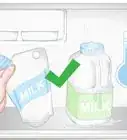
1Yes—the fridge can keep your yeast fresh for up to 6 months. If you've opened the yeast, put it into an airtight container or sealable freezer bag and label it before you stick it in the fridge.[2] This prevents moisture and heat from damaging the organisms in the yeast.[3]
- It's totally fine to put unopened packages of yeast into the fridge, too.
- When you're ready to use some of the yeast, just measure out what you need and add it to your ingredients or activate it in water, depending on what type of yeast you have.
Question 3
Question 3 of 7:Can you freeze instant dried yeast?
-
1Yes! The freezer is great for long-term yeast storage. Keep the dried yeast in its original packaging if you haven't opened it, or put it into a sealable freezer bag if you've opened the package. Store the yeast in the freezer for up to 1 year.
- When you're ready to use the yeast, you can just measure it and use it in your recipe. There's no need to defrost it first.[4]
- If you put the yeast into a freezer bag, don't forget to label it.
Advertisement

Question 4
Question 4 of 7:What's the difference between active dry and instant yeast?
-
1Instant yeast is faster and a little easier to use than active yeast. Active yeast has to be dissolved in water, but you can mix instant yeast into dough. Either way, you can proof the dough multiple times.[5]
- To make things a little complicated, instant yeast is sometimes sold as rapid- or quick-rise yeast, which is even smaller than regular instant yeast. It also has enzymes and additives that help the dough rise even faster so you can skip the first proof.
Question 5
Question 5 of 7:How long will dried yeast last?
-
1You can keep yeast for 6 to 12 months depending on how you store it. The freezer is best for long-term storage since you can keep the yeast in there for up to 1 year. If you use yeast more frequently, you can keep it in the fridge for up to 6 months. Unopened packages of dried yeast are fine to keep at room temperature for up to 1 year as long as they don't expire before them.[6]
- Don't forget to put yeast into the fridge or freezer once you open the package.
Advertisement

Question 6
Question 6 of 7:How can I check if dried yeast has gone bad?
-
1Try to activate a little of it in a bowl to see if it's still alive. Before you commit to using your yeast in a recipe, put 1 teaspoon (4 g) of sugar in a bowl with 1⁄4 cup (59 ml) of warm water. Stir in 2 1/4 teaspoons (7 g) of dried yeast until it dissolves. Then, let it sit for 10 minutes. If the yeast is good, you'll see the mixture bubble up so it doubles in size.[7]
- If you don't see any bubbles on the surface of the water, the yeast is old so throw out the rest of it.
Question 7
Question 7 of 7:What can you do with dead yeast?
-
1Unfortunately, you'll have to throw it out. Once the organisms in yeast die, you can't revive them so they won't give any lift to your baked goods. This is why it's important to check yeast that you think might be expired before you bake with it.
- Don't worry if you accidentally bake with expired yeast. It's okay to eat although the baked good will probably be heavy and dense.
Advertisement



References
- ↑ https://www.ams.usda.gov/sites/default/files/media/CID%20Yeast%20Baker%E2%80%99s%20%28Active%20Dry%29.pdf
- ↑ https://www.doesitgobad.com/does-yeast-go-bad/
- ↑ https://www.stilltasty.com/fooditems/index/18711
- ↑ https://www.stilltasty.com/fooditems/index/18711
- ↑ https://www.thekitchn.com/whats-the-difference-between-active-dry-yeast-and-instant-yeast-54252
- ↑ https://www.thekitchn.com/baking-school-day-11-all-about-yeast-and-baking-222489
- ↑ https://www.fleischmannsyeast.com/baking-basics/yeast-101/
About This Article