This article was co-authored by wikiHow staff writer, Madeleine Criglow. Madeleine Criglow is a wikiHow Staff writer based in the Pacific Northwest. She has over six years of experience working in copywriting, editing, and journalism. In addition to her work for wikiHow, she writes a monthly film column for Tigard Life and Tualatin Life newspaper. Madeleine graduated from the University of Puget Sound with a BA in English with an emphasis in Creative Writing.
There are 8 references cited in this article, which can be found at the bottom of the page.
The wikiHow Culinary Team also followed the article's instructions and verified that they work.
This article has been viewed 1,066,920 times.
Learn more...
When it comes to storing bread, you've got a whole lot of choices. Some are better than others, depending on what kind of bread you're looking to store. Whether you've just baked a loaf or recently bought fresh bread from the store, this article is here to help. Read on for how to store your bread to keep it tasting fresh!
Steps
Method 1
Method 1 of 7:Wrap store-bought bread in plastic or aluminum foil.
-
1Both trap the bread's natural moisture to keep it from drying out. If your store-bought bread came in paper wrapping, toss it out and wrap it in plastic or aluminum foil to store it. Keep sliced, processed bread that's been wrapped in plastic in its original plastic packaging. This helps the bread retain its natural moisture. Store it in a breadbox overnight for maximum freshness.[1]
- Some swear by leaving unsliced artisanal bread in the paper wrapper or even leaving it unwrapped on the counter with the cut side face-down. This retains the bread's crispiness, but it may cause the bread to go stale faster.[2]
Advertisement

Method 2
Method 2 of 7:Wrap your homemade bread in foil and store it in a breadbox overnight.
-
1Both keep the bread from going stale. If you don't have a breadbox, wrap homemade or fresh, store-bought bread in aluminum foil and leave it on the counter overnight. To ensure maximum freshness, stick it in a breadbox for the night after you've wrapped it in foil. A breadbox provides the perfect amount of ventilation so that your bread maintains its moisture as well as its crispy crust.[3]
- Just make sure you don't overstuff the breadbox. Overfilling it raises the humidity level, which may cause your bread to get soggy.
- Don't store your bread in a breadbox if you wrap it in a paper bag. This can lead to excess moisture, which damages the crust. Wrap it in aluminum foil instead.
Method 3
Method 3 of 7:Let the bread rest uncovered on the day that you make it.
-
1Make sure it's kept at room temperature at around 68 °F (20 °C), too. After you bake the bread, leave it uncovered on the counter until you store it for the night. This lets the bread breathe.[4]
- To make sure your fresh bread doesn't go stale, you might want to skip straight to freezing it after you've eaten as much as you want while it's fresh. Just wait 3-4 hours to let the bread cool down first.[5]
- If your baked bread goes stale, it doesn't have to go to waste. Use the bread to make breadcrumbs or croutons.[6]
Advertisement

Method 4
Method 4 of 7:Avoid putting bread in the refrigerator.
-
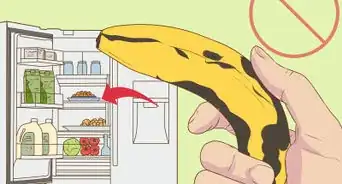
1Scientific studies show that this draws out the moisture. This can cause the bread to become stale 3 times faster than it would at room temperature. This happens from a process known as "retrogradation," which simply means that the starch molecules crystallize and the bread gets tough.[7]
Method 5
Method 5 of 7:Freeze your bread to ensure it lasts.
-
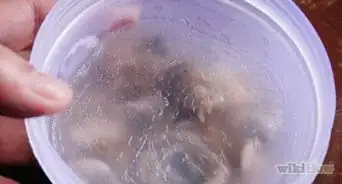
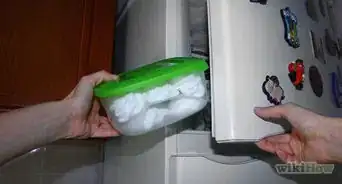
1This method works for homemade and store-bought bread. Freezing your bread stops the starch in the bread from recrystallizing and getting stale.[8] If you have more bread than you can consume within 2-3 days, the best way to store it is by freezing.[9]
- Freeze store-bought and homemade bread in plastic freezer bags or heavy-duty foil, as lightweight household foil isn't suitable for freezing.[10]
- Label and date it to prevent it from becoming a mystery cube.
- If it's homemade or unsliced, consider slicing your bread before you freeze it. That way you won't have to slice it while it's frozen or thawed, which can be pretty difficult.[11]
Advertisement
Method 6
Method 6 of 7:Thaw frozen bread.
-
1If you have frozen your bread, allow it to thaw at room temperature. Remove the freezer wrapping and let it stand. If you'd like, crisp it in the oven or toaster for a few minutes (no more than 5) to restore crustiness. Be aware that bread is only good for reheating once to return crustiness, after which you are simply reheating stale bread.[12]
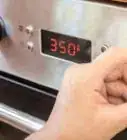
- Crisp your bread in the oven at 350 °F (177 °C) for 10 minutes.
Method 7
Method 7 of 7:Store slices in individual plastic bags when you're camping.
-
1Take the slices in pairs and keep them in their own bags. Seal each bag shut and make sure there's not any air left inside. Store all of the bags in another plastic bag (preferably the one the bread was originally packaged in). The individual, airtight bags help your bread stay fresh while also protecting it from extra moisture and bacteria.[13]
- Use a breadbox to cut back on plastic. These are ventilated storage containers that keep your bread cool and free of excess moisture.[14]
- While you're camping, keep the bread out of direct sunlight. The heat (and moisture it brings along with it) can be a breeding ground for bacteria.[15]
- Bring pre-packaged bread to go camping if you don't want to worry. Fresh-baked bread doesn't keep as long as pre-packaged bread since it doesn't have any preservatives.[16]
Advertisement
Community Q&A
-
QuestionI do not have a freezer. How can I best store a sliced loaf of store-bought bread to prevent mold?
 wikiHow Staff EditorThis answer was written by one of our trained team of researchers who validated it for accuracy and comprehensiveness.
Staff AnswerwikiHow Staff EditorStaff AnswerConsider investing in a bread box. These are ventilated storage containers that prevent excess moisture and mold growth. -
QuestionCan I place my originally bought bread in the freezer?wikiHow Staff EditorThis answer was written by one of our trained team of researchers who validated it for accuracy and comprehensiveness.
Staff AnswerwikiHow Staff EditorStaff AnswerYes, this can help increase how long your bread lasts. Keep the bread in its original packaging and take out slices as you need them. It will last 4-6 months in the freezer. -
QuestionHow can you prevent homemade yeast bread from molding or going stale?
 Community AnswerWrap the bread tightly in a few layers of plastic wrap, then freeze it. Before you defrost your bread, remember to unwrap it first. Otherwise, the water from the melting ice crystals get trapped on the surface of the bread, leaving you with soggy slices.
 -
QuestionWill air in my bag of bread make it go stale faster?
 Community AnswerYes, having air in the bag will make the bread go stale faster.
 -
QuestionHow should I store the bread if I don't have electricity?Community AnswerSimply store it in a cool, dark place.
-
QuestionHow long can bread be in the freezer?
 Zaeem AmjadCommunity AnswerAs preservatives play a large part in the answer to how long bread lasts, the answer ranges from a few days to several weeks or more. You can store bread in the freezer between seven and 14 days.
 -
QuestionCan I store store-bought bread in a brown paper bag to keep it from mold and drying out?Community AnswerNo. The paper bag causes moisture to build up, which means your bread will become even more moldy.
-
QuestionHow do I keep store-bought bread fresh?Community AnswerA good life hack is to wrap it in aluminum foil in an airtight bag. This will keep the bread moist and it will not dry out. Do not put it in the refrigerator, as this will dry it out. If you will not use your bread for a while, freeze it.
-
QuestionWhere is the fresh until date located on a package of bread?
 Community AnswerA use-by date is usually located on the plastic tag that is used to keep the bread wrapping closed.
 -
QuestionWhy did my bagels mold really quickly when I put them in a freezer bag on the counter?Community AnswerLikely because not all the bacteria had been killed inside and so the freezer bag actually acted as an incubator.


References
- ↑ https://www.epicurious.com/expert-advice/how-to-keep-bread-fresh-article
- ↑ http://www.seriouseats.com/2014/06/does-refrigeration-really-ruin-bread.html
- ↑ https://www.epicurious.com/expert-advice/how-to-keep-bread-fresh-article
- ↑ https://www.epicurious.com/expert-advice/how-to-keep-bread-fresh-article
- ↑ https://www.thekitchn.com/the-best-way-to-freeze-and-thaw-bread-246477
- ↑ https://www.epicurious.com/expert-advice/how-to-keep-bread-fresh-article
- ↑ http://archive.boston.com/news/science/articles/2007/12/31/does_bread_go_stale_faster_when_kept_in_the_fridge_or_when_stored_at_room_temperature/
- ↑ https://www.thekitchn.com/the-best-way-to-freeze-and-thaw-bread-246477
- ↑ https://www.insider.com/how-to-store-bread
- ↑ https://www.thekitchn.com/the-best-way-to-freeze-and-thaw-bread-246477
- ↑ https://www.thekitchn.com/the-best-way-to-freeze-and-thaw-bread-246477
- ↑ https://www.myrecipes.com/how-to/how-to-freeze-and-thaw-bread
- ↑ https://campinghunt.com/keeping-bread-fresh-when-camping/
- ↑ https://campinghunt.com/keeping-bread-fresh-when-camping/
- ↑ https://campinghunt.com/keeping-bread-fresh-when-camping/
- ↑ https://campinghunt.com/keeping-bread-fresh-when-camping/
- ↑ https://www.goodhousekeeping.com/uk/house-and-home/household-advice/a673628/how-to-make-bread-last-longer/
About This Article

To properly store bread, wrap it in plastic or aluminum foil, which traps the bread’s natural moisture to keep it from getting hard. Keep the bread at room temperature in a dry place out of direct sunlight for 2 days to use the bread. If you have extra bread that you won’t use within a few days, place the bread in resealable plastic bags in the freezer. Avoid storing your bread in the refrigerator, which can cause it to become dry and crumbly. If you want to learn how to thaw frozen bread, keep reading the article!