This article was co-authored by wikiHow Staff. Our trained team of editors and researchers validate articles for accuracy and comprehensiveness. wikiHow's Content Management Team carefully monitors the work from our editorial staff to ensure that each article is backed by trusted research and meets our high quality standards.
This article has been viewed 2,628 times.
Learn more...
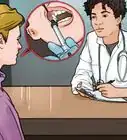
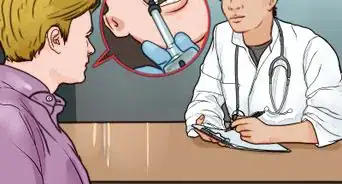
A trip to the dentist doesn’t have to be a big deal. However, if you’re someone with a strong gag reflex or if going to the dentist makes you feel particularly nervous and want to gag, it can be a real drag! Luckily, there are things you can do to not gag at the dentist. We’ve put together this list of tips and tricks to try to make your next trip to the dentist more comfortable.
Steps
Method 1
Method 1 of 10:Breathe through your nose.
-
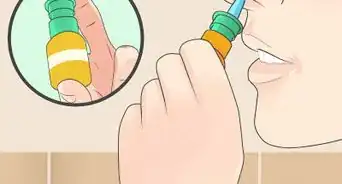
1That way, you don’t feel the air coming in across whatever’s in your mouth. Even if you typically breathe through your mouth, focus on breathing slowly in and out of your mouth whenever you’re at the dentist’s office. If you’re feeling stuffy before your appointment, take a nasal decongestant.[1]
- If you have trouble breathing through your nose, you can also try a nasal saline spray or a nasal strip to help clear you up before your appointment.
- This can help a lot during dental x-rays, for example, because you don’t notice the x-ray holder in your mouth as much. Or, it can help whenever your mouth is full of other dental tools that make it uncomfortable to breathe through your mouth.

Method 2
Method 2 of 10:Use a numbing throat spray.
-
1This can temporarily relieve your gag reflex.[2] Open up wide and spray your throat 2-3 times with a numbing throat spray just before your dental appointment. The numbing effect typically lasts up to 1 hour.
- Another type of spray you can try is snore relief spray.
- There are also numbing mouthwashes that can help relieve your gag reflex.
- This could make you much more comfortable during a routine cleaning, for example, if you always feel the urge to gag as soon as the dentist starts cleaning your teeth.

Method 3
Method 3 of 10:Rub table salt on your tongue.
-
1This is a home remedy for reducing your gag reflex. Rub a little bit of ordinary table salt on the tip of your tongue before you sit down for a dental treatment. Try rubbing salt on the sides of your tongue as well.[3]
- This works because salt stimulates your taste sensors, which can make your gag reflex less extreme.
- This technique is fine to use before any type of dental procedure that typically makes you want to gag.
- You can also try swishing salt water around in your mouth. Just make sure to spit it out when you’re done!

Method 4
Method 4 of 10:Put a graham cracker under your tongue.
-
1This provides a distraction from gagging. Lift up your tongue and stick a small graham cracker underneath it. Lower your tongue and press the cracker against your mandible, or the lower part of your jaw.[4]
- Try this when you have to take x-rays, for example. The distraction can help stop you from gagging when the dentist puts the x-ray holder in your mouth.
- Keep in mind that the dentist probably doesn’t want you to have food in your mouth if they’re cleaning your teeth or pulling a tooth or something like that. For those procedures, try a different technique.

Method 5
Method 5 of 10:Listen to music during a dental procedure.
-
1Music can distract you, so you don’t feel like gagging so much. Put in a pair of headphones and press play on your favorite playlist when you sit down in the dentist’s chair. Focus on the music and sing along in your head to distract yourself.[5]
- This can work for any type of dental procedure because headphones don’t interfere with the dentist working at all.
- You could also ask the dentist to let you watch something on TV, if they have one. Many dentist’s offices have TVs to distract their patients.

Method 6
Method 6 of 10:Hum when the dentist puts a tool in your mouth.
-
1You can’t hum and gag at the same time. As soon as the dentist sticks something in your mouth that makes you want to gag, start humming. The effort and the vibrating sensation in your nasal passage prevents you from gagging.[6]
- This is another technique that you can use during any type of dental procedure, such as a cleaning or x-rays.
- If you’re listening to music, hum along with the tune of the song.

Method 7
Method 7 of 10:Lift your ankle and calf off the dental chair.
-
1Flexing muscles helps distract you from gagging. Whenever you feel the urge to gag, lift your ankle and calf up and hold them in the air. The additional signals this sends to your brain can put gagging on the backburner.[7]
- Ask your dentist before you try this technique to make sure that moving your leg around doesn’t interfere with their work.
- Try combining this with other distractions like humming or listening to music to really distract yourself.

Method 8
Method 8 of 10:Schedule appointments later in the day.
-
1Gag reflexes can be worse in the morning. If this is the case for you, schedule your trips to the dentist’s office in the afternoon. That way, you won’t feel like gagging as much when you’re in their chair![8]
- Or, if your gag reflex happens to be worse later in the day, schedule your appointments in the mornings.

Method 9
Method 9 of 10:Ask your dentist to sedate you.
-
1Sedation ensures you don’t gag at all during a dental procedure. Ask your dentist if they can administer nitrous oxide, oral sedation, or IV sedation before they perform their work. Before you know it, the procedure is all done![9]
- The disadvantage of this is that you can’t drive after your appointment, so you’ll need to ask someone to take you home.
- If you have extreme dental anxiety, this might be the best option for you.

Method 10
Method 10 of 10:Practice not gagging when you brush your teeth.
-
1This can make your gag reflex less sensitive. Try brushing your tongue and putting your toothbrush far back enough to make you want to gag. Resist the urge to gag as much as possible. Keep practicing this to try and overcome your sensitivity.[10]
- Remember that gagging is a perfectly normal reaction to having things near the back of your throat. It’s a natural defensive reaction against choking, so sometimes you can train that defense to be less extreme.









References
- ↑ https://steelecreekdental.com/blog/how-to-stop-gagging-at-the-dentist-office-part-1-steele-creek-dental/
- ↑ https://www.danvilledentalcare.com/how-to-handle-your-sensitive-gag-reflex/
- ↑ https://www.speareducation.com/spear-review/2015/09/understanding-and-managing-gagging-patients
- ↑ https://www.rdhmag.com/patient-care/article/16408078/tips-and-tricks-preventing-activation-of-gag-reflex-when-exposing-radiographs
- ↑ https://www.speareducation.com/spear-review/2015/09/understanding-and-managing-gagging-patients
- ↑ https://www.danvilledentalcare.com/how-to-handle-your-sensitive-gag-reflex/
- ↑ https://www.dentaleconomics.com/science-tech/article/16393468/control-patient-gagging
- ↑ https://www.danvilledentalcare.com/how-to-handle-your-sensitive-gag-reflex/
- ↑ https://www.ncbi.nlm.nih.gov/pmc/articles/PMC5564139/
About This Article

Medical Disclaimer
The content of this article is not intended to be a substitute for professional medical advice, examination, diagnosis, or treatment. You should always contact your doctor or other qualified healthcare professional before starting, changing, or stopping any kind of health treatment.