This article was co-authored by wikiHow Staff. Our trained team of editors and researchers validate articles for accuracy and comprehensiveness. wikiHow's Content Management Team carefully monitors the work from our editorial staff to ensure that each article is backed by trusted research and meets our high quality standards.
There are 8 references cited in this article, which can be found at the bottom of the page.
This article has been viewed 16,696 times.
Learn more...
Truffle oil comes from the truffle fungus, which grows underground. It is foraged in the fall, winter, or spring by specially trained female hogs. There are lots of different kinds of truffle, each with their own, unique flavor. Depending on the type of truffle you use, you can make an oil that is perfect for drizzling over various savory dishes or even ice cream!
Ingredients[1]
- 1 teaspoon chopped fresh truffle
- 1 cup (240 mL) extra-virgin olive oil
Makes 1 cup (240 mL)
Steps
Part 1
Part 1 of 4:Obtaining the Truffles
-
1Buy fresh truffles online or in farmers' markets. While you can always try harvesting the truffles yourself, you might have an easier time finding them online or at a farmers' market. Because you need a specially trained female hog to harvest them, truffles can get very expensive.[2]
- For best flavor, buy truffles that were harvested during the winter.
-
2Consider dried or brined truffles. They won't be the same as fresh truffles, but they will be much easier to find. You can find them online as well as in gourmet food stores. Some farmers' markets may also carry them.[3]Advertisement
-
3Choose black truffles if you want a rich flavor. The most famous black truffle is the Black Périgord truffle, originating from France. It grows near oak and hazelnut trees and is harvested during autumn or winter. It is suitable for all sorts of dishes. Other types of black truffles include:[4]
- Burgundy truffle: best for vegetable-based dishes.
- Chinese truffle: has a delicate flavor and fragrance.
- Garlic truffle: has a garlic-y fragrance.
-
4Choose white truffles if you want a more delicate flavor. The Pecan truffle grows in the southern United States. As its name implies, it can be found near pecan trees. It is one of the most expensive truffles at $100 per pound (454 g). Here are some other types of white truffles:[5]
- Hungarian dessert truffle: sweet and ideal for dessert and ice cream
- Italian white truffle: rich fragrance and flavor with hints of garlic, shallots, and mushroom.
Advertisement


Part 2
Part 2 of 4:Making Cold-Process Truffle Oil
-
1Chop enough truffle to fill 1 teaspoon. Cut off a small piece of truffle, then chop or shave it into tiny pieces until you have enough to fill 1 teaspoon. The smaller you chop the pieces, the more flavorful the oil will be.[6]
- If you can't get fresh truffles, use 1/2 teaspoon of chopped, dried truffle or 1 teaspoon of chopped, brined truffle.
- If you are using brined truffle, make sure that you drain it.
-
2Fill a clean, glass bottle with 1 cup (240 mL) of olive oil. Choose a bottle large enough to hold at least 1 cup (240 mL) of liquid. Sterilize it, then fill it with 1 cup (240 mL) of olive oil. For best results, use a high-quality oil.
- Use a bottle with a screw-on cap. Don't use a cork. You can also use a jar instead.
-
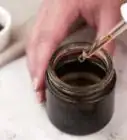
3Add the truffles and seal the jar tightly. Again, you only need 1 teaspoon of chopped or shaved truffles. This may not seem like a lot, but a little bit goes a long way! Once you have the truffles in the bottle, close the bottle tightly.[7]
-
4Store the bottle in a cool, dry place for 1 week, shaking it daily. Give the bottle a good shake, then place it into a cool cupboard or the fridge. Do this every single day for 1 week. During this time, the truffles will infuse the oil with their flavor and fragrance. [8]
-
5Use the oil after 1 week. You can leave the truffles in the bottle, or you can strain them out and pour the oil into another bottle. Leaving the truffles in the bottle, however, will allow them to continue imparting their unique flavor and aroma.[9]
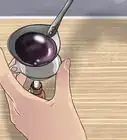
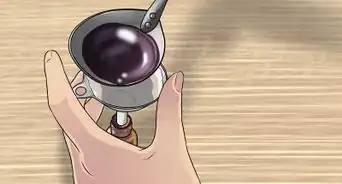
- To strain out the truffles, put a funnel into a new bottle. Line it with cheesecloth, then pour the oil through the funnel into the bottle. Discard the truffles caught in the cloth.
-
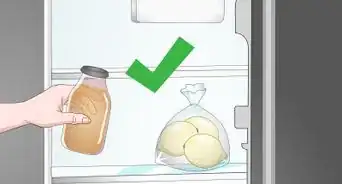
6Store the oil in the fridge and use it within 1 month. Be aware that truffle oil prepared using this method is susceptible to botulism. You can reduce this by storing the oil in the fridge and using it within 1 month.[10]Advertisement


Part 3
Part 3 of 4:Making Hot-Process Truffle Oil
-
1Pat the truffle dry, if needed. Place the truffle on a paper towel, and pat it dry with another paper towel. This is very important, as any moisture will float on top of the oil. If you are using a dried truffle, then you can skip this step.[11]
-
2Prepare 1 teaspoon of chopped truffle. Chop a small piece off of a truffle, then cut or shave it until you have enough to fill 1 teaspoon. Fresh truffle will give you the best flavor, but you can use dried or brined instead.[12]
- Dried truffle is more potent than brined or fresh truffle. You only need 1/2 teaspoon of dried truffle.
- How small you cut the pieces is up to you, but the smaller you cut them, the more potent the oil will be.
-
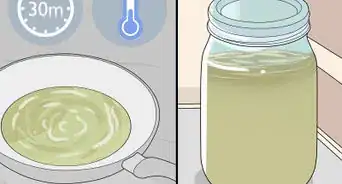
3Heat 1 cup (240 mL) of olive oil to 356 °F (180 °C). Pour 1 cup (240 mL) of high-quality olive oil into a small saucepan. Set the saucepan onto the stove, then turn the heat up to low or medium-low. Allow the oil to heat to 356 °F (180 °C).
- Use a cooking thermometer to keep track of the temperature.[13]
-
4Add the chopped truffle and cook 5 min. Pour 1 teaspoon of chopped fresh or brined truffles into the olive oil. Give the mixture a stir, then allow it to cook for 5 minutes. Adjust the heat as needed to maintain the temperature at 356 °F (180 °C).[14]
-
5Let the oil cool before you pour it into a clean, glass bottle. After 5 minutes of cooking, take the saucepan off of the stove and set it aside so that the oil can cool. Once the oil has cooled to room temperature, pour it into a clean, sterilized bottle. Close the bottle tightly with a screw-on lid; don't use a cork.[15]
- You do not need to strain the truffle pieces out, but you can if you want to. Leaving them in the oil will allow them to continue releasing their flavor and aroma.
- To strain the truffles out, put a funnel lined with cheesecloth into a new bottle. Pour the oil through the funnel into the bottle, then toss any truffles caught in the cloth.
-
6Keep the oil in a cool, dry place, and use it within 3 months. A cool cabinet or a refrigerator will work the best. This type of oil has a much longer shelf-life than cold-process oil; it should last about 3 months.[16]Advertisement


Part 4
Part 4 of 4:Storing and Using Truffle Oil
-
1Store the oil in a cool, dark place. Too much heat, air, or light will deteriorate the oil and cause it to lose its flavor faster. If you cannot store it in the fridge, choose an opaque, dark-colored container. Keep the container tightly sealed.
- Be aware that the oil may solidify and turn opaque in the fridge; this should not affect the flavor, however.
- Only pour out as much oil as your need. Don't leave it on the counter for too long, as it doesn't handle fluctuations in temperature very well.
-
2Use the oil within 1 to 3 months. The oil will lose its flavor and aroma over time, so the sooner you use it, the better. Keep in mind that the oil can also spoil. If it starts to smell or taste rancid, discard it immediately. Expect the oil to last 1 to 3 months.[17]
-
3Use the oil as a finishing oil. Truffle oil is potent and expensive, so you shouldn't use it as the main part of a recipe. You should add it at the end of a recipe to enhance the flavor.[18]
- For example, you shouldn't replace the all of the olive oil in a salad dressing with truffle oil. You can add a small amount of truffle oil in addition to the olive oil, however.
-
4Drizzle the oil over savory dishes. Unless you are using a sweet-tasting truffle, such as the Hungarian dessert truffle, you should pair the oil with a savory dish. It works especially well over savory dishes, such as mashed potatoes or mushroom ragouts.[19] Here are some other delicious combinations:
- Seafood, including lobster
- Meat, such as steak and poultry
- Soups or stews
- Sauces
- Bread, such as garlic bread and flat bread
- Risotto
- Pasta
- Vegetables, including gourmet salads
Advertisement


Warnings
- This oil is susceptible to botulism. If the oil starts to look or smell strange, discard it immediately.Thanks!
Things You'll Need
- Knife or grater
- Clean, glass bottles
- Saucepan (for hot-process)
- Cooking thermometer (for hot-process)

References
- ↑ https://www.restlesschipotle.com/what-is-truffle-oil/
- ↑ https://www.restlesschipotle.com/what-is-truffle-oil/
- ↑ https://www.restlesschipotle.com/what-is-truffle-oil/
- ↑ https://www.restlesschipotle.com/what-is-truffle-oil/
- ↑ https://www.restlesschipotle.com/what-is-truffle-oil/
- ↑ https://www.restlesschipotle.com/what-is-truffle-oil/
- ↑ https://www.restlesschipotle.com/what-is-truffle-oil/
- ↑ https://www.restlesschipotle.com/what-is-truffle-oil/
- ↑ https://www.restlesschipotle.com/what-is-truffle-oil/
- ↑ https://www.restlesschipotle.com/what-is-truffle-oil/
- ↑ https://www.youtube.com/watch?v=EK7eaVO1TJg&feature=youtu.be&t=34s
- ↑ https://www.youtube.com/watch?v=EK7eaVO1TJg&feature=youtu.be&t=1m2s
- ↑ https://www.youtube.com/watch?v=EK7eaVO1TJg&feature=youtu.be&t=1m40s
- ↑ https://www.youtube.com/watch?v=EK7eaVO1TJg&feature=youtu.be&t=2m2s
- ↑ https://www.youtube.com/watch?v=EK7eaVO1TJg&feature=youtu.be&t=2m13s
- ↑ https://www.youtube.com/watch?v=EK7eaVO1TJg&feature=youtu.be&t=3m4s
- ↑ https://whatscookingamerica.net/Vegetables/TruffleOil.htm
- ↑ https://whatscookingamerica.net/Vegetables/TruffleOil.htm
- ↑ https://www.restlesschipotle.com/what-is-truffle-oil/
About This Article