This article was co-authored by wikiHow staff writer, Jessica Gibson. Jessica Gibson is a Writer and Editor who's been with wikiHow since 2014. After completing a year of art studies at the Emily Carr University in Vancouver, she graduated from Columbia College with a BA in History. Jessica also completed an MA in History from The University of Oregon in 2013.
This article has been viewed 6,108 times.
Learn more...
If you'd love to recreate the spicy flavors of ofada stew, gather a few specialty ingredients and get started! Begin this Nigerian stew by blending and straining green bell peppers, onion, and habanero peppers. You'll need to heat palm oil before you fry the vegetables with locust bean seasoning and dried crayfish. Finish the stew by adding beef pieces or tripe along with boiled eggs. Simmer the stew and serve it along with Ofada rice.
Ingredients
- 4 green bell peppers
- 1 onions, divided
- 2 habanero peppers (rodo)
- 1/2 cup (120 ml) water
- 2 tablespoons or 2 wraps (58 g) locust bean seasoning (iru)
- 1 cup (240 ml) beef stock
- 2 tablespoons (16 g) ground dried crayfish
- 3/4 cup (180 ml) palm oil
- 4 boiled eggs
- Salt to taste
- 1/2 pound (226 g) beef or tripe, cut into bite sized pieces
- Cooked ofada rice to serve
Makes 6 to 8 servings
Steps
Part 1
Part 1 of 3:Blending and Straining the Peppers
-
1Trim and cut the bell peppers, habanero peppers, and onions into chunks. Wash 4 green bell peppers and 2 habanero peppers (rodo). Peel 1 of the large onions. Trim the stems and ends from them and rinse the seeds out of the peppers. Use a sharp knife to chop the peppers and onion into large chunks about 2 inches (5.1 cm) in size.[1]
-
2Blend the vegetables until they're smooth. Transfer the vegetable chunks to a blender or food processor. Pour 1/2 cup (120 ml) of water into the blender and put the lid on. Pulse the vegetables until they're completely combined and smooth.[2]Advertisement
-
3Boil the vegetable puree for 5 to 10 minutes. Pour the pureed peppers and onions into a large pot. Turn the heat to high, so the puree begins to bubble. Stir the mixture occasionally and let it boil so that the excess liquid evaporates. Turn off the heat once the puree is thick. This should take 5 to 10 minutes.[3]
- The pot should be at least 5-quarts (4.7 liters) in size.
Advertisement


Part 2
Part 2 of 3:Bleaching the Palm Oil
-
1Measure the palm oil into a pot and turn the heat to low. Pour 3/4 cup (180 ml) of palm oil into another large pot on the stove. Put the lid on the pot and turn the heat to low.[4]
- The pot should be at least 5-quarts (4.7 liters) in size. Try to use a pot with a clear lid, so you can see inside as the oil bleaches.
-
2Heat the oil over low heat for 8 to 10 minutes. Avoid lifting the lid as the oil heats or smoke will escape. The oil will change from a red oil to a golden brown color once it's bleached enough.<refhttps://lowcarbafrica.com/ofada-stew-ayamase-stew/</ref>
-
3Turn off the heat and cool the oil. Keep the lid on the pot and just turn the heat off. You can leave the pot to cool on the stove or carefully lift it and set it outside to cool. Let the oil cool until you can easily hold the outside of the pot with your hands.[5]
- Consider opening the windows in your kitchen in case any smoke accidentally escapes from the pot.
-
4Return the oil to the heat. If you took the pot outside to cool, bring it back inside and set it on the stove. You shouldn't see any smoke in the pot. Remove the lid and turn the heat to high, so you can cook the rest of the stew.[6]Advertisement


Part 3
Part 3 of 3:Finishing the Ofada Stew
-
1Fry the locust bean seasoning and chopped onion for 2 to 3 minutes. Once the oil is shimmering and hot, stir in 2 tablespoons or 2 wraps (58 g) of locust bean seasoning (iru). Chop 1 onion into 1⁄2 inch (1.3 cm) pieces and stir it into the oil. Stir and fry the mixture over high heat for 2 to 3 minutes.[7]
- The onion should darken and float to the top of the oil.
-
2Stir in the pureed vegetables and simmer the stew for 15 to 20 minutes. Transfer the cooked pepper and onion puree into the oil and onion mixture. Stir and bring the mixture to a lively bubble over medium heat. Cover the pot and simmer the ofada stew until the oil starts to glisten on the top. This should take 15 to 20 minutes.[8]
- Stir the stew every once in a while to prevent it from scorching. You might need to adjust the temperature if the stew is boiling too vigorously.
-
3Stir in the dried crayfish, meats, and beef stock. Remove the lid and stir in 2 tablespoons (16 g) of ground dried crayfish and 1/2 pound (226 g) of beef or tripe that you've cut into bite sized pieces. Stir in about 1 cup (240 ml) of beef stock so the sauce loosens and combines with the meats. Add salt according to your taste.
-
4Add the hard-boiled eggs and bring the stew to a boil. Peel the shells of 4 hard boiled eggs and nestle the eggs into the stew. Bring the stew to a boil over medium-high heat.[9]
-
5Turn the heat to medium-low and simmer the stew for 30 minutes to 1 hour. Stir the stew occasionally to prevent it from sticking to the pot. Cover the pot and simmer the stew until it's thickened in places and the oil glistens in pockets on the top. The meat that you added should be completely cooked and tender.[10]
-
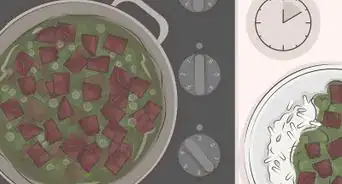
6Serve the ofada stew. You can carefully drain or ladle off the excess oil that's floating on top of the stew. Serve the stew while it's still hot with prepared ofada rice. If you don't have ofada rice, you can serve it with your favorite type of steamed rice.[11]
- Store the leftover stew in an airtight container in the refrigerator for 3 to 4 days.
- You can also serve the ofada stew with boiled or fried plantains or yams.
Advertisement


Things You'll Need
Blending and Straining the Peppers
- Knife and cutting board
- Large pot at 5-quarts (4.7 liters) in size
- Blender or food processor
- Measuring cup
Bleaching the Palm Oil
- Measuring cup
- Large pot at 5-quarts (4.7 liters) in size with a clear lid
Finishing the Ofada Stew
- Measuring cups and spoons
- Digital scale
- Knife and cutting board
- Spoon
- Ladle


-Final.webp)




References
- ↑ http://www.afropotluck.com/ayamase-stew-ofada-stew/
- ↑ http://www.afropotluck.com/ayamase-stew-ofada-stew/
- ↑ http://www.afropotluck.com/ayamase-stew-ofada-stew/
- ↑ https://lowcarbafrica.com/ofada-stew-ayamase-stew/
- ↑ https://lowcarbafrica.com/ofada-stew-ayamase-stew/
- ↑ http://www.afropotluck.com/ayamase-stew-ofada-stew/
- ↑ http://www.afropotluck.com/ayamase-stew-ofada-stew/
- ↑ http://www.afropotluck.com/ayamase-stew-ofada-stew/
- ↑ http://www.afropotluck.com/ayamase-stew-ofada-stew/
About This Article




-Final.webp)