X
wikiHow is a “wiki,” similar to Wikipedia, which means that many of our articles are co-written by multiple authors. To create this article, volunteer authors worked to edit and improve it over time.
There are 26 references cited in this article, which can be found at the bottom of the page.
Learn more...
European robins (scientific name: erithacus rubecula) are a popular animal, commonly associated with winter and Christmas. They have even been voted the UK's favourite bird[1] , but have you ever wondered how to identify one? The good news is that it's an easy process. Read on to find out how.
Steps
Part 1
Part 1 of 4:Telling By Habitat
Part 1
-
1Know where European robins typically live. As the name suggests, they mainly inhabit Europe as far as western Siberia.[2] The European robin can also be found in parts of western Asia and north Africa. Although you may get other breeds of robin across the world, the European robin has only been identified in these areas.[3]
- That being said, robins do not inhabit the far north of Europe, such as northern Scandinavia and Russia.[4]
-
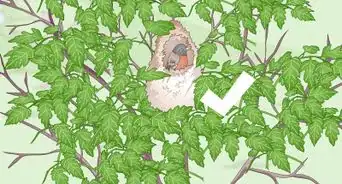
2Look at gardens, woodland and parks.[5] While robins are so widespread that these aren't the only places you could find one, robins tend to prefer these types of locations. Robins will typically nest in concealed areas on or near the ground, like in banks, log piles, hedges or tree crevices, but are also known to nest in more unusual places, such as letterboxes.[6] [7]
- Robins aren't exclusive to the wild, they can be found in urban and suburban places too.[8]
- In Northern Europe, robins prefer spruce forests with some deciduous elements such as birch.
-
3
Part 2
Part 2 of 4:Identifying Physical Features
Part 2
-
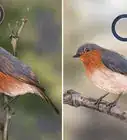
1Look out for a red breast. Perhaps the most distinctive feature of the robin is its red breast. This might be more orange than red in some robins. Part of their face will be this colour too.
-
2Take its size into consideration. Robins tend to be about 14 cm (5.5 in) long, with a wingspan of 20-22 cm (7.9 to 8.7 inches). They tend to weigh about 14-21 g (0.5-0.75 oz).[16]
-
3Take note of the other colours, including the colours of its legs. A European robin will have brown or pink legs. Apart from its red breast, it will also have feathers which are brown, cream, yellow, grey or white.[17]
- A robin may not have all these colours, or it may be hard to tell some colours apart, but it will usually exhibit at least some of them.
-
4Look at its beak. A robin will have a black beak which is short and thin.[18]
-
5
-
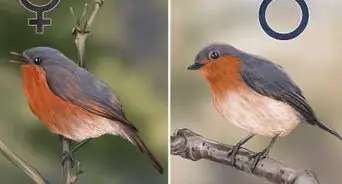
6Know the differences in sex. This can be difficult as they are virtually identical. A female robin is more likely to migrate in the winter. A male robin is more likely to bring female robins food. The grey fringe around a male robin's breast continues to grow as it gets older. The male robin also typically has a larger breast.[21]
-
7
Part 3
Part 3 of 4:Identifying Behaviours
Part 3
-
1Attract robins to your garden or allotment. There are a number of ways to do this. You could leave out a bird feeder, make your own fat balls or bird cake, make a log feeder, or hang a nestbox.[26]
- Keep in mind that this may attract other birds too.
- Winter is usually the best time to hang a nestbox.[27]
-
2Observe its song. Both sexes of robins sing and they tend to sing year-round.[28] They only stop singing in late summer when they are replacing their feathers and trying to avoid attention. It will usually sing on a hidden perch.[29] The tempo and volume of the robin's singing varies, and no two verses are the same. When it is nervous, the robin's "ticking" calls are protracted into long, rapid series: "tick-ick-ick-ick-...", sounding like a watch being wound up. On nocturnal migration, however, the robin calls out a thin, hoarse "tsi".
- A robin's autumn and spring songs are audibly different. In autumn (i.e. when it has finished moulting), its song will be more sombre in tone than in spring, when it is more confident and powerful.[30]
- You may wish to listen to a recording of its song so you have something to compare it with.
- Robins will usually start their song early in the morning, and be one of the last to stop in the evening.[31]
-
3Observe what they eat. European robins aren't that picky in their choice of food, but usually eat seeds, bird cake and mealworms.[32] They also eat fruit, insects and other invertebrates.[33]
- Robins don't eat food that is too large for them, such as dried peas, beans, rice, lentils, wheat or barley.[34]
-
4Look for aggression. Robins are known to be territorial birds, and will attack other birds in its patch. A typical dispute will look like male robins singing at each other and trying to get on a higher perch to show off their red breast. This may escalate to a fight, potentially causing injury or death.[35]
Part 4
Part 4 of 4:Differentiating Between Other Species
Part 4
-
1Know the difference between a European robin and an American robin. The most obvious distinction is where they live. While European robins live in and around Europe, American robins usually live in North America, but can very rarely be spotted in the UK too.[36]
- While both robins have red breasts, the American robin has a larger red patch, extending to its belly. Furthermore, the European robin has a brighter shade of red.
- An American robin is larger, about the size of a blue jay, while a European robin is about the size of a house sparrow.
- Both birds have different calls. A European robin's call is more sweet and high-pitched, whereas an American robin's call is more raspy and robust.[37]
- An American robin's egg will be blue, while a European robin's egg will be white and freckled.
- American robins typically flock in groups, whereas European robins are usually more solitary.[38]
-
2Learn the difference between a scarlet robin and an European robin. The scarlet robin is found in Australia and various Pacific islands. It can be distinguished by the white patch above its bill. Female scarlet robins may also have a much redder breast than most robin species.[39]
- Scarlet robins tend to be about 12-13.5 centimetres (about 4.7 to 5.3 inches) in length.[40] This is slightly smaller than a European robin.
-
3Educate yourself of the difference between European robins and rose robins. Rose robins are found in southeast Australia, not Europe. Rose robins have a pink breast, rather than an orange/red one. Rose robins also tend to be slimmer than most robins, as well as having a longer tail and shorter legs.[41]
-
4Learn the difference between a European robin and a stonechat. Both birds have a red breast, so can be commonly mistaken. Stonechats can be found across Europe, northern Africa, and southwestern Asia, to the Pacific Ocean. Stonechats can be found near bodies of water or near the coast.[42]
-
5Differentiate between the common redstart. The common redstart belongs to the same family as European robins, so can be quite easily mistaken for one. Redstarts live either in Europe and Russia, or from Crimea to central Asia, but will migrate to Sub-Saharan Africa, or parts of southern Saudi Arabia in the winter. Unlike a European robin, a redstart will have black legs and a tail with some reddish markings.[45]
- A redstart may have a wider wingspan.[46]
Warnings
- Do not abuse or assault the robins in any way.Thanks!
- Most robins want to be left alone from humans, don't try to disturb them, even if you think you are being kind.
- The exception to this is if you believe the robin to be injured or in danger, in which case, you contact your country's animal rescue service, such as the SSPCA or RSPCA.
Thanks!
Things You'll Need
- Binoculars (optional)
- Bird food (optional)
- Nestbox (optional)

References
- ↑ https://www.bbc.co.uk/news/uk-33090043
- ↑ https://ww2.rspb.org.uk/birds-and-wildlife/bird-and-wildlife-guides/ask-an-expert/previous/robinsmigrate.aspx
- ↑ https://www.britannica.com/animal/robin
- ↑ https://ww2.rspb.org.uk/birds-and-wildlife/bird-and-wildlife-guides/ask-an-expert/previous/robinsmigrate.aspx
- ↑ https://gardenbirds.net/robin/
- ↑ https://www.countryfile.com/wildlife/birds/our-guide-to-robins-where-to-see-top-facts-and-how-to-attract-robins-to-your-garden/
- ↑ https://www.rspb.org.uk/birds-and-wildlife/wildlife-guides/bird-a-z/robin/nesting-and-breeding-habits/
- ↑ https://www.rspb.org.uk/birds-and-wildlife/wildlife-guides/bird-a-z/robin/
- ↑ https://gardenbirds.net/robin/
- ↑ https://ww2.rspb.org.uk/birds-and-wildlife/bird-and-wildlife-guides/ask-an-expert/previous/robinsmigrate.aspx
- ↑ https://www.countryfile.com/wildlife/birds/our-guide-to-robins-where-to-see-top-facts-and-how-to-attract-robins-to-your-garden/
- ↑ https://www.countryfile.com/wildlife/birds/our-guide-to-robins-where-to-see-top-facts-and-how-to-attract-robins-to-your-garden/
- ↑ https://www.garden-birds.co.uk/birds/robin.html
- ↑ https://www.rspb.org.uk/birds-and-wildlife/wildlife-guides/bird-a-z/robin/
- ↑ https://www.discoverwildlife.com/animal-facts/birds/facts-about-robins/
- ↑ https://www.rspb.org.uk/birds-and-wildlife/wildlife-guides/bird-a-z/robin/
- ↑ https://www.rspb.org.uk/birds-and-wildlife/wildlife-guides/bird-a-z/robin/
- ↑ https://www.rspb.org.uk/birds-and-wildlife/wildlife-guides/bird-a-z/robin/
- ↑ https://www.rspb.org.uk/birds-and-wildlife/wildlife-guides/bird-a-z/robin/
- ↑ https://birdfact.com/articles/baby-robins-all-you-need-to-know
- ↑ https://onlinelibrary.wiley.com/doi/abs/10.1111/j.1474-919X.2011.01187.x
- ↑ https://www.countryfile.com/wildlife/birds/our-guide-to-robins-where-to-see-top-facts-and-how-to-attract-robins-to-your-garden/
- ↑ https://www.kennedywildbirdfood.co.uk/news/bird-egg-identifier-uk/
- ↑ https://www.kennedywildbirdfood.co.uk/news/bird-egg-identifier-uk/
- ↑ https://www.birdspot.co.uk/bird-brain/are-robins-eggs-blue
- ↑ https://www.countryfile.com/wildlife/birds/our-guide-to-robins-where-to-see-top-facts-and-how-to-attract-robins-to-your-garden/
- ↑ https://www.countryfile.com/wildlife/birds/our-guide-to-robins-where-to-see-top-facts-and-how-to-attract-robins-to-your-garden/
- ↑ https://www.countryfile.com/wildlife/birds/our-guide-to-robins-where-to-see-top-facts-and-how-to-attract-robins-to-your-garden/
- ↑ https://www.rspb.org.uk/birds-and-wildlife/wildlife-guides/bird-a-z/robin/robin-redbreast-song/
- ↑ https://www.rspb.org.uk/birds-and-wildlife/wildlife-guides/bird-a-z/robin/robin-redbreast-song/
- ↑ https://www.rspb.org.uk/birds-and-wildlife/wildlife-guides/bird-a-z/robin/robin-redbreast-song/
- ↑ https://www.countryfile.com/wildlife/birds/our-guide-to-robins-where-to-see-top-facts-and-how-to-attract-robins-to-your-garden/
- ↑ https://www.rspb.org.uk/birds-and-wildlife/wildlife-guides/bird-a-z/robin/
- ↑ https://www.lovethegarden.com/uk-en/article/what-do-robins-eat
- ↑ https://www.discoverwildlife.com/animal-facts/birds/facts-about-robins/
- ↑ https://www.uksafari.com/americanrobin.htm
- ↑ https://www.mysanantonio.com/news/article/North-American-and-European-robins-share-a-2422226.php
- ↑ https://www.birdsandblooms.com/birding/european-robin-vs-american-robin/
- ↑ https://birdlife.org.au/bird-profile/scarlet-robin
- ↑ https://www.beautyofbirds.com/scarletrobins.html
- ↑ https://birdlife.org.au/bird-profile/rose-robin
- ↑ https://glenlivet-wildlife.co.uk/birds/stonechat/
- ↑ https://glenlivet-wildlife.co.uk/birds/stonechat/
- ↑ https://glenlivet-wildlife.co.uk/birds/stonechat/
- ↑ https://a-z-animals.com/blog/5-birds-that-look-like-robins/
- ↑ https://www.rspb.org.uk/birds-and-wildlife/wildlife-guides/bird-a-z/redstart/
- ↑ https://www.birdspot.co.uk/bird-brain/why-are-robins-so-friendly
- Collins Bird Guide by Killian Mullarney, Lars Svensson, Dan Zetterström, and Peter J. Grant