This article was co-authored by Elmer Bensinger and by wikiHow staff writer, Hunter Rising. Elmer Bensinger is a Pest Control Specialist with Eden Advanced Pest Technologies in Spokane, Washington. With over 20 years of experience, Elmer specializes in integrated pest management and products such as insecticides and rodenticides. He studied business at South Puget Sound Community College.
There are 10 references cited in this article, which can be found at the bottom of the page.
wikiHow marks an article as reader-approved once it receives enough positive feedback. This article has 13 testimonials from our readers, earning it our reader-approved status.
This article has been viewed 571,584 times.
Black widows are spiders found across the world and are one of the most venomous species in the United States. Even though black widow bites are rarely fatal and only happen when you provoke a spider, they can still cause a lot of pain and make you extremely sick. If you’re worried about a spider you found near your home, there are many ways to tell if you’re dealing with this dangerous species. We’ll start with some distinguishing physical features to look out for and move on to information about the spiders’ webs and where to find them.
Steps
Method 1
Method 1 of 10:Red hourglass marking
-
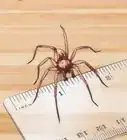
1Check for 1–2 red triangles on the bottom of the spider’s body. The triangles are on the bottom of the spider’s backside, also known as its abdomen, so they'll be visible when the spider is hanging from a web but harder to see if it's crawling around.[1] The triangles might connect to form an hourglass shape, or they could be separated by a black stripe.[2]
- Black widows can have up to 4 red spots on the top of their abdomens.
- Markings are usually red, but they could also look yellowish-orange.
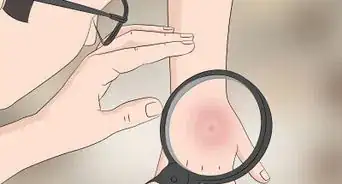
- Use a magnifying glass or take a picture to get a better look without moving closer.
Advertisement

Method 2
Method 2 of 10:Shiny black bodies for females
-
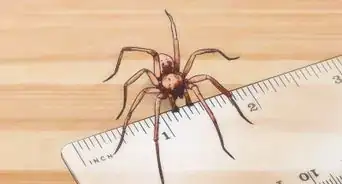
1Females are seen most often and they have hairless, dark bodies. Female black widows are dark-colored and have smooth, shiny bodies that grow up to 1⁄2 in (13 mm) long, excluding the legs.[3] While the spiders are usually jet black, they could also have a brown or purple tinge on their bodies.[4]
- Female black widows are more dangerous since they're more prevalent and more likely to bite than males.

Method 3
Method 3 of 10:Tan body for males and juveniles
-
1Look for white and tan patterns on these lesser-seen spiders. Young spiders and males have reddish-brown legs and a splotchy white abdomen. Males retain the same color as they mature, but they’re only half the size of females, or about 1⁄4 in (6.4 mm) long.[5]
- Males are much rarer to find since they have a shorter lifespan and are smaller.
- Male and juvenile female black widows don’t have large enough fangs to bite humans.[6]
Advertisement

Method 4
Method 4 of 10:Large round abdomen
-
1The back half of the spider's body will look like a large ball. The abdomen is the back half of the spider’s body and looks much larger than the head. Female black widows have bulbous abdomens that have the signature hourglass marking on the bottom. Males still have round abdomens, but they aren’t as large or prominent as their female counterparts.[7]
- Some female black widows have abdomens that are larger than 1⁄2 in (13 mm) in diameter.

Method 5
Method 5 of 10:Long spindly legs
-
1Black widows’ legs grow longer than their bodies. A female black widow can grow to around 1 1⁄2 inches (3.8 cm) long when you include the legs. Check the spider for long black legs if it’s a female or reddish-brown legs if it’s a male. Typically, the front pair of legs are the longest.[8]Advertisement

Method 6
Method 6 of 10:Bristles on back legs
-
1Check for comb-like bristles on the rear set of legs. Use a magnifying glass or zoom in on a picture of the spider to see if it has short hairs along its back legs. A black widow uses these bristles to help wrap webs around its prey so it can’t get away.[9]
- Both males and females have bristles on their legs.
- Be careful when you get close to a spider since it could bite if it feels provoked.

Method 7
Method 7 of 10:Irregular tangled web near the ground
-
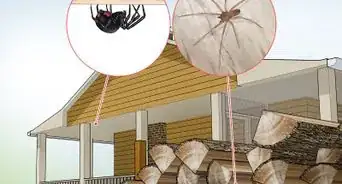
1Search for messy cobwebs with vertical silk strands. Black widows don’t weave large symmetrical webs that you’re used to seeing. Instead, they make cobwebs that fit the space where they live and look erratically thrown together.[10] Search the web for a few strands that go vertically since the spider uses these to trap prey. You’ll usually find the webs within 3 feet (0.91 m) of the ground so they can catch prey crawling on the ground.[11]
- Some black widows build webs in eaves on your home, but it’s more likely you’ll find them closer to the ground.
- If you break apart a black widow web, you should hear an audible ripping sound.
Advertisement

Method 8
Method 8 of 10:Webs in quiet, dark places
-
1Holes, sheds, and cluttered basements are common spots for webs. Outdoors, check between logs in woodpiles, near rock piles, or in holes between bricks and pipes. Even though black widows don’t usually go inside since there isn’t enough prey, they may come in during cold winter weather. Look through cluttered areas of basements, attics, or closets.[12]
- If you’re looking for black widows, wear gloves and long sleeves to protect yourself from potential bites.

Method 9
Method 9 of 10:Active at night
-
1You usually won’t see black widows out during the day. Black widow spiders are nocturnal, so they come out to their webs at night and wait for prey. If you’re concerned about a black widow, wait until the sun goes down and look near any webs you’ve found to see if the black widow is there.[13]Advertisement

Method 10
Method 10 of 10:Hanging upside-down
-
1Look for the spider hanging in its web with its belly exposed. When you see a spider on a web, check if the abdomen is pointing up. You should be able to see any red hourglass markings on the bottom of the spider while it’s in this position, so it’ll be easy to tell if you’re dealing with a black widow or not.[14]

Expert Q&A
Did you know you can get premium answers for this article?
Unlock premium answers by supporting wikiHow
-
QuestionHow can I get rid of black widow spiders naturally?
 Elmer BensingerElmer Bensinger is a Pest Control Specialist with Eden Advanced Pest Technologies in Spokane, Washington. With over 20 years of experience, Elmer specializes in integrated pest management and products such as insecticides and rodenticides. He studied business at South Puget Sound Community College.
Pest Control SpecialistIf you can eliminate their food source, they won't stay there. Black widows usually make their webs down low, so to cut off their food source, you want to trim back vegetation and remove clutter.
Support wikiHow by unlocking this expert answer.
-
QuestionCan I use pesticides to get rid of black widows?Elmer BensingerElmer Bensinger is a Pest Control Specialist with Eden Advanced Pest Technologies in Spokane, Washington. With over 20 years of experience, Elmer specializes in integrated pest management and products such as insecticides and rodenticides. He studied business at South Puget Sound Community College.
Pest Control SpecialistSpraying pesticides around the outside of your house will help because it will reduce their food source and deter them from staying there. If you're seeing a ton of them, I would definitely get an expert out there to see what's going on though.Support wikiHow by unlocking this expert answer.
Warnings

References
- ↑ https://www.osha.gov/sites/default/files/publications/black_widow_spider.pdf
- ↑ Elmer Bensinger. Pest Control Specialist. Expert Interview. 5 February 2021.
- ↑ https://www.osha.gov/sites/default/files/publications/black_widow_spider.pdf
- ↑ http://ipm.ucanr.edu/PMG/PESTNOTES/pn74149.html
- ↑ http://ipm.ucanr.edu/PMG/PESTNOTES/pn74149.html
- ↑ https://www.aces.edu/blog/topics/home/the-black-widow/
- ↑ https://www.pubs.ext.vt.edu/444/444-422/444-422.html
- ↑ https://www.aces.edu/blog/topics/invasive-wildlife-control/black-widow-and-recluses/
- ↑ https://www.livescience.com/39919-black-widow-spiders.html
- ↑ https://www.aces.edu/blog/topics/home/the-black-widow/
- ↑ http://ipm.ucanr.edu/PMG/PESTNOTES/pn74149.html
- ↑ https://idfg.idaho.gov/sites/default/files/we_octt17blackwidowspider_final.pdf
- ↑ http://ipm.ucanr.edu/PMG/PESTNOTES/pn74149.html
- ↑ https://www.aces.edu/blog/topics/home/the-black-widow/
- ↑ https://idfg.idaho.gov/sites/default/files/we_octt17blackwidowspider_final.pdf
- ↑ https://www.osha.gov/sites/default/files/publications/black_widow_spider.pdf
- ↑ https://medlineplus.gov/ency/article/002858.htm
- ↑ https://kidshealth.org/en/kids/black-widow.html
About This Article

To identify a black widow, look for traits commonly found on black widows, like a bright red marking that resembles an hourglass on the spider’s round belly, which are found on female spiders. Additionally, female black widows will have shiny, hairless black bodies, and males are marked with brown and white. All black widows have long legs, and their hind legs are covered in bristles, which help them kill their prey. For more tips for spotting a black widow spider, including how to identify a black widow’s web, keep scrolling!