wikiHow is a “wiki,” similar to Wikipedia, which means that many of our articles are co-written by multiple authors. To create this article, 28 people, some anonymous, worked to edit and improve it over time.
There are 7 references cited in this article, which can be found at the bottom of the page.
wikiHow marks an article as reader-approved once it receives enough positive feedback. This article received 45 testimonials and 87% of readers who voted found it helpful, earning it our reader-approved status.
This article has been viewed 977,088 times.
Learn more...
Wolf spiders don't fit the traditional spider archetype. They don’t spin webs and don't catch their prey in them; instead, they stalk and hunt their prey - just as wolves do. Although it's true that wolf spiders look very similar to Tarantulas, wolf spiders are generally smaller and from a different family of spider. The scientific name for wolf spiders is Lycosidae (Greek for “wolf.”)
Steps
Method 1
Method 1 of 2:Identifying a Wolf Spider
-
1Look for a wolf spider's physical features. Here are some key characteristics: Hairy, brown to gray in color with various markings or lines, females are 1-3/8” (3 4mm) and males are 3/4" (19 mm) long.
-
2Look at the arrangement of their eight eyes. Their eyes comprise three rows; the first row has four small eyes; the second row has two larger eyes and the third row has two medium-sized eyes. The two eyes in the center of their faces are distinctively larger than the other six eyes.Advertisement
-
3See if the spider has three tarsal claws to make sure it’s a wolf spider. A tarsal is the final segment of an insect's leg.[1] In the wolf spider's case there are three claws at the end of them.
-
4Look at the arrangement of the fangs. Wolf spiders have fangs that resemble pincers, with a side-to-side orientation. However, this is true of all species within the infraorder Araneomorphae, of which the wolf spider is a member. The infraorder Araneomorphae contains a vast number of species that as a group are known as "true spiders", so the fang orientation is not exclusive to wolf spiders.[2]
- However, this may be helpful in distinguishing a wolf spider from a small tarantula, because tarantulas are a member of infra-order Mygalomorphae and have vertically-oriented fangs.
-
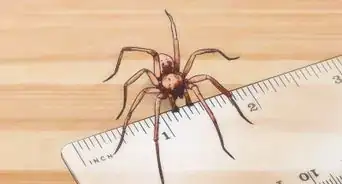
5Don’t confuse the wolf spider with a brown recluse spider. The wolf spider has the same brownish-grey coloration, but does not have the violin-shaped marking behind its head that a brown recluse has. Also, the wolf spider has shorter legs than the brown recluse or any other web dwelling spider.
-
6Check for hairs covering its abdomen.[3] This is why you may confuse the wolf spider with a Tarantula, but most wolf spiders are a great deal smaller than most Tarantulas.Advertisement


Method 2
Method 2 of 2:Recognizing Wolf Spider Habitats
-
1Check if the spider retreats to a burrow.[4] Examine the areas around your doors and windows, both around your house and any outbuildings you may have. If, you find one moving towards a burrow or crevice, instead of a web, that's further evidence that it's a wolf spider. However, the tarantulas and the trap doors also burrow, though they are usually quite a bit larger than the wolf spider.
-
2Look for wolf spiders stalking their prey along the ground. Spiders that spin webs will rarely be found on the ground. Wolf spiders are very comfortable there and will rarely climb tall structures.
-
3Look for a white sack attached to the back of the abdomen in the early spring and summer. Female wolf spiders carry their eggs at the back of their abdomens.
-
4Check to see if the female is carrying her spiderlings on her back. This is a trait unique to wolf spiders.
-
5Be aware that the wolf spider can be found hunting during the day and the night. You'll notice that most of the wolf spider's prey (crickets, caterpillars, etc.) can be found out at day and night, as well. If you have a lot these bugs around, you can expect to find a wolf spider nearby.
-
6Watch the speed that the spider runs. Wolf spiders are incredibly fast. They are hard to catch due to their extreme speeds.Advertisement


Community Q&A
-
QuestionCan a wolf spider kill you?
 wikiHow Staff EditorThis answer was written by one of our trained team of researchers who validated it for accuracy and comprehensiveness.
Staff AnswerwikiHow Staff EditorStaff AnswerWhile a person with a strong allergy to wolf spider venom might have a strong reaction, being bitten usually results in minor pain and itchiness that does not require any treatment. It does not appear that there are records of a person ever dying from a wolf spider bite. -
QuestionAre wolf spiders dangerous to humans?wikiHow Staff EditorThis answer was written by one of our trained team of researchers who validated it for accuracy and comprehensiveness.
Staff AnswerwikiHow Staff EditorStaff AnswerWolf spiders can give a bite that can be painful and itchy, but almost never very dangerous unless the person has an allergy to the venom or a weak immune system. See a doctor immediately if you notice symptoms like dizziness, nausea or a rapid heartbeat. However, wolf spiders are not aggressive at all and only bite when provoked. -
QuestionWhere do you find wolf spiders?wikiHow Staff EditorThis answer was written by one of our trained team of researchers who validated it for accuracy and comprehensiveness.
Staff AnswerwikiHow Staff EditorStaff AnswerWolf spider species can be found all across the world in nearly every kind of habitat. More specifically, you can find wolf spiders roaming around outdoors, in woods and grassland often near sources of water. -
QuestionWhat do wolf spiders like to eat?wikiHow Staff EditorThis answer was written by one of our trained team of researchers who validated it for accuracy and comprehensiveness.
Staff AnswerwikiHow Staff EditorStaff AnswerWolf spiders usually prey on ants, crickets, grasshoppers, other spiders and a wide number of other small invertebrates. Large species of wolf spiders may eat small frogs or lizards on rare occasions.. -
QuestionDo brown recluse spiders get as big as a wolf spider?
 Community AnswerVery rarely do any of the recluses (Loxosceles spp.) get to the size of wolf and fishing spiders. They may have a similar legspan, but recluses are much thinner and have tiny fangs, while wolf spiders are bulky and have large fangs.
 -
QuestionCan a wolf spider bite be fatal?
 Community AnswerNo. The bite will hurt, but the venom is not potent enough to kill a person.
 -
QuestionCan a wolf spider make a web across a front porch above bushes?
 Community AnswerThis article says a wolf spider does not build a web. It lives in crevices and holes.
 -
QuestionDo wolf spiders bite? Are they venomous?
 Community AnswerThey would rather run the other way. Although painful, their bites are never lethal and do not cause serious damage.
 -
QuestionWhat do wolf spiders eat?Community AnswerWolf spiders eat small insects, such as grasshoppers, flies, crickets, and ants.
-
QuestionCan wolf spiders harm a cat?Community AnswerNo, a wolf spider cannot harm a cat.
Warnings
- While the wolf spider is venomous, avoid killing wolf spiders; their venom will barely have an effect on you if you manage to get bitten but they are not aggressive. In fact, because they eat so many harmful insects, they are critically important to the ecosystem.Thanks!
- If you have a weak or half dead wolf spider in a container, you shouldn't give it any insects that can fight back such as live ants for food.Thanks!
- Do not handle wolf spiders. Although the wolf spider is relatively calm species of spider, it has been known to bite. Their bite has been known to be quite painful.Thanks!





References
- ↑ http://www.encyclopedia.com/doc/1O8-tarsalclaw.html
- ↑ https://en.wikipedia.org/wiki/Spider#Taxonomy
- ↑ http://www.termite.com/spider-identification.html
- ↑ http://lancaster.unl.edu/pest/resources/wolfspider.shtml
- http://www.ento.okstate.edu/ddd/insects/wolfspider.htm
- Herbert and Lorna Levi, Spiders and Their Kin, (New York, NY; St. Martin’s Press 2002)
- Cecil Warburton, Spiders, (Cambridge, UK; Cambridge University Press, 2011)
About This Article
To identify a wolf spider, check the spider for key characteristics like a hairy body, brown-gray color, and markings or lines. Next, you will see 3 rows of eyes, including 4 small eyes on top, 2 larger eyes in the middle, and 2 medium-sized eyes on the bottom. If you can see its claws, there will be 3 tarsal claws if you're looking at a wolf spider. Finally, check your surroundings to see if the spider moves towards a burrow rather than a web, which is a sign that it's a wolf spider. To learn how to distinguish between a wolf spider and a brown recluse, read on!