This article was co-authored by Klare Heston, LCSW and by wikiHow staff writer, Amy Bobinger. Klare Heston is a Licensed Independent Clinical Social Worker based in Cleveland, Ohio. With experience in academic counseling and clinical supervision, Klare received her Master of Social Work from the Virginia Commonwealth University in 1983. She also holds a 2-Year Post-Graduate Certificate from the Gestalt Institute of Cleveland, as well as certification in Family Therapy, Supervision, Mediation, and Trauma Recovery and Treatment (EMDR).
This article has been viewed 15,158 times.
It’s perfectly normal for couples to argue occasionally, but that doesn’t mean it’s much fun. Whether you have been dating your boyfriend for years or you’ve just made it official, getting along can sometimes take a little bit of work. Luckily, by respecting your boyfriend’s needs and communicating your own needs clearly, you can do your part to have a happy relationship.
Steps
Method 1
Method 1 of 3:Communicating with Him
-
1Make time to talk to each other. The best way to get along is to keep the lines of communication open at all times. If you live together, you might catch up on your day during dinner. If you don’t live together, you might try to talk on the phone each night before bed.[1]
- Show your boyfriend that he’s important by giving him all of your attention when you’re talking. Put away your phone, stop watching TV, and make your relationship a priority. It’s okay to ask him to do the same. Try saying something like, “I was hoping we could spend a few minutes together. Do you think we could wait before we play a new show?”
- If you’ve been arguing a lot, set aside a specific time to talk about the problem. It may help to pick a location for the conversation that’s outside of your home so you don’t fall into the same patterns that lead you to fight.
-
2Express your appreciation for him. Everyone wants to hear that they are appreciated, and focusing on the positive will make your boyfriend feel like you really care. Look for the good things your boyfriend does or says, then verbally acknowledge them.[2]
- Your appreciation might be for things that he does. For instance, you might say, “It really helped me when you took out all the trash last night, so thank you,” or “You really went out of your way to make my mom feel welcomed at dinner. That meant a lot to me.”
- You can also tell him that you appreciate certain qualities that he has. For example, you could say something like, “I really admire how hard you work at your job. You have a great work ethic.”
Advertisement -
3Show your boyfriend affection. Physical affection is a form of communication, too. You don’t have to do anything that makes you uncomfortable; something as small as holding hands, giving your boyfriend a hug, or placing your hand on his shoulder can make him feel warm and loved.[3]
- People who are deprived of affection are more likely to report feeling less satisfied in their relationships.[4]
-
4Express your thoughts openly and honestly. Holding things in will only lead to resentment, so if you’re feeling a certain way, you should talk to your boyfriend about it. Take a little time to think about what you’re really trying to say and organize your thoughts so you don’t get sidetracked arguing about insignificant details.[5]
- Try expressing yourself with “I statements” such as “I wish I got to choose our date nights more often” instead of “You never let me pick where we’re going.”[6]
-
5Listen to him. Listening can be hard, even if you’re not feeling upset. Instead of waiting for your turn to talk in a conversation, try to clear your mind of what you want to say and really focus on what your boyfriend is saying. You might be surprised at what you can find out about him in even the most casual conversations.[7]
- Practice being a more active listener by paraphrasing what your boyfriend said and repeating it back to him.
-
6Try to see things from his point of view. You don't have to agree with your boyfriend all the time, but you should make an effort to see where he's coming from. He has a whole lifetime of different experiences, relationships, and knowledge that can benefit you if you let it. That insight can give you a better understanding of why he acts the way he does.[8]
- For instance, if you know that he had a bad relationship in the past, it might explain why he always shuts down when the two of you argue.
Advertisement


Method 2
Method 2 of 3:Building a Healthy Relationship
-
1Plan fun activities together. Having shared positive experiences will create a deeper bond that will help the two of you get along better. Try exploring each other’s interests in a way that is fun for both of you, or look for new things that neither of you have ever tried before.[9]
- If he loves being outdoors, look for a trail that the two of you could hike one afternoon.
- If you love live music, see if any of his favorite bands are playing nearby and get tickets for the two of you.
- You could also try going to a new restaurant or museum, or plan a day trip to a nearby town neither of you have ever visited before.
-
2Make an effort to get along with his friends and family. When you’re dating someone, it’s important for both of you to have relationships outside of just the two of you. Try to understand that his friends and family were an important part of his life before he met you, and give him space to maintain those relationships.[10]
- Take the time to get to know the other people in your boyfriend’s life before you decide you don’t like them.
- Invite his friends to come out with you and your boyfriend occasionally so he’ll feel like he doesn’t have to choose.
- Let him go out with his friends every once in awhile, and use the time to reconnect with your family and friends.
-
3Accept your boyfriend for who he is. You fell in love with him for a reason, so try to respect his identity. Trying to change him will send the message that you don’t love him for who he is, and he’s likely to grow distant or feel unhappy in the relationship.
- Remember that you can only change yourself, not your partner.
- Don’t let your boyfriend try to change you, either. Controlling behavior is not healthy in a relationship
Advertisement


.
Method 3
Method 3 of 3:Moving Past an Argument
-
1Don't say anything in an argument that you can't take back. Even if you’re feeling angry, try to edit yourself. If you feel yourself getting so upset that you can’t control the things you’re saying, take a deep breath and tell your boyfriend you need to take a few minutes to calm down.[11]
- Putting your boyfriend down, calling him names, yelling, or telling him you want to break up just because you’re angry can do serious damage to your relationship.
- If you need to take a break, tell your boyfriend something like, “This isn’t going to get us anywhere and I’m feeling really upset right now. I need to get a glass of water and clear my head before we talk anymore.”
- Remember that the two of you are on the same team, even if you disagree.
-
2Stop the argument as quickly as possible. Disagreements can get heated, but there’s no reason to drag them out. Once you recognize that you’re not having a productive conversation, try to end the argument quickly, even if that means agreeing to disagree.[12]
- Try saying something like, “I love you and I don’t want to fight about this. It’s obvious that we don’t see this issue the same way, so maybe it’s something we shouldn’t talk about for now.”
-
3Acknowledge your role in the argument and apologize. Don’t qualify your apology by pointing out what he did wrong or asking for an apology for him. Think about what you could have done differently and apologize sincerely. If he’s mature, he’ll probably apologize once he calms down too.[13]
- Even if you weren’t the one that started the argument, you can say something like, “I’m sorry that I lost my temper. I was feeling really defensive, but I should never have yelled at you like that.”
- If you find yourself frequently apologizing while he rarely does, you may be in an unhealthy relationship and you might be better off on your own.
-
4Forgive him if he is wrong. Don’t hold an argument over his head once it’s over, especially if he apologizes. Hanging on to resentment is unhealthy in a relationship, so be willing to forgive him and move on.
-
5See a couple’s counselor if you need to. If the two of you are arguing frequently and you can’t seem to resolve your issues, talking to a counselor can help you get to the root of the problem and learn healthy coping techniques.[14]
- Counseling is especially helpful for couples who grew up in dysfunctional homes or had parents who fought often.
-
6Know when to call it quits. Some relationships are toxic or abusive, and no amount of trying can fix them. If your boyfriend is aggressive with you when you’re arguing, tries to make you feel bad about yourself, breaks your belongings, or threatens you, you should leave the relationship.
- If you’re in an abusive relationship and you’re not sure where to turn, call the National Domestic Violence Hotline at 1-800-799-SAFE.
Advertisement


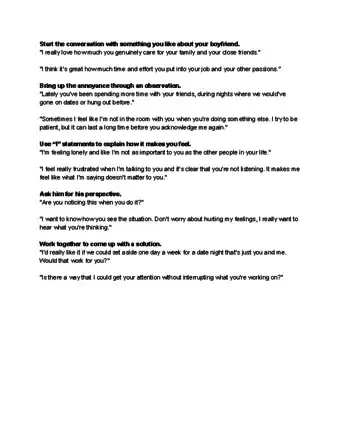
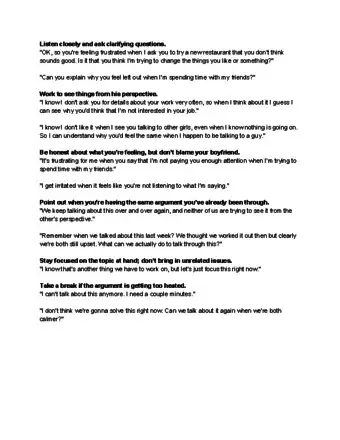
Conversation Help


Expert Q&A
-
QuestionHow do I make my boyfriend happy when he's upset?
 Klare Heston, LCSWKlare Heston is a Licensed Independent Clinical Social Worker based in Cleveland, Ohio. With experience in academic counseling and clinical supervision, Klare received her Master of Social Work from the Virginia Commonwealth University in 1983. She also holds a 2-Year Post-Graduate Certificate from the Gestalt Institute of Cleveland, as well as certification in Family Therapy, Supervision, Mediation, and Trauma Recovery and Treatment (EMDR).
Licensed Social WorkerAccept that he is upset. Don't expect to cheer him up instantly. Adjust to his needs; ask what he would like to do that day or what might help. -
QuestionHow do I get my boyfriend to talk to me more?Klare Heston, LCSWKlare Heston is a Licensed Independent Clinical Social Worker based in Cleveland, Ohio. With experience in academic counseling and clinical supervision, Klare received her Master of Social Work from the Virginia Commonwealth University in 1983. She also holds a 2-Year Post-Graduate Certificate from the Gestalt Institute of Cleveland, as well as certification in Family Therapy, Supervision, Mediation, and Trauma Recovery and Treatment (EMDR).
Licensed Social WorkerLet him know that it is important to you. If he finds personal conversations difficult, suggest that you can write letters, notes or emails/texts instead. This might be a good warm-up to a subsequent conversation. -
QuestionHow do I show my boyfriend I really love him?Klare Heston, LCSWKlare Heston is a Licensed Independent Clinical Social Worker based in Cleveland, Ohio. With experience in academic counseling and clinical supervision, Klare received her Master of Social Work from the Virginia Commonwealth University in 1983. She also holds a 2-Year Post-Graduate Certificate from the Gestalt Institute of Cleveland, as well as certification in Family Therapy, Supervision, Mediation, and Trauma Recovery and Treatment (EMDR).
Licensed Social WorkerBe kind, listen, encourage his interests/friends, and show affection and appreciation.












References
- ↑ https://www.relate.org.uk/relationship-help/help-relationships/communication/5-communication-tips-try-your-partner
- ↑ https://www.betterhealth.vic.gov.au/health/healthyliving/relationships-and-communication
- ↑ https://www.psychologytoday.com/us/blog/affectionado/201308/what-lack-affection-can-do-you
- ↑ https://www.psychologytoday.com/us/blog/affectionado/201308/what-lack-affection-can-do-you
- ↑ https://psychcentral.com/blog/9-steps-to-better-communication-today/
- ↑ https://psychcentral.com/blog/9-steps-to-better-communication-today/
- ↑ https://psychcentral.com/blog/9-steps-to-better-communication-today/
- ↑ https://www.psychologytoday.com/us/blog/emotional-fitness/201107/10-truths-keep-your-relationship-healthy
- ↑ https://www.psychologytoday.com/us/blog/emotional-fitness/201107/10-truths-keep-your-relationship-healthy
- ↑ https://www.psychologytoday.com/us/blog/emotional-fitness/201107/10-truths-keep-your-relationship-healthy
- ↑ https://www.psychologytoday.com/us/blog/emotional-fitness/201107/10-truths-keep-your-relationship-healthy
- ↑ https://www.psychologytoday.com/us/blog/emotional-fitness/201107/10-truths-keep-your-relationship-healthy
- ↑ https://www.psychologytoday.com/us/blog/emotional-fitness/201107/10-truths-keep-your-relationship-healthy
- ↑ https://www.psychologytoday.com/us/blog/emotional-fitness/201107/10-truths-keep-your-relationship-healthy
About This Article