X
This article was written by Jack Lloyd. Jack Lloyd is a Technology Writer and Editor for wikiHow. He has over two years of experience writing and editing technology-related articles. He is technology enthusiast and an English teacher.
This article has been viewed 634,975 times.
This wikiHow teaches you how to determine your Windows computer's bit count, which typically will be either 32- or 64-bit.
Steps
Method 1
Method 1 of 2:Windows 10 and 8
Method 1
-
1
-
2Open Settings . Click the gear-shaped icon in the bottom-left corner of the Start window. This will open the Settings window.Advertisement
-
3Click System. It's a computer monitor-shaped icon in the Settings window.
-
4Click About. This tab is at the bottom of the left-hand column of options. Doing so brings up a list of your computer's attributes.
-
5Look for the "System type" heading. It's near the bottom of the "Device specifications" section toward the bottom of the window. You'll see either "64-bit" or "32-bit" to the right of "System type"; this is your computer's bit count.Advertisement


Method 2
Method 2 of 2:Windows 7
Method 2
-
1
-
2Right-click Computer. It's on the right side of the Start window. Doing so prompts a drop-down menu.
- If the My Computer app is on your desktop, you can right-click it instead.
- If you're using a laptop with a trackpad, tap the trackpad with two fingers instead of right-clicking.
-
3Click Properties. This option is near the bottom of the drop-down menu.
-
4Look for the "System type" heading. It's below the "Installed RAM" heading on this page. You'll see either "64-bit" or "32-bit" to the right of "System type"; this is your computer's bit count.Advertisement


Community Q&A
-
QuestionIs there an easy way to install a 64-bit processor?
 Community AnswerYes, open up the PC. Look for a big fan. Unscrew the fan. Underneath the fan is a processor. Take out the processor. Put in a 64 bit processor (must purchase separately). Apply thermal paste. Put the fan back on. Close the computer.
 -
QuestionI'm building a new computer and have selected the AMD Athlon 760k Richland 3.8GHz. Is this a 64-bit processor?Community AnswerThis is, in fact, a 64-bit processor.
-
QuestionWhat is a 64 bit PC?Community AnswerThe terms 32-bit and 64-bit refer to the way a computer's processor (also called a CPU), handles information. The 64-bit version of Windows handles large amounts of random access memory (RAM) more effectively than a 32-bit system.
-
QuestionWhich version of Windows is good for a 32 bit processor?
 UK_Gamer05Community Answer32 bit processors tend to be the older ones, although you really just have to check the specs on your processor, and the specs of the operating system. All OS's from Microsoft, including Windows 10, have 32-bit versions available.
 -
QuestionWhat is the difference between dual-core and an i7 microprocessor?
 Community AnswerThe term "core" generically refers to how many virtual processors are inside the physical chip, which is clearly 1 physical processor. Different versions of the Intel i7 chip may have a different number of cores. The goal is creating processors faster, more complex, with the possibility of more cores. The practical limit requires making the parts smaller, reducing "wire" size (many times smaller than a human hair), voltage, and heat.
Warnings
- Attempting to run a 64-bit program on a 32-bit system will generally result in problems.Thanks!
Advertisement





About This Article
Article SummaryX
1. Right-click the Start icon.
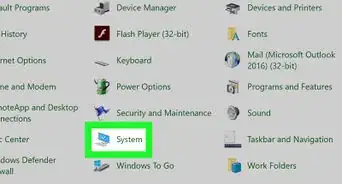
2. Click System.
3. Click the About tab.
4. Look for 32-bit or 64-bit to the right of the "System type" heading.
Did this summary help you?
Advertisement