This article was co-authored by wikiHow Staff. Our trained team of editors and researchers validate articles for accuracy and comprehensiveness. wikiHow's Content Management Team carefully monitors the work from our editorial staff to ensure that each article is backed by trusted research and meets our high quality standards.
There are 16 references cited in this article, which can be found at the bottom of the page.
This article has been viewed 2,656 times.
Learn more...
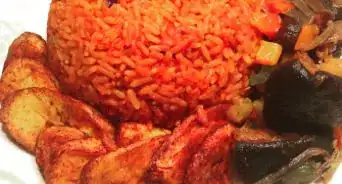
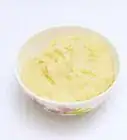
Banga soup, also called "Ofe Akwu", is a popular soup from the Niger Delta and the Nigerian South East. It consists of palm fruit extract, beef, fish, scent leaves, and other ingredients. The soup is fairly easy to prepare. While you can always use store-bought palm fruit extract, making it yourself is definitely worth the time and effort!
Ingredients
- 1 kilogram (2.2 lb) of palm fruits or 800-gram (28.2-oz) can palm fruit concentrate
- 1 kilogram (2.2 lb) of beef, cut into 5 to 7 cm (2.0 to 2.8 in) pieces
- 3 pieces of dried fish (mangala), soaked and deboned
- Scent leaves, washed and sliced
- 1 red onion, diced
- 2 tablespoons (12 g) of crayfish, ground
- 1 small piece of ogiri okpei, ground
- Ground habanero pepper, to taste
- Salt, to taste
- 3 stock cubes, divided
Serves 4
Steps
Part 1
Part 1 of 3:Grilling the Beef
-
1Preheat your oven to 180 °C (356 °F). Place a grilling rack onto a baking sheet and have it ready to place the meat on. You can also grill the meat directly on the rack in your oven, but you'll need to slide a large baking sheet into the slots beneath it.
- The baking sheet is there to catch any dripping fat.
-
2Crumble and massage 2 stock cubes into the cut beef. Cut 1 kilogram (2.2 lb) of beef into 5 to 7 cm (2.0 to 2.8 in) pieces. Crumble 2 stock cubes with your fingers, then massage the powder into the meat with your hands.[1]
- The exact size of the beef pieces doesn't really matter, but make sure that they're all the same size so that they cook evenly.
- You can use any flavor of stock you want, but beef would be a good choice.
Advertisement -
3Place the beef into a small, covered pot for 10 minutes. Don't put the pot on the stove or start cooking with it; simply set it off to the side. Massage the meat again after it's finished resting. This will help redistribute any crumbled stock.[2]
-
4Grill the beef for 40 minutes, turning it halfway through. Place the beef chunks onto the grilling rack, then allow them to cook in the oven for 20 minutes. Use a pair of tongs to turn the beef pieces over, then allow them to finish baking for another 20 minutes or so.[3]
- As the beef is grilling, get started on preparing the palm fruit extract. This will save you some time.
- How long it takes for the beef to grill will vary from oven to oven. It needs to be well-done without any pink or juices inside.
-
5Take the beef out of the oven and set it aside. Use a pair of oven mitts to pull the baking sheet out of the oven. Set it down on a heat-safe surface, such as your stovetop. If you placed the beef slices directly onto the oven rack, use a pair of tongs to pull them off and transfer them to a plate.Advertisement
Part 2
Part 2 of 3:Extracting the Palm Juice
-
1Rinse 1 kilogram (2.2 lb) of palm fruits with cool water. You can use tinned palm fruit concentrate, but you'll get a much more authentic flavor if you extract the juice from them yourself.[4]
- If you're using an 800-gram (28.2-oz) can of palm fruit concentrate instead, click here to continue.
-
2Boil the palm fruits in a pot filled with water for 30 to 60 minutes. Place the palm fruits into a medium-sized pot, then cover them with several centimeters/inches of water. Bring the water to a boil over high heat, then allow it to cook until the palm fruits turn tender. This can take anywhere between 30 and 60 minutes.[5]
- Save time by preparing the rest of the recipe while the palm fruits are boiling.
- The palm fruits may start to split and burst open as you cook them. Once that happens, they are ready.
-
3Drain the water, then grind the fruits in a mortar with a pestle. Pour the palm fruits through a strainer, then transfer them into a mortar. Grind them with a pestle until the hulls break open and you can see the fibers.[6]
- Depending on the size of your mortar, you may have to work in several batches. Place each finished batch into a separate colander.
-
4Rub the palm fruits under clean water to extract the pulp. Place the palm fruits into a large pot or bowl, then cover them with a few centimeters/inches of water. Massage and rub the palm fruits against each other to loosen the hulls and reveal the fibrous fruits inside.[7]
-
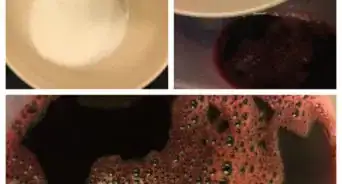
5Strain the water from the palm fruits into a bowl. Place a strainer over a bowl, pour the palm fruits into the strainer, then lift the strainer up. The liquid that drains from the palm fruits and into the bowl will be a golden brown color. Keep this liquid; that's your extract![8]
- Don't worry if some fibers get into the drained water.
- Press the palm fruits to squeeze out any last bits of water.
-
6Repeat the rubbing and straining process 2 to 3 more times. Dump the palm fruits back into their bowl. Add a few more centimeters/inches of water, then rub them between your fingers. Pour the liquid through a strainer into the extracted pulp. Do this a few more times until only the fibers and hulls remain; there should be no pulp.[9]
- Each time you rub and strain the fruits, the hulls will peel away and reveal the fibrous interior. Be sure to throw these away.
-
7Pour the extract through a fine, mesh sieve. Set a fine, mesh sieve over a clean bowl. Pour the strained liquid into the sieve and allow it to drain. Scrape a spoon or rubber spatula against both sides of the sieve to get as much of the liquid through it.[10]
- There may be some fibers caught in the sieve. Discard those.
- You will end up with about 800 grams (28.2 ounces) of extract. This is roughly equivalent to an 800-gram (28.2-oz) can of palm fruit concentrate.
Advertisement
Part 3
Part 3 of 3:Finishing the Banga Soup
-
1Place the beef, soaked fish, onion, and remaining stock cube into a pot. Use a pair of tongs to transfer the grilled beef into a large pot. Break 3 pieces of soaked and deboned dried fish into smaller pieces, then add them into the pot as well. Finally, add in 1 diced red onion and the remaining stock cube.[11]
- Soak the dried fish ahead of time in cool water, then clean it with a brush. Remove the bones and break the fish into smaller pieces with your fingers.
- You don't have to crumble the stock cube since the water will dissolve it. Make sure that it's the same flavor as the previous 2 that you used.
-
2Cover the ingredients with water, then bring the water to a boil. How much water you use will depend on the size of the pot; use just enough to cover the ingredients. Once you have the water in the pot, bring the water to a boil over medium heat.[12]
- Cover the pot with a lid to help the water boil faster.
-
3Boil the ingredients, covered, for 5 minutes. As soon as the water starts to boil, cover the pot with a lid and start the timer for 5 minutes.[13]
- There should only be a little bit of water in the pot at this point. You can always add more later.
-
4Add the crayfish, ogiri okpei, habanero pepper, and palm fruit extract. Open the pot and add 2 tablespoons (29.6 ml) (12g g) of ground crayfish. Add 1 small piece of ground ogiri okpei and a ground habanero pepper. Finally, add in your palm fruit extract.[14]
- Alternatively, you can use an 800-gram (28.2-oz) can of palm fruit concentrate. Be sure to stir it well first, however![15]
- How many habanero peppers you use is up to you. Start with half a pepper if you'd prefer a mildly spicy soup, or 2 to 3 peppers if you'd like stronger heat.
-
5Cook the soup, covered, until the oil floats to the top. As the soup cooks, the water will get absorbed into the meat and seafood. If you want a thinner soup, add a little more water, and let it cook some more.[16]
- If you are using tinned, palm fruit extract, cook it until it dissolves. You may have to add a little bit more water since it is thicker than the homemade kind.
-
6Add the scent leaves and simmer the soup for 2 more minutes. Scent leaves are native to Nigeria, so they can be difficult to find in other places. If you can't find them in an African grocery store, try pumpkin leaves or another type of vegetable.[17]
- If you want to make Delta-style Banga soup, skip the scent leaves altogether and use some dried, crushed bitter leaves instead.
-
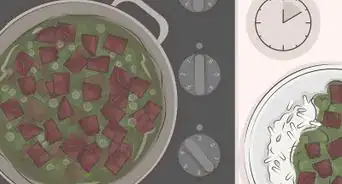
7Serve the soup with steamed white rice. Place the rice on 1 side of a plate, and the soup on the other. If you made the Delta-style soup, you can serve it with starch, garri, semolina, amala, or pounded yams instead. There's enough to make 4 servings.[18]
- Store any leftovers in an airtight container in the fridge for up to 3 or 4 days.[19]
Advertisement
Things You'll Need
- Oven
- Grilling rack
- Baking sheet
- Tongs
- Small pot
- Medium pot
- Large pot
- Bowls
- Strainer
- Fine, mesh sieve
- Rubber spatula
- Mortar and pestle

-Final.webp)

References
- ↑ https://www.youtube.com/watch?v=IgXEJjU9kIA&t=20s
- ↑ https://www.youtube.com/watch?v=IgXEJjU9kIA&t=55s
- ↑ https://www.youtube.com/watch?v=IgXEJjU9kIA&t=1m
- ↑ http://www.sisiyemmie.com/2014/08/banga-soup-recipe-and-starch-niger.html
- ↑ http://www.sisiyemmie.com/2014/08/banga-soup-recipe-and-starch-niger.html
- ↑ https://www.youtube.com/watch?v=A8dthOh08W8&t=1m14s
- ↑ https://www.youtube.com/watch?v=A8dthOh08W8&t=2m5s
- ↑ https://www.youtube.com/watch?v=A8dthOh08W8&t=2m31s
- ↑ http://www.sisiyemmie.com/2014/08/banga-soup-recipe-and-starch-niger.html
- ↑ https://www.youtube.com/watch?v=A8dthOh08W8&t=3m50s
- ↑ https://www.youtube.com/watch?v=IgXEJjU9kIA&t=3m14s
- ↑ https://www.youtube.com/watch?v=IgXEJjU9kIA&t=3m30s
- ↑ https://www.youtube.com/watch?v=IgXEJjU9kIA&t=3m40s
- ↑ https://www.youtube.com/watch?v=IgXEJjU9kIA&t=3m51s
- ↑ http://www.allnigerianrecipes.com/soups/banga-soup.html
- ↑ https://www.youtube.com/watch?v=IgXEJjU9kIA&t=4m5s
- ↑ http://www.allnigerianrecipes.com/soups/banga-soup.html
- ↑ http://www.allnigerianrecipes.com/soups/banga-soup.html
- ↑ www.stilltasty.com/fooditems/index/16499
- ↑ https://www.youtube.com/watch?v=IgXEJjU9kIA&t=2m35s
- ↑ http://www.allnigerianrecipes.com/soups/banga-soup.html
About This Article



-Final.webp)









































