This article was co-authored by Katie Styzek and by wikiHow staff writer, Madeleine Criglow. Katie Styzek is a Professional School Counselor for Chicago Public Schools. Katie earned a BS in Elementary Education with a Concentration in Mathematics from the University of Illinois at Urbana-Champaign. She served as a middle school mathematics, science, and social studies teacher for three years prior to becoming a counselor. She holds a Master of Education (M.Ed.) in School Counseling from DePaul University and an MA in Educational Leadership from Northeastern Illinois University. Katie holds an Illinois School Counselor Endorsement License (Type 73 Service Personnel), an Illinois Principal License (formerly Type 75), and an Illinois Elementary Education Teaching License (Type 03, K – 9). She is also Nationally Board Certified in School Counseling from the National Board for Professional Teaching Standards.
There are 9 references cited in this article, which can be found at the bottom of the page.
wikiHow marks an article as reader-approved once it receives enough positive feedback. In this case, 80% of readers who voted found the article helpful, earning it our reader-approved status.
This article has been viewed 88,301 times.
Sometimes it's so hard to stay quiet in class. When you think of something truly hilarious, it almost feels painful to wait until the bell rings to share it. It's perfectly normal to want to talk, but it can also make it difficult for you (and your classmates) to focus. Try out these methods to help you keep side conversations or random remarks to a minimum! You'll have plenty of time to talk after school.
Steps
Method 1
Method 1 of 12:Move to the front of the class.
-
1Talking in class seems less fun when you’re right in front of the teacher. Sitting up close to the board also helps you stay focused on the lesson. If you’re allowed to choose your seat, choose a desk up front.[1]
- If the spots at the front are taken, look for a quiet student and sit by them. Chances are they won’t start a conversation with you like your best friend might!

Method 2
Method 2 of 12:Try to be like the quiet students.
-
1Think of the quiet students as your role models. Look around the classroom and see if you notice a student that rarely talks during class. For the rest of the class, try acting like them. This can help you practice being more well-behaved and less talkative.[2]
- For example, maybe this student sits quietly and takes notes. Follow their lead and get your own notebook!
- Another student might participate a lot in class but always makes sure to raise their hand first. Try that out, too.

Method 3
Method 3 of 12:Think before you speak.
-
1Before you open your mouth, ask yourself “Is this something that can wait?” Sometimes it's hard to remember to filter your thoughts. Think about if what you want to say is related to the class discussion. If it's not, wait until class is over to share what you're thinking. Even the funniest joke in the world can wait until break![3]
- If it’s at all disruptive, like "This subject is boring, is class almost over?" don’t say that out loud.
- Another good trick is to raise your hand. While waiting to be called on, think about what you want to say. If it's not related to the subject your teacher is discussing, put your hand down and remain quiet.
- Always raise your hand when you have a question about class. Not talking during class doesn't mean your questions about the lesson should go unanswered.

Method 4
Method 4 of 12:Keep a notebook at your desk.
-
1Take notes to stay focused on the lesson. It’s hard to have side conversations when you’re too busy writing down the latest vocab words! If you really struggle to talk, you can write down thoughts you have in your notebook instead of saying them.[4]
- Classroom notes should take priority, but if you think of a joke you want to tell your friend, write that down, too. That way you can remember it after class and share it with your friend!
- You can also use your notebook to write down anything you want to talk about after class. For example, instead of talking to your friend during a lesson, write down, "Remember to tell Jimmy that my mom said it was okay for them to stay the night this weekend."

Method 5
Method 5 of 12:Put your phone away.
-
1Texting what you have to say instead of talking isn't a good option. Using your phone in class distracts you from the lesson. It also disrupts the whole class if the teacher has to stop and ask you to put your phone away. Leave your phone tucked away in a safe place like your pocket or locker.[5]
- You should also avoid passing notes during class, A.K.A. texting the old-fashioned way.

Method 6
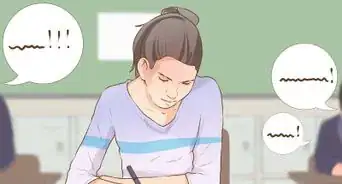
Method 6 of 12:Avoid responding to classmates.
-
1Sometimes it’s not you doing all the talking! It can be hard to know how to stop responding to talkative people in class. Do your best to politely tell the students around you that you can’t talk until class is finished. After that, ignore their comments. They’ll get the message and stop trying to talk. Side conversations can be really distracting to teachers, and it’s hard to follow along with the lesson in the middle of another conversation! Try your best to avoid talking with your classmates to really focus.[6]
- While you're in the hallway before class, try taking your talkative classmates aside and say something like “I’m not going to talk during class anymore, so can we talk at lunch instead?”
- Try not to be impolite if your friends talk to you during class. Always be kind and ask them nicely not to pester you while you focus.
- Yelling "SHH!" across the room is no better than talking.

Method 7
Method 7 of 12:Ask your friends for help.
-
1There is no shame in asking someone to help you stop talking. Try asking one of your friends to give you a cue whenever you start to talk in class. Maybe they can cough or tap your shoulder. Whatever cue you decide on, make sure it doesn’t involve them talking to you at all or it defeats the purpose.[7]
- Ask a friend that doesn’t usually talk in class. Try something like, “Hey Sam, I’m trying to do a better job at not talking in class. Next time I try to talk to you, can you tap a pencil on your desk as a cue for me to stop?”

Method 8
Method 8 of 12:Ask your teacher for help.
-
1They may be upset when you talk, but they can also give you great advice. Tell your teacher you’re having a hard time not talking in class, and see if they have any suggestions for things you can try. Remember that teachers want to see you succeed! They’ll be happy to help you.[8]
- After class, tell your teacher something like "I'm trying really hard to stop talking during your class, but I'm still struggling with it. Could you please help me?"

Method 9
Method 9 of 12:Use a visual aid like a sticky note.
-
1Write something on it to remind yourself not to talk! Every time you get the urge to speak, glance down at your sticky note. Consider picking a fun, bright color so that it will attract your attention and act as a good reminder.[9]
- Try writing something like “I can talk when class is over” or “silence is golden.”

Method 10
Method 10 of 12:Set realistic goals for yourself.
-
1You may not be able to change your habits overnight. Try to break up your goal into a few smaller goals so that it doesn’t seem so overwhelming. Start by not talking at all through the first half of class. Once that becomes second nature, make your next goal to not speak during the entire class. Finally, make it your goal to avoid side conversations all day![10]

Method 11
Method 11 of 12:Don’t get discouraged if you struggle to keep quiet.
-
1Just try your best! It can be easy to get discouraged when you’re trying something new. If you mess up and talk during class, tell yourself that it’s okay and keep moving forward. Everyone makes mistakes! All that matters is that you keep trying and never give up.[11]
- Let’s say you accidentally blurt out a joke in class. Instead of beating yourself up, tell yourself something like, “I just made a mistake and that’s okay. Now I just have to be quiet for the rest of class to make up for it!”

Method 12
Method 12 of 12:Reward yourself for succeeding.
-
1Tell yourself that if you're quiet, you get to watch your favorite movie! Positive reinforcement helps you keep up the good work and stay motivated. As you meet your goals, reward yourself with a piece of candy, 10 extra minutes of playtime after school, or something else you enjoy. It’s hard to stay quiet all day in school, and you deserve it![12]
- Talk to your parents about a reward system that you both agree on. Maybe your mom can take you out for ice cream at the end of the week if you promise to be quiet and focused in class!

Community Q&A
Did you know you can get premium answers for this article?
Unlock premium answers by supporting wikiHow
-
QuestionHow can I focus on what my teacher's saying during class?
 Katie StyzekKatie Styzek is a Professional School Counselor for Chicago Public Schools. Katie earned a BS in Elementary Education with a Concentration in Mathematics from the University of Illinois at Urbana-Champaign. She served as a middle school mathematics, science, and social studies teacher for three years prior to becoming a counselor. She holds a Master of Education (M.Ed.) in School Counseling from DePaul University and an MA in Educational Leadership from Northeastern Illinois University. Katie holds an Illinois School Counselor Endorsement License (Type 73 Service Personnel), an Illinois Principal License (formerly Type 75), and an Illinois Elementary Education Teaching License (Type 03, K – 9). She is also Nationally Board Certified in School Counseling from the National Board for Professional Teaching Standards.
Professional School CounselorTry taking notes during class to help you better focus on the material being taught.
Support wikiHow by unlocking this expert answer.
-
QuestionHow should I react if someone tells a very funny joke that distracts the class?
 wikiHow Staff EditorThis answer was written by one of our trained team of researchers who validated it for accuracy and comprehensiveness.
Staff AnswerwikiHow Staff EditorStaff AnswerIt can be really hard not to laugh when someone interrupts the class with a funny joke. Do your best not to get distracted and pay attention to the teacher's instructions.Support wikiHow by unlocking this staff-researched answer.
-
QuestionHow can I be more organized in class?wikiHow Staff EditorThis answer was written by one of our trained team of researchers who validated it for accuracy and comprehensiveness.
Staff AnswerwikiHow Staff EditorStaff AnswerTry keeping a notebook or binder for each class subject. During class, take notes and try to keep side conversations to a minimum.Support wikiHow by unlocking this staff-researched answer.









References
- ↑ https://news.wisc.edu/top-ways-to-stay-focused-in-class/
- ↑ Katie Styzek. Professional School Counselor. Expert Interview. 28 October 2020.
- ↑ https://www.psychologytoday.com/us/blog/peaceful-parents-happy-kids/201506/8-steps-help-your-child-develop-self-control
- ↑ https://news.wisc.edu/top-ways-to-stay-focused-in-class/
- ↑ https://news.rutgers.edu/cellphone-distraction-classroom-can-lead-lower-grades-rutgers-study-finds/20180723#.XNpXjo4zZPY
- ↑ https://undergraduate.northeastern.edu/peer-tutoring/resources/students/classroom-etiquette/
- ↑ https://kidshealth.org/en/teens/help-obstacles.html
- ↑ Katie Styzek. Professional School Counselor. Expert Interview. 28 October 2020.
- ↑ https://www.psychologytoday.com/us/blog/get-psyched/201207/learning-through-visuals
About This Article

If you want to avoid talking in class but you’re finding it hard to stop, try ignoring your talkative classmates as this will show them you’re not interested in chatting. However, it can be hard to stop talking because your classmates will probably want you to answer so if they bug you, just say: “I’ve got to listen more in class so I’m not going to talk anymore. Can we talk at lunch instead?”. Get your friends to help too by asking them to nudge you or say “ssh” when they see you talking a lot in class. And if you’re still finding that it’s too hard to stop talking, try switching seats and sit next to a quiet student you know won’t talk at all to you during class so you can get your work done. For more tips, including how to think before you speak, read on!