Solar Powered Grain Mill

solar milling

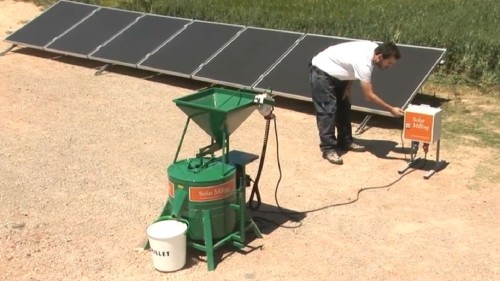
“Graining cereal crops is a basic, century old business and it will continue to be as important as ever before for centuries to come. Before the age of oil grain milling was entirely based on renewable energy. It was either done by wind energy, hydropower, animals or manpower. For the last century the traditional grain milling has been mainly replaced by electricity and fuel driven milling.”

“The Solar PV Grain Mill works to the same principle like any conventional, electrically driven mill. The mill has a very efficient 3-phase AC motor which is directly coupled to the graining system. The main invention of the system is, and that makes it unique among PV systems, that it is a “direct drive system” without the need of batteries. The Solar PV generator converts solar radiation into electricity, and the generated electricity is directly feeding the motor drive. There are no additional conversion losses, such as energy storage losses in batteries, battery maintenance or replacement costs, which are a common problem in conventional Solar PV off-grid systems.”

Read More: Solar Milling. Via Engineering for Change.

I would like to add that the direct drive system also eliminates the high energy use caused by the production of the batteries, which can make solar PV off-grid systems everything but sustainable. Therefore, storing work instead of energy — the solar mill only operates when the sun shines — is a very interesting strategy in sunny regions.

Related:
The Motorized “Solution” to Harvesting Wheat in Nepal

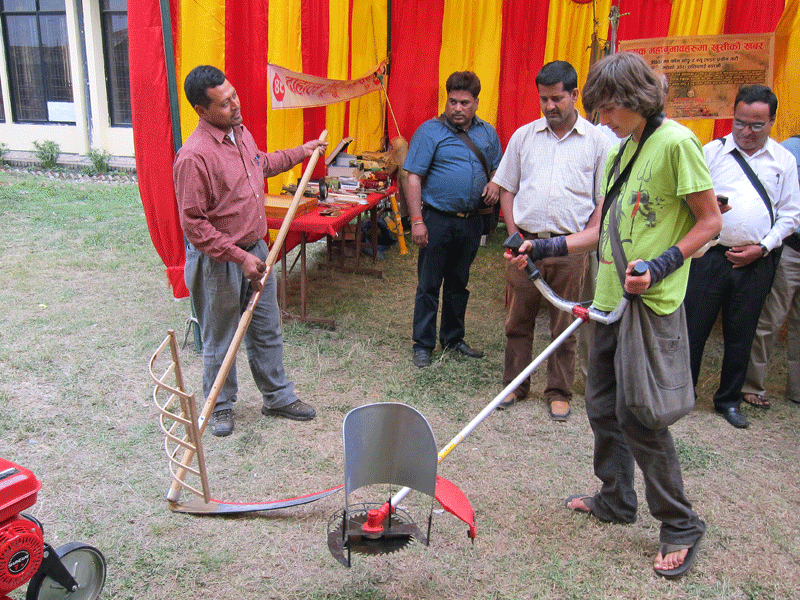
scythe versus grain wheaperThree short videos demonstrate how an ingenious (and centuries old) adaptation of the scythe for harvesting wheat beats simple tools and high-tech alike.

Steve Leppold writes us:

Here’s an example of a low-tech approach that is clearly superior to the motorized “solution”; and yet the expensive, fossil-fueled “upgrade” is being successfully marketed in developing nations like Nepal and India. One man from Canada is attempting to bring some sanity to the situation.

Alexander Vido and his teenage son brought donated equipment to Nepal in 2012, and made this short video of their volunteer efforts. The project is described at Scythe Project in Nepal.

Thanks, Steve. The project’s website has lots of technical information. Previously: The Religion of Complexity.

Lost Crops of the Incas

lost crops of the incas

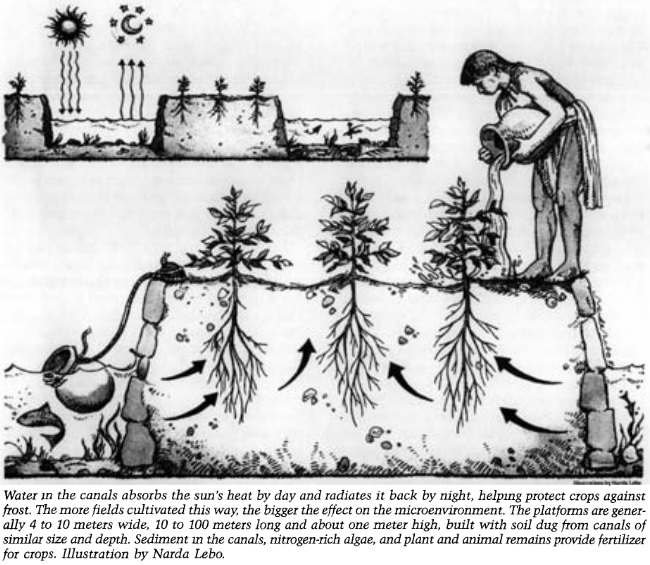
“At the time of the Spanish conquest, the Incas cultivated almost as many species of plants as the farmers of all Asia or Europe. On mountainsides up to four kilometers high along the spine of a whole continent and in climates varying from tropical to polar, they grew a wealth of roots, grains, legumes, vegetables, fruits, and nuts.

Without money, iron, wheels, or work animals for plowing, the Indians terraced and irrigated and produced abundant food for fifteen million or more people—roughly as many as inhabit the highlands today.

Throughout the vast Inca Empire, sprawling from southern Colombia to central Chile—an area as great as that governed by Rome at its zenith—storehouses overflowed with grains and dried tubers. Because of the Inca’s productive agriculture and remarkable public organization, it was usual to have 3–7 years’ supply of food in storage.


But Pizarro and most of the later Spaniards who conquered Peru repressed the Indians, suppressed their traditions, and destroyed much of the intricate agricultural system. They considered the natives to be backward and uncreative. Both Crown and Church prized silver and souls—not plants.

Crops that had held honored positions in Indian society for thousands of years were deliberately replaced by European species (notably wheat, barley, carrots, and broad beans) that the conquerors demanded be grown. Forced into obscurity were at least a dozen native root crops, three grains, three legumes, and more than a dozen fruits.

Domesticated plants such as oca, maca, tarwi, nuñas, and lucuma have remained in the highlands during the almost 500 years since Pizarro’s conquest. Lacking a modern constituency, they have received little scientific respect, research, or commercial advancement. Yet they include some widely adaptable, extremely nutritious, and remarkably tasty foods.”

Lost Crops of the Incas: Little-known Plants of the Andes with Promise for Worldwide Cultivation, 1989. The book can be consulted online at The National Academic Press.

21st Century Toy Farm

21st century toy farm

Toy farm 2

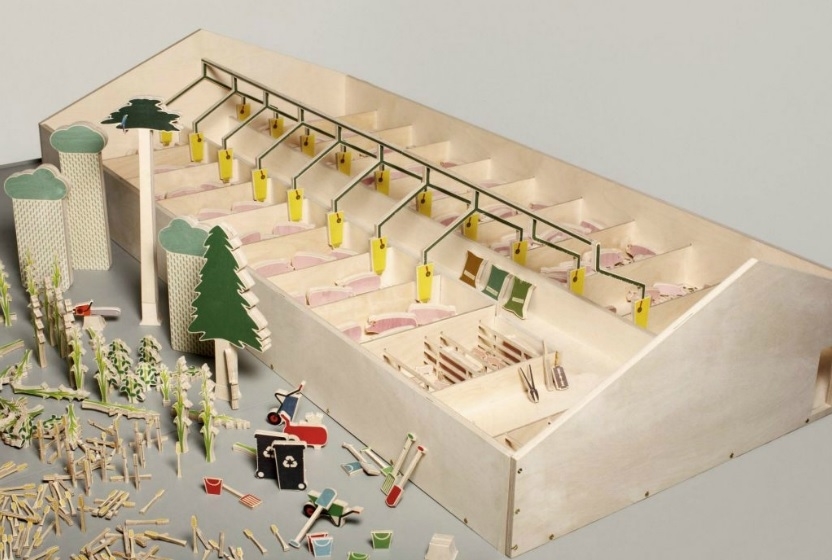
“Hoping to cultivate a better understanding of where the food on our plates comes from, Tomm Velthuis designed a toy farm highlighting the unsustainable reality of the meat industry.

The wooden set, called Playing Food, comes complete with 200 pigs, the enormous amounts of food required to fatten them up, the trees that must be cleared for feed crops, and the acid rain caused by the pigs’ manure. It’s factory farming packaged as an ‘innocent’ childhood toy.”

See more pictures at Tomm’s blog. The farm is on display at mEATing-kill your darlings, an art event about our relationship with meat and animals in Tilburg, the Netherlands. See also: Can I see your Meat License?

The Culticycle: a Pedal-Powered Tractor

the culticycle

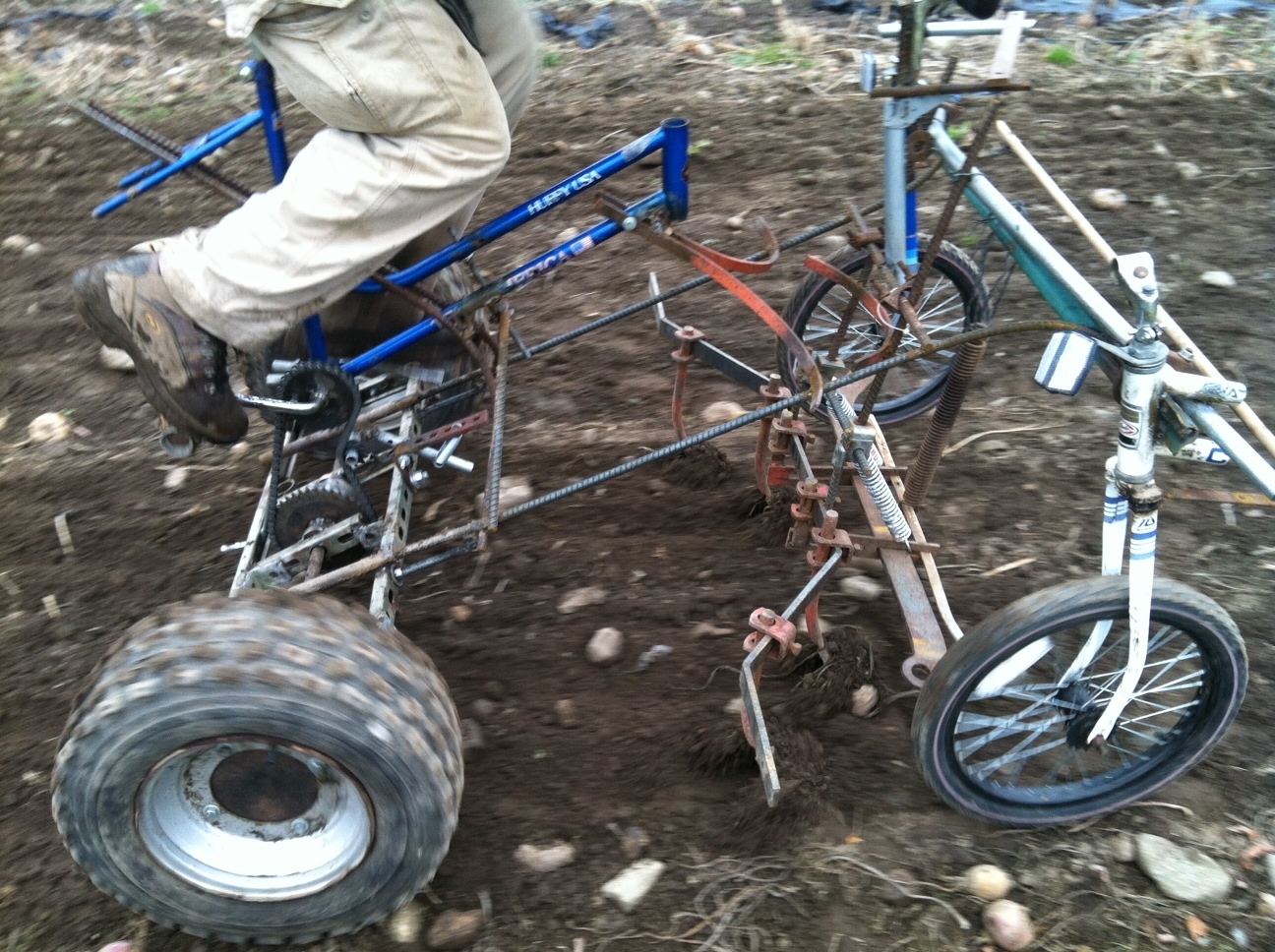
“The Culticycle is a pedal powered tractor that can cultivate, seed, spray, or pull gear for most low horsepower tasks. Small tractors do many jobs very well and very fast, but also consume fuel, compact soil, cost a lot, and cause physical damage to the operator -– mainly spine and joint problems. Many of their jobs could be done, slower but better, by human pedal power.

This prototype consists of:

  • the front ends of 2 bikes welded together at 42” on center;
  • a lawn tractor differential mounted in a unistrut rectangle for a rear end , with 3/4″ round axles and 20” ATV tires;
  • a bike frame welded above the rear end with motorcycle sprocket and chain driving the differential (a springloaded idler tensions the chain);
  • a belly mount lift to hold cultivators, seeders, etc.;
  • a bike handlebar, separate from the bike frame and joined to the front end, steering the front wheels.

The materials are rebar, unistrut, landscape rake tines, and parts from bikes, an ATV, and a lawn tractor. It attempts to show that human pedal power can do some jobs of small tractors, albeit in twice the time, and that the design can be simple enough that no extra weight is needed for traction. The effort required is similar to climbing a 10 degree slope on a seventies Schwinn 3 speed. This prototype was built for testing: a more easily buildable version is in the works.”

Found at Farmhack. This is begging for an open modular approach. Thanks to Tim Cooke.

Read more: Slow Farming Tools.

How to Plant an Iroquois Garden

Three sisters“According to Iroquois legend, corn, beans, and squash are three inseparable sisters who only grow and thrive together. This tradition of interplanting corn, beans and squash in the same mounds, widespread among Native American farming societies, is a sophisticated, sustainable system that provided long-term soil fertility and a healthy diet to generations.” 

“Corn provides a natural pole for bean vines to climb. Beans fix nitrogen on their roots, improving the overall fertility of the plot by providing nitrogen to the following years corn. Bean vines also help stabilize the corn plants, making them less vulnerable to blowing over in the wind. Shallow-rooted squash vines become a living mulch, shading emerging weeds and preventing soil moisture from evaporating, thereby improving the overall crops chances of survival in dry years. Spiny squash plants also help discourage predators from approaching the corn and beans. The large amount of crop residue from this planting combination can be incorporated back into the soil at the end of the season, to build up the organic matter and improve its structure.” Read more: 1 / 2 / 3.