This article was co-authored by Jake Adams. Jake Adams is an academic tutor and the owner of Simplifi EDU, a Santa Monica, California based online tutoring business offering learning resources and online tutors for academic subjects K-College, SAT & ACT prep, and college admissions applications. With over 14 years of professional tutoring experience, Jake is dedicated to providing his clients the very best online tutoring experience and access to a network of excellent undergraduate and graduate-level tutors from top colleges all over the nation. Jake holds a BS in International Business and Marketing from Pepperdine University.
There are 8 references cited in this article, which can be found at the bottom of the page.
This article has been viewed 10,881 times.
Your personal statement is your ticket to getting an interview at your chosen medical school. Good medical schools are extremely competitive, so it's extremely important to write a compelling essay. The admissions board can't tell everything about you from your grades and test scores alone – they want to know about your character, your strength, who you are as a person. The purpose of the personal statement is to fill in those gaps.
Steps
Method 1
Method 1 of 3:Choosing a Topic for your Personal Statement
-
1Make a list. Write down all your hobbies, volunteer projects, classes you've taken, and similar experiences. Think about your experiences with each, and come up with several different options before choosing one to write about.[1]
- When brainstorming, write down every idea you have – even if it seems silly at the time. Sometimes those odd thoughts can inspire a great idea.
-
2
-
3Make it relevant. Choose an incident or a period in your life that explains why you want to go into medicine. You could describe the person who inspired you to become a doctor, or talk about the specific moment when you decided to become one.[4]
-
4Choose a common theme, if you're stuck. If you don't have an original theme that you really want to work with, it's okay to go with the tried and true. Many medical school personal statements are based three common themes. Then flesh out your essay with original details that are specific to you – you can't afford to be boring.[5]
- Why you want to be a doctor
- Why you are an extraordinary person
- Why you are completely qualified (for medical school, or for the medical profession)
-
5Avoid being too sentimental. Avoid overly personal topics such as a romantic breakup, your parents' divorce, or a relative's illness. Choose a subject you can discuss openly without resorting to melodrama or cliché.[6]
- Your essay does not need to be really heavy and serious, or describe an event that few people have experienced.
- The central theme of your essay can be light. It just needs to illustrate the points you are trying to get across.[7]
- Avoid discussing the death of a beloved grandparent who was a doctor. Instead, explain how you were inspired by interactions with their patients during a summer internship at their office.
- Avoid discussing how you dressed up in scrubs for Halloween in 3rd grade – your early childhood dreams have little bearing on whether you are right for medical school, now. Instead, you might talk about how you learned the value of hard work and attention to detail by restoring a boat with your father last summer.
-
6Avoid controversial topics. Since you don't know exactly who will be reading your essay, or what their personal politics or beliefs may be, it's best to stick to neutral topics. If you do mention something that is potentially controversial, make sure your tone is neutral and you aren't being preachy or judgemental.[8]
- Avoid discussing politics or religion, because you don't know the views of the person who will be reading your essay.
- Try to avoid any subject that commonly makes people angry or defensive.
-
7Read sample statements. If you need inspiration, there are many sources online that have sample statements you can look at. Just be sure your statement is your own work, and isn't too similar to something you've read.


Method 2
Method 2 of 3:Writing Your Essay
-
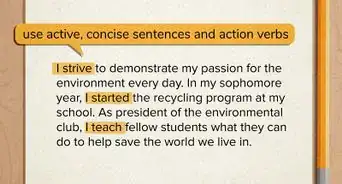
1Use active voice and clear language. You are trying to show the school who you really are, so try to use a natural tone when writing.[9]
- Use the active voice as much as possible.
- Don't be too casual. This is a professional academic paper, not creative writing.
- Don't be too stilted. When you're finished writing, go through and change any words you've chosen that you wouldn't ordinarily use.
-
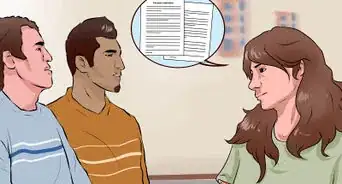
2Consider your audience. When writing, bear in mind that many people will probably read your personal statement. Medical school admission decisions are usually determined by a board or committee made up of professors, school administrators, and local doctors. Imagine your essay as seen through their eyes.[10]
-
3Grab your readers' attention right away. The person reading your personal statement will probably be reading dozens of others in the same day. Be sure yours stands out from the crowd and gets noticed.[11]
- Imagine you are advertising yourself. List all your “selling points.”
- Put the most impressive information at the beginning.
-
4Show, don't tell. Personal statements are best when you include concrete actions rather than abstract descriptions. Instead of describing your personal moral code, give an example of a specific incident when you acted on principle.[12]
- Think of the “interest equation” when writing: personal experience + specific details = interesting.[13]
-
5Avoid jargon. Resist the urge to show off the medical knowledge you have already acquired by using technical terms. Not everyone reading and judging your essay will be a medical professional.[14]
-
6Avoid being overly modest. If you don't like to boast, or feel uncomfortable talking about yourself, you'll need to put aside those feelings. The whole point of the exercise is to make yourself look good.[15]
- This can be tricky, but you need to find the right balance between confidence and humility. You don't want to come across as boastful or arrogant.
-
7Don't hold back. Your statement needs to be an expression of who you are – how your mind works and what you believe in. Be as honest as you can in your statement, so you will expose your true character.[16]
-
8Avoid making excuses. Unless there is something on your permanent record that you feel requires an explanation, avoid making excuses in your essay. Play to your strengths, don't point out your inadequacies.[17]
-
9Avoid opening with a quote. Resist the urge to begin your essay with a quote from your favorite author or scientist – it will just sound pretentious. The admissions board wants to hear what you have to say, not what a famous person had to say.[18]
-
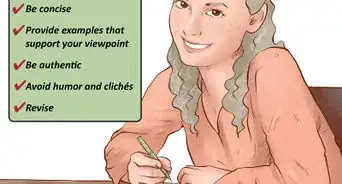
10Avoid clichés. When writing your essay, avoid using overused phrases that sound trite. This comes across as lazy writing and poor use of language.[19]
- Common clichés include: “a clean slate,” “a thirst for knowledge,” “go the extra mile,” “as luck would have it,” and “it goes without saying.” If you aren't sure if something is cliché, it's best to avoid it.


Method 3
Method 3 of 3:Preparing Your Essay for Submission
-
1Understand the purpose of the personal essay. Schools are looking for very specific things when they read your personal statement. Make sure your submission succeeds in illustrating the qualities the advisory committee is looking for.[20]
- Proven achievements
- Critical and analytical thinking skills
- Language and writing skills appropriate to this level of education
- Evidence that you'll be a successful medical student
- Evidence that you'll be a good doctor
-
2Follow instructions to the letter. Each school has its own requirements for writing your personal statement. Find out what they are, and follow them to the letter.[21] Ignoring even a small detail will make you appear careless and unprofessional, and therefore a poor candidate for medical school.[22]
- Be sure your essay is the appropriate length by using the “Word Count” function in your word processing program.
- If you are applying through the American Medical College Application Service (AMCAS), there is a 5,300 character maximum limit. This is about one and a half pages, single spaced.[23]
-
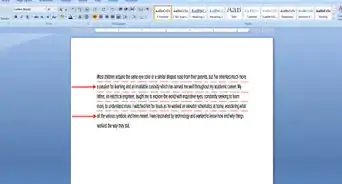
3Use standard formatting. If the school lists specific formatting guidelines, use those. Otherwise, you can use standard formatting to create an essay that is easy to read on the page.
- Type your statement single-spaced. Double space between paragraphs.
- Leave at least 1” margins on both sides, top, and bottom.
- Use a 12 pt. standard font such as Helvetica or Times New Roman.
- At the top of the page, center the title of your essay if you have one, or simply type “Personal Statement.” You can also include your name, if you wish.
-
4Think about your interview. If your essay impresses the board, the next step will most likely be a personal interview. Since you will probably be asked to discuss your essay, be sure you've written about things you will want to talk about during the interview.[24]
-
5Prepare to defend it. Go through your essay, and be certain you can defend every point. Try not to exaggerate your accomplishments, and don't pad your statement with fictional details. The school may verify the information you provide, especially if your essay seems too good to be true. If you're caught in a lie, you will definitely not be admitted.[25]
-
6Get feedback. When you finish your final draft, ask a few people to read your essay and give you their honest assessment. Ask a favorite professor, a current medical student, or your doctor.[26]
- Don't ask too many people to read it, or you may end up with too many conflicting opinions.


Community Q&A
-
QuestionHow do I make my personal statement stronger?
 Jake AdamsJake Adams is an academic tutor and the owner of Simplifi EDU, a Santa Monica, California based online tutoring business offering learning resources and online tutors for academic subjects K-College, SAT & ACT prep, and college admissions applications. With over 14 years of professional tutoring experience, Jake is dedicated to providing his clients the very best online tutoring experience and access to a network of excellent undergraduate and graduate-level tutors from top colleges all over the nation. Jake holds a BS in International Business and Marketing from Pepperdine University.
Academic Tutor & Test Prep SpecialistFocus on the climax of the story that you're trying to tell. Determine the conflict and the point that you're trying to get across so the admissions counselors care more about the story.
Warnings
- Don't delete or lose your statement. Many schools will base interview questions around your personal statement, and it will look very bad if you can't remember what you wrote.Thanks!








References
- ↑ https://ocs.yale.edu/blog/2020/05/14/writing-the-personal-statement-for-health-professions-applications/
- ↑ Jake Adams. Academic Tutor & Test Prep Specialist. Expert Interview. 20 May 2020.
- ↑ https://ocs.yale.edu/blog/2020/05/14/writing-the-personal-statement-for-health-professions-applications/
- ↑ https://ocs.yale.edu/blog/2020/05/14/writing-the-personal-statement-for-health-professions-applications/
- ↑ http://www.studentdoctor.net/2007/06/before-you-write-your-personal-statement-read-this/
- ↑ https://ocs.yale.edu/blog/2020/05/14/writing-the-personal-statement-for-health-professions-applications/
- ↑ http://www.studentdoctor.net/2007/06/before-you-write-your-personal-statement-read-this/
- ↑ http://www.kaptest.com/mcat/medical-school/medical-school-personal-statement
- ↑ http://www.princetonreview.com/med-school-advice/medical-school-personal-statement
- ↑ http://www.studentdoctor.net/2007/06/before-you-write-your-personal-statement-read-this/
- ↑ http://www.studentdoctor.net/2007/06/before-you-write-your-personal-statement-read-this/
- ↑ https://ocs.yale.edu/blog/2020/05/14/writing-the-personal-statement-for-health-professions-applications/
- ↑ http://www.studentdoctor.net/2007/06/before-you-write-your-personal-statement-read-this/
- ↑ http://www.studentdoctor.net/2007/06/before-you-write-your-personal-statement-read-this/
- ↑ https://ocs.yale.edu/blog/2020/05/14/writing-the-personal-statement-for-health-professions-applications/
- ↑ https://ocs.yale.edu/blog/2020/05/14/writing-the-personal-statement-for-health-professions-applications/
- ↑ http://www.kaptest.com/mcat/medical-school/medical-school-personal-statement
- ↑ https://www.oxford-royale.co.uk/articles/analysis-personal-statement.html
- ↑ http://www.be-a-better-writer.com/cliches.html
- ↑ http://www.studentdoctor.net/2007/06/before-you-write-your-personal-statement-read-this/
- ↑ Jake Adams. Academic Tutor & Test Prep Specialist. Expert Interview. 20 May 2020.
- ↑ http://www.princetonreview.com/med-school-advice/medical-school-personal-statement
- ↑ http://www.kaptest.com/blog/med-school-pulse/2014/12/12/application-essentials-ii-the-medical-school-personal-statement/
- ↑ http://www.kaptest.com/mcat/medical-school/medical-school-personal-statement
- ↑ https://ocs.yale.edu/blog/2020/05/14/writing-the-personal-statement-for-health-professions-applications/
- ↑ http://www.princetonreview.com/med-school-advice/medical-school-personal-statement
About This Article