X
wikiHow is a “wiki,” similar to Wikipedia, which means that many of our articles are co-written by multiple authors. To create this article, volunteer authors worked to edit and improve it over time.
This article has been viewed 42,454 times.
Learn more...
A letter to Authority is similar to a "Letter of persuasion". However it should not be mixed with a "Letter of Complaint"; its main aim is to try to convince and persuade an authority figure into doing something, or changing his mind on a particular matter. For instance, your boss at work decided to cancel some employee benefits such as free transportation for all workers, due to budget cuts. You can write a letter to your boss to argue your position.
Steps
Method 1
Method 1 of 2:Preparation:
Method 1
-
1Analyze the situation or prompt. Highlight the KEY WORDS.
-
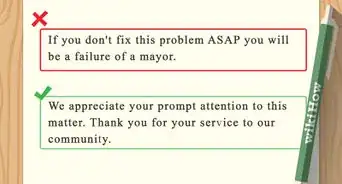
2Think about the appropriate tone to use; remember you are talking to an authority figure, and you are persuading him, not forcing him. Therefore, do not be aggressive, and stay polite!
-
3Think of valid and powerful arguments; talking about important things, and use strong arguments in order to convince him/her. Talking about irrelevant and weak arguments will ruin your letter.
-
4Prepare hard evidence and facts, in order to justify your arguments.


Method 2
Method 2 of 2:Layout:
Method 2
-
1Like any other Letter, you should state your address, his/her address, and the date.
- YOUR ADDRESS: Building #, Street Name, City/ State, Zip Code, Country. (on the top right)
- DATE: The date is under your address.
- HIS/HER ADDRESS: Building #, Street Name, City/ State, Zip Code, Country. (below the date, and on the left)
-
2Greetings:
- If the person you are addressing is known: "Dear Mr./ Mrs./ Miss Smith," (Title + Last name).
- If the person you are addressing is unknown: "Dear Sir/Madam,"
-
3Introduction:
- Your position.
- Reason for writing.
- Example: " I am a student at Harlem High School writing on behalf of all students concerning the discontinuation of the art, drama, and music programs in our school"
-
4Body: (consists of about 3 paragraphs)
- Paragraph 1: Argument 1, with justification.
- Paragraph 2: Argument 2, with justification.
- Paragraph 3: Counter Argument/ or suggestions and solutions.
-
5Conclusion: conclude what you previously said, and write closing remarks. Example: "I hope you find this option suitable", "I hope you take this matter into consideration", "Thank you for your time and effort", etc.
-
6Sign off:
- If the person you are addressing is Known: "Yours sincerely,"
- If the person you are addressing is Unknown: "Yours faithfully,"
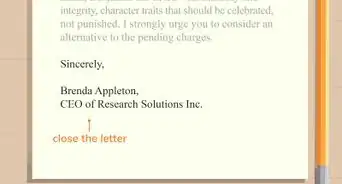
- Under it, write your full name and signature.


Warnings
- Do not be aggressive; let us not forget who we are talking to, and that you are trying to convince, not to refute or complain. DO NOT write for example: "I would like to refute this decision", or "I am writing to tell you that you should not cut our benefits as employees", or "I am writing to tell you that the decision you made was a poor one".Thanks!
- Avoid One Sentence Paragraph.Thanks!