This article was co-authored by Bryce Warwick, JD and by wikiHow staff writer, Janice Tieperman. Bryce Warwick is currently the President of Warwick Strategies, an organization based in the San Francisco Bay Area offering premium, personalized private tutoring for the GMAT, LSAT and GRE. Bryce has a JD from the George Washington University Law School.
There are 10 references cited in this article, which can be found at the bottom of the page.
This article has been viewed 18,123 times.
Tired of always being the last person to hand in your exam? Managing your time during a test can be incredibly tough, especially if you’re tackling a timed essay. Don’t worry. With some careful planning and practice, you can hit the ground running once your exam rolls around. We’ve put together some tips, tricks, and strategies to help you get started!
Steps
Method 1
Method 1 of 10:Review your course notes.
-
1Looking over your notes is the best way to stay prepared. Maybe your teacher has dropped a few hints about the upcoming exam, or maybe they’ve stayed silent. Regardless, re-reading your notes and textbook will help you feel calm and comfortable enough to tackle any essay prompt or test question that comes your way.[1]
- It’s always better to study too much than not enough. This way, you won’t be blindsided by any test questions!
- Create a study schedule for yourself before the test. In the days and weeks before your exam, spend 15-20 minutes going over your notes each day. This way, you can balance your studies without burning yourself out.[2]

Method 2
Method 2 of 10:Predict possible prompts.
-
1Ask your teacher for a copy of an old exam. How are the questions in this test constructed, and what do they focus on? While you’ll have different prompts on your own test, old exams can shed some light on how your teacher tends to structure their essay questions. The more prepared you are, the quicker you’ll be able to dive into your test.[3]
- For example, your teacher might write a lot of test questions about comparing and contrasting points.
- Or, your teacher might center their test questions around persuasive arguments.

Method 3
Method 3 of 10:Grab a ballpoint pen.
-
1Ballpoint pens dry quickly and are less likely to smudge. Gel pens are less ideal for timed essays, as the ink takes a little while to dry. Marker pens fall into a similar issue, as they tend to bleed through thin paper. To be safe, stick with a ballpoint pen when your exam date arrives.[4]
- Certain tests might ask you to use specific writing utensils, like a number 2 pencil. Always follow the test-taking company’s guidance so your exam can be graded accurately.

Method 4
Method 4 of 10:Practice writing under pressure.
-
1Writing a timed essay by hand can be a pain, especially if you’re out of practice. Before your exam date, grab a few sheets of lined paper, a pen, and a stopwatch. Then, pick out a sample essay question to answer. Give yourself the same amount of time that you’ll have during your exam, so you can get used to writing quickly. Practice makes perfect![5]
- Check online for a sample essay question or see if your teacher has any old tests you can take a look at.

Method 5
Method 5 of 10:Re-read the essay prompt.
-
1You might miss something during your first read-through. Double-check what the essay prompt is asking you before jumping into any outlining or writing. Is the prompt asking for an explanation, your opinion, or something else entirely? If you answer the question with the wrong focus, you’ll have to spend extra time backtracking and rewriting.[6]
- Look for keywords like describe, contrast, compare, illustrate, evaluate, state, trace, prove, critique, analyze, discuss, and argue, which are frequently used in essay prompts.[7]

Method 6
Method 6 of 10:Do a memory dump.
-
1Jot down all the valuable info you’ve memorized on a separate sheet of paper. Don’t make these notes exhaustive. Instead, just jot down basic tidbits and facts for easy reference as you go through your essay. Do your memory dump at the very beginning, so you can spend more time writing and less time recalling certain facts.[8]
- A memory dump might be especially helpful for a subject with a lot of specific names and dates, like history.

Method 7
Method 7 of 10:Outline your essay before you write.
-
1Outlining can save you time in the long run. Think of it this way—if you start writing without a plan in place, you’re bound to hit time-consuming roadblocks later on. Instead, take 10-20% of your total exam time to outline your essay first. This way, you’ll know exactly what to write as you go along.[9]
- For example, if you have 30 minutes to complete the essay, you could spend 7-8 minutes understanding the prompt and outlining.[10]

Method 8
Method 8 of 10:Allot a certain amount of time for each paragraph.
-
1Creating a test-taking schedule will help you finish on time. Review how much time you have to finish the written test. Then, divide your test-taking time into smaller chunks. Dedicate a certain amount of time to each paragraph, as well as outlining and proofreading. Even if you don’t follow these parameters exactly, having a rough schedule may help you stay on track.[11]
- If you have to write a 5-paragraph essay in an hour, you might spend 10 minutes outlining, 10 minutes writing each paragraph, and 10 minutes proofreading.

Method 9
Method 9 of 10:Steer clear of “fluff.”
-
1“Fluff” is a slang term for unnecessary filler. Always get straight to the point as you write; ultimately, writing fluff takes up valuable test-taking time, and won’t do you any favors in the long run. Stick with sharp, actionable sentences that help take your essay from point A to point B instead.[12]
- Filling your essay with fluff probably won’t do wonders for your final grade, either. Your teacher also wants you to get to the point!

Method 10
Method 10 of 10:Proofread after you finish writing.
-
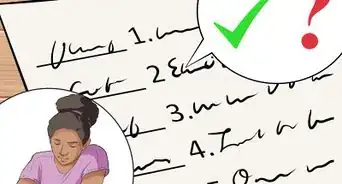
1Don’t edit and proofread while you write. While editing is important, editing as you write can be a huge time-sink. Instead, finish writing your draft out first. Once everything’s written down, feel free to nitpick and revise to your heart’s content.[13]

Community Q&A
-
QuestionWhat is the best way to study for the CBSE examination?
 Community AnswerDo as many worksheets from the CBSE website as you can. Make your own questions when you are learning a new chapter, then answer them at the end.
 -
QuestionWhat if I am a slow test taker and I already tried all of the above?
 Community AnswerDon't worry about other people. Take time on your test and make sure to fully understand everything. Take a deep breath and keep working. Don't look around or worry, just breathe and focus on your own test.
 -
QuestionI'm trying to study for the Food Protection Certificate exam. They only give me an hour and I'm used to getting that time extended because of my IEP. How do I write this test faster?
 Ashtyn FeltonCommunity AnswerThere is a method I love to use. I personally call it the "Meat" method. Basically, imagine your test as a steak. There are the fatty parts surrounding it, and the juicy center. Eat the center of the meat first, then cut down all the fat around it. This means, take out the hardest part of the exam first, then go through all the easy stuff second. That way, once you have the hardest part out of the way, you can get the easy stuff done without a problem.
 -
QuestionHow can I better time in a test?Community AnswerPractice is the only way. Get yourself used to the timings and how long you should spend on each question. If you have to write essays, then write on the question paper what time you need to finish writing the essay and what time you should have finished the writing in order to check your answers.
-
QuestionI'm studying for an examination that will grant me entry to an academically selective school if I pass. The tests are incredibly short, often allowing only 30 minutes to do 60 questions. Any tips?
 Community AnswerAttempt the questions with worth higher marks first, this will ensure you get most of the marks. After you complete these questions, move onto the easier ones. Use the marks each question is worth as a guideline of how much time to spend on it. If you do not know an answer to a question, move on. This will save time.
Warnings
- Stay away from the “kitchen sink” writing method. With the “kitchen sink” strategy, test-takers tend to jot down everything that comes to mind instead of relating their content back to the essay prompt.[17]Thanks!









References
- ↑ https://uwaterloo.ca/writing-and-communication-centre/blog/post/9-tips-ace-timed-essay
- ↑ https://learningcenter.unc.edu/tips-and-tools/studying-101-study-smarter-not-harder/
- ↑ https://depts.washington.edu/pswrite/essayex.html
- ↑ https://www.goodhousekeeping.com/life/g21565162/best-pens/
- ↑ https://uwaterloo.ca/writing-and-communication-centre/blog/post/9-tips-ace-timed-essay
- ↑ https://jerz.setonhill.edu/writing/academic1/timed-essays-top-5-tips-for-writing-academic-essays-under-pressure/
- ↑ https://accounts.smccd.edu/skyenglish/11TimedWriting.pdf
- ↑ https://depts.washington.edu/pswrite/essayex.html
- ↑ https://www.lib.sfu.ca/about/branches-depts/slc/learning/exam-types/essay-exams
- ↑ Bryce Warwick, JD. Academic Tutor. Expert Interview. 5 November 2019.
- ↑ https://uwaterloo.ca/writing-and-communication-centre/blog/post/9-tips-ace-timed-essay
- ↑ https://jerz.setonhill.edu/writing/academic1/timed-essays-top-5-tips-for-writing-academic-essays-under-pressure/
- ↑ https://uwaterloo.ca/writing-and-communication-centre/blog/post/9-tips-ace-timed-essay
- ↑ https://www.usu.edu/academic-support/files/TestTakingTips.pdf
- ↑ Bryce Warwick, JD. Academic Tutor. Expert Interview. 5 November 2019.
- ↑ https://learningcenter.unc.edu/tips-and-tools/tackling-test-anxiety/
- ↑ https://depts.washington.edu/pswrite/essayex.html
About This Article