This article was co-authored by Mark Co, DPM and by wikiHow staff writer, Sophia Latorre. Dr. Mark Co is a Podiatrist who runs his own private practice in San Francisco, California. Dr. Co specializes in treatments for bunions, ingrown toenails, toenail fungus, warts, plantar fasciitis and other causes of foot pain. He also offers custom orthotics for the treatment and prevention of foot and ankle issues. Dr. Co completed a Master of Business Administration (MBA) at New York University and an MA in Electrical Engineering and Computer Science at Johns Hopkins University. Dr. Co also completed his DPM at the California School of Podiatric Medicine and a residency and internship at the Kaiser Permanente Medical Center, Santa Clara, California. Dr. Co was awarded San Francisco's "Top 3 Podiatrists" in 2018, 2019, and 2020. Dr. Co is also a member of the CPMA (American Podiatric Medical Association).
There are 14 references cited in this article, which can be found at the bottom of the page.
This article has been viewed 5,166 times.
Ingrown toenails are really common, but that doesn’t make them any less of a pain—literally. Will an ingrown toenail heal itself? If not, how should you treat it? We’ve done the research for you and will answer these questions and more below. Keep reading to find out the best ingrown toenail treatments.
Steps
Question 1
Question 1 of 7:Will an ingrown toenail heal itself?
-
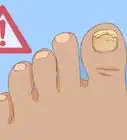
1It’s possible if your case is mild. If your toenail is red, a little swollen, and not infected, you may not need professional medical treatment.[1] You can try letting the nail grow out on its own.[2]
- What happens if you leave an ingrown toenail? It could get infected, so it's best to see a doctor unless your case is mild.[3]
- In the first, or mild, stage of an ingrown toenail, the surrounding skin is a little red and sore.[4]
- In the second, or moderate, stage, there is more swelling and you may notice pus or discharge.[5]
- In the third, or severe, stage, increased redness, pain, swelling, and discharge indicate an infection.[6]
Advertisement

Question 2
Question 2 of 7:How long does it take for an ingrown toenail to grow out?
-
1It could take about 2 weeks with self-care.[7] In healthy young adults, toenails grow an average of 1.62 mm per month. Unfortunately, toenails grow slower than fingernails. And, healthy nails might grow faster than those that are damaged or ingrown.[8]
- Most experts suggest seeking treatment for an ingrown toenail instead of trying to let it grow out on its own.

Question 3
Question 3 of 7:How do you get rid of an ingrown toenail at home?
-
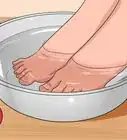
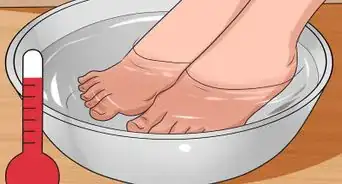
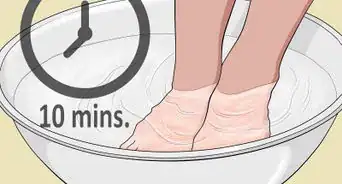
1Soak your foot in warm water. Soak your affected foot in warm water for 15-20 minutes 3-4 times per day.[9] This helps soften the skin and nail and reduces swelling and pain.[10]
-
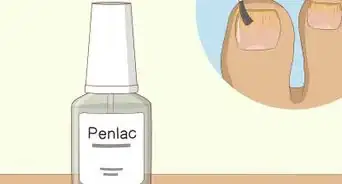
2Apply an antibiotic ointment if the problem worsens. If you notice increased redness or swelling, an antibiotic ointment may help prevent an infection. After soaking your toe, let it dry, then apply an over-the-counter antibiotic ointment to the problem area.[13] You can cover the toe with a bandage, as well.[14]
-
3Wear comfortable shoes that fit well. Shoes that are too tight or pinch your toes can cause ingrown toenails and make existing problems worse. If you’re dealing with an ingrown toenail, opt for sandals or other open-toed shoes if you can. If you need to wear close-toed shoes, pick a pair with enough room in the toe box for you to wiggle your toes.[15]
-
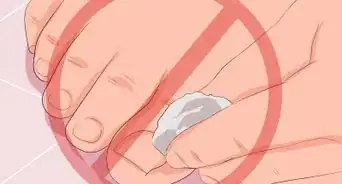
4Avoid putting cotton underneath the nail. Many websites suggest lifting up the corner of the nail and putting a piece of cotton underneath it to prevent the nail from digging into your skin. However, the American College of Foot and Ankle Surgeons advises against it. The cotton creates a perfect home for bacteria, which increases the likelihood that your ingrown toenail will get infected.[16]Advertisement


Question 4
Question 4 of 7:Should you dig out an ingrown toenail?
-
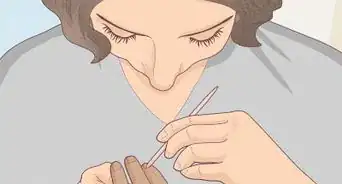
1No, you definitely shouldn't dig out an ingrown toenail. Cutting the nail itself or trying to remove the skin around it is likely to make the problem worse and can lead to an infection. Don't try to dig out the ingrown toenail at home.[17] If you need to cut your toenail, trim it carefully straight across.[18]

Question 5
Question 5 of 7:When should you go to the doctor for an ingrown toenail?
-
1
-
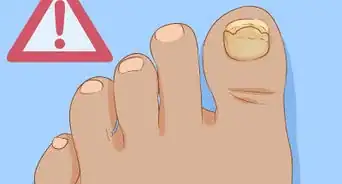
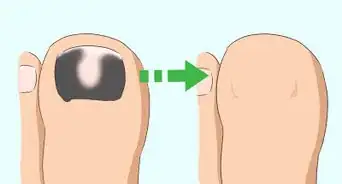
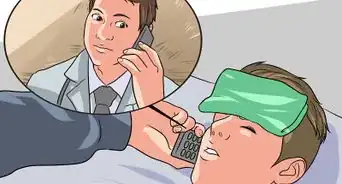
2Make a doctor’s appointment if your toenail is infected. It’s quite common for ingrown toenails to become infected, and an infection needs medical treatment. If your ingrown toenail is red, swollen, and painful and you notice pus or other discharge, visit a doctor so they can prescribe antibiotics to treat the infection.[21]
-
3Get medical treatment if you have diabetes or another health condition. Avoid trying to treat an ingrown toenail at home if you have poor blood circulation, nerve problems in your legs or feet, or diabetes. Instead, see your primary care provider or a podiatrist right away.[22]Advertisement


Question 6
Question 6 of 7:What will a podiatrist do for an ingrown toenail?
-
1Most often, a podiatrist will remove part of your toenail. There are a few different procedures available depending on the location and severity of the ingrown toenail. In general, a podiatrist will use local anesthetic to numb your toe before cutting away the infected or ingrown part of your toenail. They then apply a solution to the root of the nail to prevent the removed part of the toenail from growing back.[23]
- After the procedure, most doctors will recommend that you soak your foot in an Epsom salt bath twice a day. Use 1-3 tablespoons of Epsom salt per 1 liter of water.[24]
- Keep your nails and feet clean and dry and wear comfortable, roomy shoes.

Question 7
Question 7 of 7:Can ingrown toenails be prevented?
-
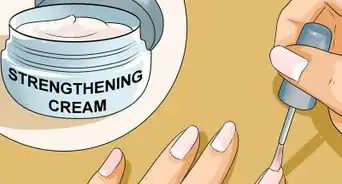
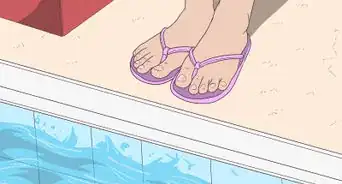
1In many cases, yes, ingrown toenails can be prevented. Some people may be more likely to get ingrown toenails because of their genetics.[25] However, there are steps you can take to reduce the likelihood of developing an ingrown toenail, including:Advertisement



References
- ↑ https://orthoinfo.aaos.org/en/diseases--conditions/ingrown-toenail
- ↑ https://health.clevelandclinic.org/how-you-can-prevent-and-treat-painful-ingrown-toenails/
- ↑ https://www.nhsinform.scot/illnesses-and-conditions/skin-hair-and-nails/ingrown-toenail
- ↑ https://bpac.org.nz/BPJ/2014/December/docs/BPJ65-ingrown-toenails.pdf
- ↑ https://bpac.org.nz/BPJ/2014/December/docs/BPJ65-ingrown-toenails.pdf
- ↑ https://bpac.org.nz/BPJ/2014/December/docs/BPJ65-ingrown-toenails.pdf
- ↑ https://www.seattlechildrens.org/conditions/a-z/toenail-ingrown/
- ↑ https://www.researchgate.net/publication/26802467_Growth_rate_of_human_fingernails_and_toenails_in_healthy_American_young_adults
- ↑ Mark Co, DPM. Podiatrist. Expert Interview. 21 April 2020.
- ↑ https://www.mayoclinic.org/diseases-conditions/ingrown-toenails/diagnosis-treatment/drc-20355908
- ↑ https://health.clevelandclinic.org/how-you-can-prevent-and-treat-painful-ingrown-toenails/
- ↑ https://www.health.harvard.edu/newsletter_article/foot-health-what-to-do-about-an-ingrown-toenail
- ↑ https://www.aafp.org/afp/2002/0615/p2557.html
- ↑ https://health.clevelandclinic.org/how-you-can-prevent-and-treat-painful-ingrown-toenails/
- ↑ https://bpac.org.nz/BPJ/2014/December/docs/BPJ65-ingrown-toenails.pdf
- ↑ https://www.foothealthfacts.org/conditions/ingrown-toenail
- ↑ https://www.aad.org/public/parents-kids/healthy-habits/parents/kids/ingrown-nails
- ↑ Mark Co, DPM. Podiatrist. Expert Interview. 21 April 2020.
- ↑ Mark Co, DPM. Podiatrist. Expert Interview. 21 April 2020.
- ↑ https://orthoinfo.aaos.org/en/diseases--conditions/ingrown-toenail
- ↑ https://bpac.org.nz/BPJ/2014/December/docs/BPJ65-ingrown-toenails.pdf
- ↑ https://medlineplus.gov/ency/article/001237.htm
- ↑ https://bpac.org.nz/BPJ/2014/December/docs/BPJ65-ingrown-toenails.pdf
- ↑ Mark Co, DPM. Podiatrist. Expert Interview. 21 April 2020.
- ↑ https://bpac.org.nz/BPJ/2014/December/docs/BPJ65-ingrown-toenails.pdf
- ↑ https://www.footcaremd.org/conditions-treatments/toes/ingrown-toenail
- ↑ https://health.clevelandclinic.org/how-you-can-prevent-and-treat-painful-ingrown-toenails/
- ↑ https://health.clevelandclinic.org/how-you-can-prevent-and-treat-painful-ingrown-toenails/
- ↑ https://medlineplus.gov/ency/article/001237.htm
About This Article