This article was co-authored by Monique Capanelli and by wikiHow staff writer, Hannah Madden. Monique Capanelli is a Plant Specialist and the Owner and Designer for Articulture Designs, an innovative design firm and boutique in Austin, Texas. With over 15 years of experience, Monique specializes in interior botanical design, living walls, event decor, and sustainable landscape design. She attended the University of Texas at Austin. Monique is a Certified Permaculture Designer. She provides plant and botanical design experiences, from small gifts to entire transformations, to shoppers as well as commercial clients including Whole Foods Market and The Four Seasons.
There are 11 references cited in this article, which can be found at the bottom of the page.
This article has been viewed 3,422 times.
Delicious, juicy tomatoes are always a treat to have fresh from the garden. But when your tomato leaves start turning yellow, you might wonder if all is lost. Although there are multiple reasons why your tomato plants might be turning yellow, the good news is that they can usually be fixed if you catch them early enough. Keep reading to learn why your tomato plant has yellow leaves and what you can do about it.
Steps
Question 1
Question 1 of 8:What nutrient deficiency causes yellow leaves?
-
1Usually, yellow leaves indicate nitrogen deficiency. You might notice that your tomato leaves turn pale yellow, and your plant could be stunted or even wilting. If your tomato plant doesn’t have enough nitrogen, try adding compost or manure to the soil. In a few weeks, your tomato plant should look green and healthy again.[1]
-
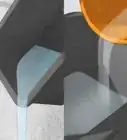
2Yellow leaves can also indicate potassium deficiency. While nitrogen deficiency is generally visible in your entire plant, potassium deficiency makes the leaf margins, or the edges, look bright yellow.[2] To add more potassium to your soil, use a commercial fertilizer or compost.Advertisement


Question 2
Question 2 of 8:Which diseases and disorders can cause yellow leaves?
-
1Leaf mold can cause yellow-ish or pale green spots. Leaf mold is caused by a fungus, and it’s common on the lower leaves that touch the soil. You might notice that some of the leaves have round, pale-green or yellow spots that get bigger over time. If you think you’re dealing with leaf mold, try pruning off the affected leaves and applying an antifungal spray to your garden.[3]
- To start using an antifungal, head to your local garden supply store and pick up a liquid antifungal spray. Read the dilution instructions on the back of the bottle, then mix the antifungal with water in a spray bottle. Spritz your entire tomato plant with your antifungal mixture for 5 to 7 days, or however long your antifungal spray specifies.
-
2Septoria leaf spot can cause round yellow spots. Usually, septoria leaf spot occurs on the lower leaves after the plant starts fruiting. The leaves might look yellow-ish with tan or brown spots all over. If you are dealing with septoria leaf spot, trim off the infected leaves and then disinfect your tools. Apply an antifungal to the soil to avoid any further spread.[4]
-
3Bacterial spot can infect green tomatoes. On tomatoes, bacterial spot causes leaves to turn yellow and dry out. They might also tear and rot while still on the plant. If you’re dealing with bacterial spot, trim the infected leaves off and keep your tomatoes pruned back to promote air flow. You can also treat them with an antifungal.[5]Advertisement


Question 3
Question 3 of 8:Should I remove yellow leaves on my tomato plants?
-
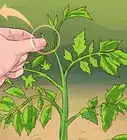
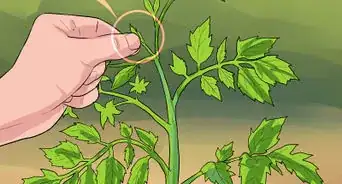
1Yes, because yellow leaves can be a drain on your plant. No matter what is causing the yellow leaves on your tomato plant, it’s a good idea to prune them off so they don’t take away any energy from the rest of the plant.[6] Use sharp pruners, and clip the leaves as close to the base of the plant as you can. If you know that the yellow leaves are infected with fungus or mold, throw them away in the regular trash, not your compost.[7]
- Bacteria and fungus can still spread from a dead leaf, which is why you want to get them out of your garden as soon as possible.

Question 4
Question 4 of 8:Can you save a tomato plant with yellow leaves?
-
1Yes, especially if you catch the issue early. Yellow leaves aren’t a death sentence for your tomato plant, and you can still get tons of delicious fruit from it. If you notice yellow leaves, prune them off right away and try to figure out the cause. Then, take steps to prevent the leaves from turning yellow again.
- If you leave the yellow leaves on your plant for too long, the problems could spread to the rest of the plant, especially if you’re dealing with fungus or mold. If that’s the case, you may have to pull up the entire plant.[8]
Advertisement

Question 5
Question 5 of 8:Do yellow leaves ever turn green again?
-
1No, they usually don’t. Yellow leaves are usually too far gone to be saved, which is why experts recommend pruning them off. New leaves will grow in their place, and hopefully, they will be healthy and green.[9]

Question 6
Question 6 of 8:How do you know if you are overwatering tomatoes?
-
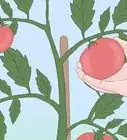
1The fruit might crack. If you notice that your tomatoes have large, brown cracks in them, it could be due to inconsistent watering. Both too much water and too little water can cause cracks like these, so try to keep your tomatoes on a more consistent schedule.[10]
-
2Your tomatoes might develop blossom end rot. Blossom end rot happens when the bottom of the tomato turns brown and starts to rot. This is also due to an inconsistent watering schedule, so it can happen when there’s too much water or not enough.[11]Advertisement


Question 7
Question 7 of 8:How do you know if you are underwatering tomatoes?
-
1The plant might turn yellow from the top down. Unlike mold and fungus issues, tomato plants will start turning yellow from the top if they aren’t getting enough water. They also might look wilted or a little droopy, especially if they’ve been without water for a few days.[12]
- If your tomatoes aren’t getting enough water, consider setting up a drip irrigation system for a steady water flow all day.

Question 8
Question 8 of 8:Can tomato plants get too much sun?
-
1Yes, especially when they are young. If your tomato plants develop tan spots on their leaves, they might be getting burned by the hot rays of the sun. If this happens to your plant, cover the area with a sun shade for a few weeks to let the plant grow bigger, thicker leaves (often called sun leaves). Once your plant has enough new growth to protect itself from the sun, you can remove the sun shade.[13]Advertisement

Warnings
- Although Epsom salt is sometimes recommended as a natural antifungal, experts warn that this is a common myth. Applying Epsom salt to your plants probably won’t kill the fungus, and it can actually accumulate in the soil and make your plants grow slower than usual.[14]Thanks!
References
- ↑ https://extension.msstate.edu/sites/default/files/publications/publications/p2975_web.pdf
- ↑ https://extension.msstate.edu/sites/default/files/publications/publications/p2975_web.pdf
- ↑ https://hgic.clemson.edu/factsheet/tomato-diseases-disorders/
- ↑ http://www.missouribotanicalgarden.org/Portals/0/Gardening/Gardening%20Help/Visual%20Guides/Tomato%20Foliage%20Problems.pdf
- ↑ https://hgic.clemson.edu/factsheet/tomato-diseases-disorders/
- ↑ Monique Capanelli. Plant Specialist. Expert Interview. 22 September 2020.
- ↑ https://lancaster.unl.edu/hort/articles/2002/tomatowilt.shtml
- ↑ https://www.canr.msu.edu/news/septoria_leaf_spot_on_tomatoes_preventing_spots_before_your_eyes
- ↑ https://www.canr.msu.edu/resources/michigan_fresh_tomato_diseases_in_the_home_garden
- ↑ https://extension.msstate.edu/sites/default/files/publications/publications/p2975_web.pdf
- ↑ https://hortnews.extension.iastate.edu/blossom-end-rot
- ↑ https://newswire.caes.uga.edu/story/3748/Drowning-plants.html
- ↑ https://www.canr.msu.edu/news/tomato_transplants_experiencing_problems
- ↑ http://www.uvm.edu/pss/ppp/articles/myths.html
About This Article