X
This article was co-authored by wikiHow staff writer, Jessica Gibson. Jessica Gibson is a Writer and Editor who's been with wikiHow since 2014. After completing a year of art studies at the Emily Carr University in Vancouver, she graduated from Columbia College with a BA in History. Jessica also completed an MA in History from The University of Oregon in 2013.
Learn more...
African violets are one of the most popular houseplants for a reason. They don't take up a lot of space and they make colorful blooms year-round. You may have heard that African violets are tricky to grow, but as long as they get plenty of indirect sunlight they'll thrive. Read through our answers to find out if your plant is getting the light it needs.
Steps
Question 1
Question 1 of 7:What's the best place to put the plant?
Question 1
-
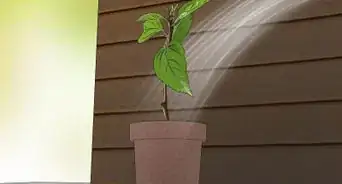
1A window that gets lots of indirect sunlight. Usually, this means a southeast- or west-facing window if you live in the Northern hemisphere. Try to put the plant about 3 feet (0.91 m) away from the window so it doesn't get direct light.[1]
- Don't have a southeast- or west-facing window? No problem! You could put your plant in a north-, northwest-, or northeast-facing window. Just put the plant closer to the window and ensure that it gets a light for a longer period of time.
- Plan on moving your plants throughout the year. In the winter, put them in a south- or west-facing window if you're in the Northern hemisphere, or in a north- or east-facing window if you're in the Southern hemisphere.
Advertisement

Question 2
Question 2 of 7:How much sunlight do African violets need?
Question 2
-
1Aim for at least 8 hours of indirect light every day. African violets thrive with enough sunlight and they can handle up to 16 hours of light a day! Since this much sunlight isn't possible for a lot of regions, aim for giving your plant at least 8 hours. You can always supplement with artificial lighting to reach this amount.[2]
- Not sure if your plant is getting the right amount of light? Your African violets should have big, dark green leaves with lots of flower buds.

Question 3
Question 3 of 7:Can African violets handle morning sun?
Question 3
-
1Yes—as long as it's indirect light. This just means you don't want your plant to be directly in front of a window with bright morning light. Instead, place it about 3 feet (0.91 m) away or hang a curtain to diffuse some of the light.[3]
- African violets do great with 2 to 4 hours of morning or afternoon sunlight, in addition to the rest of the light they get throughout the day.
Advertisement

Question 4
Question 4 of 7:Do I need to move my plant throughout the day?
Question 4
-
1You don't need to during the day but rotate the plant once a week. If you never move or turn your plant and it's sitting near a window, it can grow lopsided since one side gets more sunlight. To help it grow symmetrically, rotate the plant a quarter turn once a week.[4]
- Always rotate the plant in the same direction so you don't forget which way you rotated it last.

Question 5
Question 5 of 7:How do I know if my African violets are getting too much sun?
Question 5
-
1The leaves will turn yellow and might look burned. Sometimes, they look reddish-yellow or the leaves might look faded. If you look closely, the edges may look crispy, burned, or bleached. These are all signs that your plant is stressed because it's getting too much sunlight.[5]
- To fix this, you could try moving the plant to a window that gets less light or hang a sheer curtain in the window to diffuse the sunlight so not as much reaches your plant.
Advertisement

Question 6
Question 6 of 7:What happens if my plant doesn't get enough sunlight?
Question 6
-
1The leaves will grow, but your plant won't flower. Some people don't mind if their African violets don't flower, but the bright blooms are the main attraction for a lot of people. If your healthy plant isn't blooming, it's a sign that you need to move it to a sunnier spot or supplement it with artificial lighting.[6]
- For example, if it's wintertime and your plant's only getting around 6 hours of sunlight, place a fluorescent or LED grow light over it for an extra 2 hours.

Question 7
Question 7 of 7:How do I supplement with artificial light?
Question 7
-
1Place a fluorescent or LED grow light 12 to 15 in (30 to 38 cm) above the plant. You can hang them from the underside of a shelf that's over your African violets. Choose a 20- to 40-watt bulb and leave it on for 14 to 16 hours assuming that your plant gets only a few hours of natural sunlight.[7]
- If your plant gets some natural sunlight, play around with adding a few hours of artificial light every day to see how your plant responds. For instance, if your African violets get 3 or 4 hours of sunlight, start by supplementing with 6 or 7 hours of artificial light. Watch its leaves to decide if it needs more or less artificial light.
- Unfortunately, standard incandescent lightbulbs aren't great light sources for African violets and they put out too much heat.
Advertisement












References
- ↑ https://edis.ifas.ufl.edu/publication/MG028
- ↑ https://edis.ifas.ufl.edu/publication/MG028
- ↑ https://www.tagawagardens.com/documents/African_Violets_2015.pdf
- ↑ https://www.optimara.com/doctoroptimara/diagnosis/sunlight-unevenexposure.html
- ↑ https://extension.uga.edu/publications/detail.html?number=C660&title=Growing%20African%20Violets
- ↑ https://www.tagawagardens.com/documents/African_Violets_2015.pdf
- ↑ https://extension.uga.edu/publications/detail.html?number=C660&title=Growing%20African%20Violets
About This Article

Jessica Gibson
wikiHow Staff Writer
This article was co-authored by wikiHow staff writer, Jessica Gibson. Jessica Gibson is a Writer and Editor who's been with wikiHow since 2014. After completing a year of art studies at the Emily Carr University in Vancouver, she graduated from Columbia College with a BA in History. Jessica also completed an MA in History from The University of Oregon in 2013.
How helpful is this?
Co-authors: 3
Updated: July 27, 2021
Views: 253
Categories: Growing Flowers
Advertisement