This article was co-authored by wikiHow staff writer, Hunter Rising. Hunter Rising is a wikiHow Staff Writer based in Los Angeles. He has more than three years of experience writing for and working with wikiHow. Hunter holds a BFA in Entertainment Design from the University of Wisconsin - Stout and a Minor in English Writing.
There are 10 references cited in this article, which can be found at the bottom of the page.
Learn more...
If you want to grow a ton of fresh veggies in your garden, you'll want to do everything you can to get the most out of your harvest. Fertilizers provide your vegetables with all the nutrients they need to grow, but we know it can be a little confusing seeing all the options you can choose from. Luckily, we're here to help you choose the perfect fertilizer for your garden. We've answered some of your most common questions so you can have happy, healthy plants all season long!
Steps
Question 1
Question 1 of 8:What should you fertilize vegetables with?
-
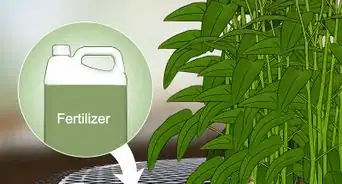
1Fertilizer with nitrogen, phosphorus, and potassium usually works best. These are the most important nutrients your vegetables need to grow. Look for packaged fertilizer labeled with “NPK” to ensure it has all three. Choose a fertilizer that has “10-10-10” or “5-10-5” on the label so you have an even balance for each nutrient.[1]
- A 10-10-10 fertilizer works perfectly for growing tomatoes, which require an even balance of all the nutrients.
- The numbers refer to the percent of nutrients in your fertilizer. For example, a 10-10-10 fertilizer is 10% nitrogen, 10% phosphorus, and 10% potassium. The remaining 70% is made up of filler material so the nutrients can easily spread out.
- Many garden stores sell pre-fertilized soil mixes specifically made for vegetables so you don’t have to mix it in yourself.
Advertisement

Question 2
Question 2 of 8:How do you know what nutrients your soil needs?
-
1Run a soil test to see which nutrients you should add. If you’re planting in the ground, your soil can have a lot of imbalances that make it tougher to grow vegetables. You can either buy a home test from your local garden store or send a sample to your local cooperative extension office to get a breakdown of what your soil already has and what nutrients it still needs.[2]
- For example, if you have high nitrogen levels in your soil, then you can get fertilizer that doesn’t contain any nitrogen.
- Many experts recommend checking your soil every 2 years to see how the nutrient levels have changed.
-
2Check the nutrient requirements for your veggies to see what they need. Even though a balanced manure generally works, some vegetables might have other growing requirements. Always check the labels on the plants and look at their preferred soil conditions so you’re able to add the right nutrients.[3]
- For example, beans and peas don’t need as much nitrogen since they produce their own and too much could delay flowering.
Advertisement


Question 3
Question 3 of 8:What organic fertilizer works best for vegetables?
-
1Wood ash adds more potassium and raises the pH of your soil. Wood ash comes from burnt pieces of wood, and you can buy it from your local garden store. If your soil is potassium-deficient after running a soil test, spread 1–1 1⁄2 pounds (0.45–0.68 kg) of wood ash for every 100 square feet (9.3 m2) of soil. Mix it into the soil thoroughly so it doesn’t pile up in one area.[4]
- Wood ash contains salt, so using too much could cause damage to your plants.
-
2Manure enriches soil with nitrogen and improves texture. You can use horse, cow, chicken, or sheep manure in your garden. Look for composted manure at your local garden store since it won’t contain any harmful bacteria that could contaminate your plants. [5] Work the manure into the top 2–3 inches (5.1–7.6 cm) of soil in the fall before planting so it’s the most effective.[6]
- Avoid using fresh manure in your garden since it contains bacteria that could make you sick.
- Manure doesn’t have consistent levels of nitrogen, so you may need to use it along with other fertilizers to get all the nutrients you need.
Advertisement


Question 4
Question 4 of 8:Is fertilizer necessary for a vegetable garden?
-
1Yes, your soil doesn’t have enough nutrients on its own. Vegetables need consistent levels of nutrients throughout the growing season, or else you’ll have a small harvest. When you’re planning a veggie garden, always check the nutrients your plants need so you can get the proper fertilizer to support them.[7]
- Even if you already have nutritious soil, you’ll probably need to apply fertilizer at some point in the growing season as your vegetables absorb more nutrients.

Question 5
Question 5 of 8:Should I fertilize my garden before planting vegetables?
-
1Yes, mix the fertilizer into the soil in the spring before your plants. Follow the directions on the fertilizer packaging when you’re applying the fertilizer so you don’t use too much. Typically, you’ll need around 3 1⁄2 pounds (1.6 kg) of 10-10-10 fertilizer for 100 square feet (9.3 m2) of soil. Spread the fertilizer evenly and mix it in really well with a shovel or spade. Don’t forget to water the soil afterward to help it absorb all of the nutrients.[8]Advertisement

Question 6
Question 6 of 8:How often should you fertilize your garden?
-
1Add fertilizer after 3–4 weeks to support veggies through the season. As your vegetables grow, they sap nutrients out from the soil and they’ll need more. After about 3–4 weeks, check if your plants are still green and growing well. If they’re struggling, side-dress your vegetables with some extra fertilizer. Spread the fertilizer 2–3 inches (5.1–7.6 cm) to the side of your plant row so it reaches your vegetables’ roots.[9]
- If you have clay soil, then you can wait up to 6 weeks before applying more fertilizer.

Question 7
Question 7 of 8:How should I fertilize vegetables growing in containers?
-
1Mix a time-release fertilizer in the soil so you’re set for the whole season. Vegetables need nutrients through the entire growing season, and regular fertilizers might get sapped up quickly. A time-release fertilizer takes a few months to break down completely so it lasts for longer. Follow the package directions for mixing and applying the fertilizer with your soil.[10]
- Time-release fertilizers are activated by the temperature. If temperatures are consistently above 85 °F (29 °C), then the fertilizer may only last for 2 months instead of 5.
-
2Give your veggies water-soluble fertilizers when they look weak. Start by dissolving 2 cups (453 g) of a complete 10-20-10 fertilizer in 1 gallon (3.8 L) of warm water to make a concentrated solution. Mix 2 tablespoons (30 ml) of your solution with 1 gallon (3.8 L) of water to make a nutrient blend. When you water your plants, use this nutrient solution to keep your plants happy and healthy.[11]
- Once a week, pour regular tap water into the soil to leach out the unused fertilizer. That way, it will flush out any excess chemicals that could damage your vegetables.
Advertisement


Question 8
Question 8 of 8:How else do I improve the soil in my vegetable garden?
-
1Mix in organic matter to improve drainage. Organic matter includes compost, manure, peat moss, or composted sawdust. While these don’t really add nutrients to the soil, they let water easily drain through the soil so the vegetable roots are less likely to become waterlogged and drown. Aim to have an even ratio of organic matter and soil in your garden.[12]
-
2Amend the soil until it has a pH between 5.8–6.5. Vegetables prefer soil that’s not too alkaline or acidic. Run a soil test to find out the current pH of your soil. If you need to raise the pH, try adding lime or wood ash to the soil. If you need to bring the pH down a few steps, mix some aluminum sulfate or sulfur into your garden. Keep testing and amending the soil until it’s within the range.[13]
- The pH of your soil affects how well your vegetables can absorb nutrients.
Advertisement


Warnings
- Too much fertilizer can damage your plants or prevent them from producing healthy vegetables.[14]Thanks!
References
- ↑ https://extension.colostate.edu/topic-areas/yard-garden/fertilizing-the-vegetable-garden-7-611/
- ↑ https://aggie-horticulture.tamu.edu/vegetable/guides/texas-vegetable-growers-handbook/chapter-iii-soils-fertilizers/
- ↑ https://extension.umd.edu/resource/fertilizing-vegetables
- ↑ https://catalog.extension.oregonstate.edu/sites/catalog/files/project/pdf/ec1503.pdf
- ↑ https://aggie-horticulture.tamu.edu/vegetable/guides/texas-vegetable-growers-handbook/chapter-iii-soils-fertilizers/
- ↑ https://catalog.extension.oregonstate.edu/sites/catalog/files/project/pdf/ec1503.pdf
- ↑ https://extension.psu.edu/general-recommendations-for-growing-vegetables-in-containers
- ↑ https://catalog.extension.oregonstate.edu/sites/catalog/files/project/pdf/ec1503.pdf
- ↑ https://gardeningsolutions.ifas.ufl.edu/care/fertilizer/applying-fertilizer-to-vegetables.html
- ↑ https://extension.psu.edu/general-recommendations-for-growing-vegetables-in-containers
- ↑ https://agrilifeextension.tamu.edu/library/gardening/vegetable-gardening-in-containers/
- ↑ https://extension.psu.edu/soil-management-in-home-gardens-and-landscapes
- ↑ https://hgic.clemson.edu/factsheet/changing-the-ph-of-your-soil/
- ↑ https://content.ces.ncsu.edu/home-vegetable-gardening-a-quick-reference-guide
About This Article