X
wikiHow is a “wiki,” similar to Wikipedia, which means that many of our articles are co-written by multiple authors. To create this article, volunteer authors worked to edit and improve it over time.
This article has been viewed 91,276 times.
Learn more...
How to clutch on a dirt bike.
Steps
-
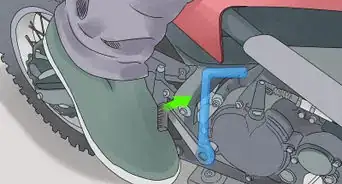
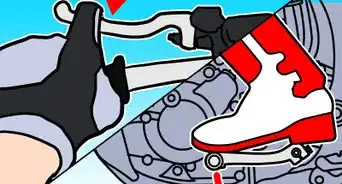
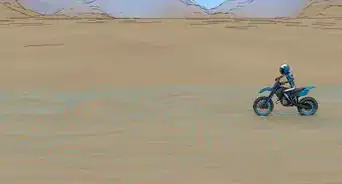
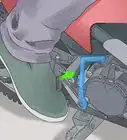
1Take off: Start the bike, compress the clutch and then push the shift lever downwards ( most bikes shift pattern is Down for first, and up for the following gears )[1]
-
2Once the bike is in gear, very slowly let the clutch out while applying throttle at an equal rate. This is often the hardest part for beginners. If the engine RPM suddenly drops, that either means you are not giving enough throttle, or you are releasing the clutch too rapidly, or perhaps both. Once in first gear and moving, shifting to the next gears is much easier.[2]
-
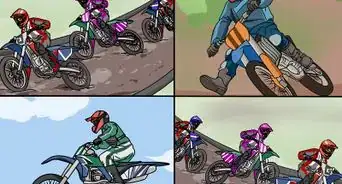
3To shift to second, pull in the clutch lever, at the same time release the throttle. Doing so in sync will keep the engine RPM from spiking. Lift the shifter lever until there is a firm click into the next gear.[3]
-
4Once in the next gear, let off the clutch and apply throttle, in sync with the clutching. You may then accelerate and shift into the next gear using the same process.
-
5To shift down, ease off the throttle until your speed is roughly equal to the higher end speed of the lower gear.[4]
-
6Compress the clutch while letting off the throttle, shift down, then let the clutch out while applying little throttle. You will be in the top end of the gear most likely, and applying too much throttle will cause your RPM to spike.
-
7Hit neutral: In a bike with a shift pattern that is Down, Up, Up, you will need to get to first gear, and then raise the shift lever halfway between first and second. This is often hard to do for beginners. An easy way to hit neutral on most bikes is to shift to neutral while still moving.[5]


Community Q&A
-
QuestionCan I use the brakes without holding the clutch?
 Community AnswerYes, but when you start to slow down, rapidly lay off the gas and pull in the clutch to avoid stalling.
 -
QuestionDo I use the clutch while turning a bike?
 Community AnswerYou should pull in your clutch and shift to a lower gear, and make the turn while slowly accelerating.
 -
QuestionDo I use the clutch while driving?
 Community AnswerNever use the clutch while driving. Doing so will damage the clutch and decrease the life of the engine.
 -
QuestionHow can I keep my balance while riding in heavy traffic with frequent stops?Community AnswerTry putting the tips of your toes on the ground when stopping or just stop riding.
-
QuestionHow do I ride a clutch?Community AnswerThis is something you should never do. It does your clutch no favors. A clutch should be completely engaged only at start off or while changing gears.
-
QuestionCan I pull on the clutch to stop my bike in traffic and then gently release the clutch to move again?Community AnswerNo. Use your brake. The clutch is used for shifting, not stopping. The clutch can wear if you don’t use it correctly.
-
QuestionWhy does my bike stop when I release the clutch while riding?
 Community AnswerIt could be that you are dumping the clutch. When the clutch comes in contact with the engagement mechanism it puts too much strain on the engine and it dies. Let off the clutch easy and apply equal throttle, you should be doing it in one fluid motion.
 -
QuestionCan I use the brakes without holding the clutch in when turning, and should I pull the clutch again to speed up?Community AnswerYou can use the brakes without the clutch, the clutch is only needed in starting off and completely stopping without stalling the bike.
-
QuestionWill the bike run if the clutch is continuously pressed?Community AnswerYes, but don't always keep on pressing the clutch, as this can cause stalling or even stopping.
-
QuestionDo I need to use the clutch during turning and when braking?Community AnswerUse the clutch at the end of the brake sequence to keep the bike running. It is a necessity if you want to make fast turns.
Warnings
- DO NOT WEAR OPEN TOED SHOESThanks!
- Make sure you have a helmet and proper gear ( gloves, boots, etc. )Thanks!
- If you are new to dirt biking, start in an open area with few or no objects that may be hit.Thanks!
- Take care when using a bike larger than you are. You could be thrown off, or may lose control. Some bikes are much heavier than they look, and can cause severe injury if they land on you,Thanks!
Things You'll Need
- Dirt bike ( preferably of small displacement if you a beginner )
- Helmet
- Open area to practice
- Optional, but recommended: Somebody to watch and help you in case you fall off or injure yourself.