This article was co-authored by wikiHow staff writer, Hannah Madden. Hannah Madden is a writer, editor, and artist currently living in Portland, Oregon. In 2018, she graduated from Portland State University with a B.S. in Environmental Studies. Hannah enjoys writing articles about conservation, sustainability, and eco-friendly products. When she isn’t writing, you can find Hannah working on hand embroidery projects and listening to music.
There are 9 references cited in this article, which can be found at the bottom of the page.
wikiHow marks an article as reader-approved once it receives enough positive feedback. In this case, 89% of readers who voted found the article helpful, earning it our reader-approved status.
This article has been viewed 80,436 times.
Learn more...
Writing in a diary is a great way to process your thoughts and feelings. No matter how old you are, what stage of life you’re in, or what your future plans are, a diary can help you keep track of your goals and your daily life. If you’ve never written in a diary before, starting one can seem a bit intimidating—but don’t let that stop you! Once you get started, the words will start flowing easily.
Steps
Method 1
Method 1 of 12:Try to write every day.
-
1Set aside a few minutes for writing every day. If you’re super busy, even just 10 minutes will help you get into the habit. You can set a timer on your phone and write continuously until it goes off to make sure you fill out the page. Try writing first thing in the morning, before you go to bed, or on your lunch break.[1]
- Write to pass the time when you're riding in a car or on a bus.These trips are a good opportunity to jot down your thoughts and ideas.
Advertisement

Method 2
Method 2 of 12:Write down major life events.
-
1Keep the details fresh so you can look back at them. If you got an award, graduated from high school, got a new job, or moved into a new home, write about it! You’ll be able to look back on your experiences and remember how good you felt during them.[2]
- You might also write about getting a new sibling, making a new friend, moving to a new school, or getting a new pet.
- Think of your diary as a gift to your future self. What would you like to read in the future as a reminder of your life?

Method 3
Method 3 of 12:Jot down things about ordinary days.
-
1Not every day has to be extraordinary. If you want to use your diary every day, make it a point to write down things about the normal days, too. Even if you just went to school or hung out with a friend, it might be a nice memory to look back on some day.[3]
- Things like having a picnic in the park or taking your dog on a walk can be fun to write about, too.
- What seems ordinary today could very likely seem extraordinary to you in the future. Nothing you write in your diary is boring.
Advertisement

Method 4
Method 4 of 12:Work through your emotions.
-
1Your diary can help you in times of stress and sadness. If you’re having a bad day, if you got in a fight with someone, or if you just feel super down, write about it in your diary. It can help you process what you’re feeling and why, exactly, you’re feeling it.[4]
- A diary can be really useful when you’re angry, too. Getting your thoughts down on paper before talking to someone you’re mad at is a great way to express your emotions without saying anything you might regret.

Method 5
Method 5 of 12:Collect photos and keepsakes.
-
1Use glue or tape to keep momentos in your diary. You can write text to go with the items if you want, but it’s not a necessity. Include ticket stubs, snapshots of your friends, pressed flowers, and found objects.[5]
- You can get even more creative and arrange these items into an artistic collage.
- Don’t be afraid to get super creative with it. If you feel like rubbing dirt into your diary one day, do it! This is your space to use as you’d like to.
Advertisement

Method 6
Method 6 of 12:Keep track of your dreams.
-
1Look back on all the crazy things you dream about. Keep your diary close to your bed and use it to record your dreams every morning. Try to write down the details of your dreams as soon as you wake up, since they can be incredibly fleeting.[6]
- You can keep a separate diary just for dreams, or you can enter them into your regular diary.
- If you enter them into your every-day diary, it might be helpful to write them down in a different color of ink, just to keep them entirely separate from other entries.

Method 7
Method 7 of 12:Practice drawing or art.
-
1Use your diary as a creative space to express yourself. Feel free to write poetry, put down song lyrics, and record quotes from others that are meaningful to you. Some people express themselves best through art, and that is a completely valid way to use your diary, too.[7]
- Experiment with drawing, painting, collecting found objects and creating collages in your diary, especially if you find that the words aren’t flowing.
Advertisement

Method 8
Method 8 of 12:Write down your goals.
-
1Put your goals into words to make them more concrete. You can jot down goals both big and small, long-term and short-term. Describe them clearly and make them actionable so they’re easy to follow in the future.[8]
- You could write down goals like: “Work out for 30 minutes 4 days per week,” “Eat a healthy breakfast every morning,” “Practice drawing for 10 minutes every day.”

Method 9
Method 9 of 12:Create to-do lists.
-
1Keep track of everything you need to do, either daily or weekly. You can make daily lists of simple things you need to get done, or you can create to-do lists for more long-term goals. Whether you’re trying to accomplish a certain goal, solve a particular problem or simply plan out your day, they are all much easier to tackle once you’ve broken them down into smaller tasks.[9]
- You can also use your diary to set a schedule for yourself.
Advertisement

Method 10
Method 10 of 12:Track your successes.
-
1When you achieve a goal, write it down! Sometimes it feels like you’re spinning your wheels when it comes to getting something accomplished, especially if it’s something big. Your diary is a written account of what you’ve done along the way and functions as an excellent log of your progress.[10]
- Progress can be hard to measure objectively and sometimes it's easy to forget successes you’ve already had.

Method 11
Method 11 of 12:Look back on older entries.
-
1As time goes by, your perspective might shift and change. It can be fun to have a look at older entries from months or years past. Try going back every now and then to see how far you’ve come since you first started your diary.[11]
- This is a fun way to go down memory lane, too!
Advertisement

Method 12
Method 12 of 12:Keep your diary private.
-
1It will help you stay honest and true when you write in it. Put it somewhere that your parents or siblings can’t find it: a closet, a drawer, or under the bed. If you know that you’re the only one reading your entries, you’ll be much more likely to use your diary all the time.[12]
- If you’re super worried about someone else reading your diary, get one with a lock on it.
- Or, keep an online diary in a password-protected folder.
Community Q&A
-
QuestionHow can I make my diary beautiful even though I am not an artistic person?
 wikiHow Staff EditorThis answer was written by one of our trained team of researchers who validated it for accuracy and comprehensiveness.
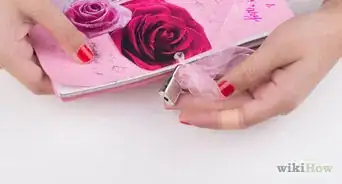
Staff AnswerwikiHow Staff EditorStaff AnswerTry covering the front and back of your diary in patterned paper. Simply use craft glue or Mod Podge to attach a sheet to the front and the back, then let it dry. Or, bedazzle your diary using glue and sequins for a fun, sparkly cover. -
QuestionWhere can I buy a good diary?
 Community AnswerBookstores often sell very nice diaries. Sometimes even the school supplies section of a grocery store will have some quality options. You can always search online for your perfect diary and order it.
 -
QuestionShould I use a pen or a pencil?
 Community AnswerIt's up to you! But if you make a mistake when writing, it is easier to write in a good quality pencil so that you can rub it out.
 -
QuestionCan I write the diary in a different language?
 Community AnswerIf you know a second language, or want to make one up, go ahead! It's your diary! As long as you can read it again later, it's fine.
 -
QuestionWhat can I do if I feel like someone's watching me when writing in my diary?
 Community AnswerMake sure you're writing in a very private place, such as under the covers in your bed. You could also find a place that nobody knows about. I have a corner in my room that has some of my favorite things in it. It's private, and it gets me inspired if I don't know what to write about. Also, hide your diary so nobody can read it when you're not writing!
 -
QuestionHow can I get a good diary in bookstores in Cambodia?Community AnswerWe do not know what bookstores in Cambodia are like. However, if you're not satisfied with the options you find there, you can always order one online. You can also just get a regular notebook and use it as a diary, or even make one yourself.
-
QuestionWhere I can purchase a 2019 diary online?Community AnswerTry stores like Amazon and Walmart, or specialty stationery stores or auction sites like eBay. All of these will carry diaries. For quirkier diaries with handmade elements, try Etsy.
-
QuestionHow can I avoid forgetting to write each day?Community AnswerExperts say it takes anywhere from three weeks to two months to develop a new habit, depending on the complexity of the task. Until this time, put a reminder on your device or a sticky note somewhere to remind you. It can also help if you do it at around the same time every day as part of your routine.
-
QuestionDo you always have to write in your diary?
 Olive ZhangCommunity AnswerNot really. Don't feel bad if you miss a few days, weeks, or even months! Dairies are ways of relaxing and reflecting on yourself, but you don't have to write every day!


References
- ↑ https://www.urmc.rochester.edu/encyclopedia/content.aspx?ContentID=4552&ContentTypeID=1
- ↑ https://screening.mhanational.org/content/how-keep-mental-health-journal/
- ↑ https://medium.com/darius-foroux/how-to-start-a-daily-journaling-habit-and-what-to-write-about-1efd2993833b
- ↑ https://medium.com/darius-foroux/how-to-start-a-daily-journaling-habit-and-what-to-write-about-1efd2993833b
- ↑ https://www.npr.org/2020/06/11/875054593/not-sure-what-youre-feeling-journaling-can-help
- ↑ https://www.psychologytoday.com/us/blog/dreaming-in-the-digital-age/201705/keeping-dream-journal
- ↑ https://www.npr.org/2020/06/11/875054593/not-sure-what-youre-feeling-journaling-can-help
- ↑ https://infed.org/writing-and-keeping-journals-a-guide-for-educators-and-social-practitioners/
- ↑ http://infed.org/mobi/writing-and-keeping-journals-a-guide-for-educators-and-social-practitioners/
- ↑ https://screening.mhanational.org/content/how-keep-mental-health-journal/
- ↑ https://infed.org/writing-and-keeping-journals-a-guide-for-educators-and-social-practitioners/
- ↑ https://www.psychologytoday.com/us/blog/here-there-and-everywhere/202001/how-start-journaling-better-mental-health
- ↑ https://www.washingtonpost.com/lifestyle/2020/12/15/journaling-kids-practice-covid/
About This Article

To use a diary, carry it with you and try to write for at least 10 minutes every day to get yourself in the habit. Start by writing the date at the top of your entry, then write down major life events, everyday details, your feelings, dreams, to-do lists, and anything else you'd like. Don't worry about writing perfect sentences, just write whatever comes naturally to you and try to avoid editing yourself. You can also use your diary for drawing, art, poetry, song lyrics, and collecting keepsakes! For tips on using your diary to set and achieve goals, read on!