This article was co-authored by wikiHow Staff. Our trained team of editors and researchers validate articles for accuracy and comprehensiveness. wikiHow's Content Management Team carefully monitors the work from our editorial staff to ensure that each article is backed by trusted research and meets our high quality standards.
This article has been viewed 712,884 times.
Learn more...
Colons are like flashing arrows: they are there to direct your attention to the information that follows them. Colons are used to connect sentences, to present information, and to set off lists and quotations. They call your attention to information following an independent clause, and that information amplifies, explains, or fulfills the information presented before the colon. Once you know how to use a colon, it's easy to remember.
Steps
Method 1
Method 1 of 3:Using Colons to Direct Attention
-
1Precede a list with a colon. Connect a full sentence with a list using a colon. The colon sets off your information, making it easy to sort. Consider these examples:
- "I went to the store and bought a lot of fruit: peaches, apricots, grapes, kiwis, and nectarines.
- "You're missing everything: the pre-game, the party, and the afterparty."
-
2Set off a noun or noun phrase with a colon. Colons can be used to join a full sentence with an explanatory noun, proper noun, or noun phrase. Use this to place a lot of emphasis on the noun.
- You can write, "My nightmare revealed to me my deepest fear: solitude."
- Another example could be, "The clouds broke to pour sun down on her favorite place in the world: her father's rose garden."
-
3Introduce a lengthy quotation. To quote a full sentence or more, lead with a colon. Don't do this if you are only quoting a few words. Proper usage might include any of the following:[1]
- 'In her poem "Houses," Laura Riding described the difference between lined and unlined panes of glass: "Windows give up their secrets, not mirrors."'


Method 2
Method 2 of 3:Connecting Full Sentences with Colons
-
1Join a sentence with another that explains it. Colons can be used to connect full sentences that are related. When the second sentence serves to explain the first, they can be connected with a colon. Here are some examples:[2]
- "Golf is more than a sport for me: it is an essential networking practice on which my business depends."
- "I gave him my number: I wanted to see him again."
-
2Amplify a statement. Connect two full sentences with a colon if the second sentence serves to extend, or amplify, the first.[3]
- For instance, you could write, "Reading books makes me happy: reading in the morning fills me with a joy that illuminates my entire day."
-
3Introduce a conclusion. Connect a sentence that introduces a problem with another sentence that provides the conclusion. A colon may also imply that the second sentence is the result of the first.[4]
- For instance, you could say, "The teacher finally decided what to do with her rowdy class: she added a ten-minute playground break before storytime."
- An example of an implied connection might be, "We brought too much bread to the picnic: the birds were very happy."


Method 3
Method 3 of 3:Avoiding Common Colon Mistakes
-
1Capitalize after the colon in certain cases. When you use a colon to connect two full sentences, you can capitalize the first letter of the second sentence or not. If you are writing a paper in a certain style, such as APA, MLA, Chicago, or AMA, you must follow their guidelines.
- Do not capitalize the first letter of the second clause if it is not a complete sentence.
- Do not capitalize the first letter of the second clause if you are writing a paper using MLA or AMA formatting, unless it is a proper noun.[5]
- Do capitalize the first letter of the second clause when using APA formatting.
- When using Chicago formatting, capitalize the first letter after a colon only if it introduces two or more sentences. Example: "Masha had three options: She could cry. She could yell. Finally, she could pretend that nothing had happened."[6]
-
2Do not use a colon after an incomplete sentence. A common colon error is to use the colon to introduce a list or noun after an incomplete sentence. Sentences that include common mistakes sound abrupt and disjointed:[7]
- "His list of goals was: go to Europe, fall in love, and get on TV."
-
3Use colons only to connect related sentences. Complete sentences that do not have a clear causal or thematic connection should not be connected with colons.[8]
- It would be incorrect, for instance, to write this: "I would have to go to the store in an hour: winter in Minnesota is cold."
- A correct usage might be, "I would have to pick up a solid coat: winter in Minnesota is cold."
-
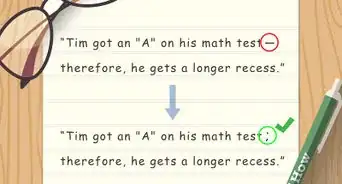
4Don't use a colon where a semi-colon should be. When you are connecting two full sentences that are of equal weight, a semi-colon will serve you better than a colon. A colon draws attention to the clause that follows it, while the semi-colon does not.
- For instance, it would be incorrect to say, "The TV is next to the bookcase: the couch is flanked by two end tables." This is because the second clause does not explain, amplify, or answer the first. It merely adds more information.
- Instead, you would write, "The TV is next to the bookcase; the couch is flanked by two end tables."


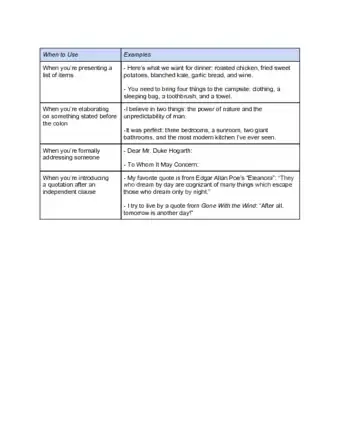
Colon Usage Cheat Sheet

Community Q&A
-
QuestionIs it correct to write a sentence like this: "Remember: if you don't listen carefully, you won't know what steps to follow."
 Community AnswerYes.
 -
QuestionCan I use a colon twice in a sentence after two or three words?
 DonaganTop AnswererIt would be an extremely unusual--even awkward--sentence if it required two colons.
 -
QuestionIs this correct? "Give me: cheese, bread and butter."DonaganTop AnswererNo colon needed.
-
QuestionIs a colon used inside of quotation marks?DonaganTop AnswererIt can be.
-
QuestionIs it correct? "But he wasn't free yet: he still had to get out of the room."DonaganTop AnswererIt's OK that way, or you could write, "He wasn't free yet, however. He still had to get out of the room."
-
Question"But the real question is: Did the police lied to the people in town?" Is this correct?
 Community AnswerThe colon is correct. Use "lie" instead of "lied."
 -
QuestionCan I end a sentence with a colon?
 Community AnswerNo. Although a colon may appear to be ending a sentence, it's really just introducing a continuation of a thought with a list of items or an added clause.
 -
QuestionWould I use a colon after the word "of" when writing "in memory of?"
 KeziahmcCommunity AnswerGenerally, you wouldn't; mostly you use a colon to introduce a list, for example, 'the girl had two hobbies: reading mystery novels and playing the piano'. This works because the first part (the girl had two hobbies) could stand on its own.
 -
Question"Some of the necessary skills are: strong leadership ability, exemplary classroom management skills." Would this be a correct use?Community AnswerThis is a correct use. A few pointers, however: 1. This would be an unusual and unnecessary way to write such a sentence in most contexts, since you can equally well just write the same sentence without the colon. 2. You should generally have 'and' before the last item in the series (and no comma in this case, since there are only two items). 3. 'Include' is a better word choice here than 'are'. 4. The most likely scenario for a construction exactly like the one you wrote would be a form that has been filled out. For example, a form or questionnaire can sometimes have an item ending with a colon, where the person filling it out needs to list whatever applies.
-
QuestionCan a colon be used to link several sentences related to each other?Community AnswerYes, the colon is used in place of a period but acts like a period to end a sentence and to capitalize the following word. For example -- Carrots are a good source of vitamins: They promote healthy vision.











References
- ↑ https://www.pugetsound.edu/academics/academic-resources/cwlt/writing-advisor-schedule/writing-resources/colon-and-dashes/
- ↑ http://writingcenter.unc.edu/tips-and-tools/semi-colons-colons-and-dashes/
- ↑ http://writingcenter.unc.edu/tips-and-tools/semi-colons-colons-and-dashes/
- ↑ http://writingcenter.unc.edu/tips-and-tools/semi-colons-colons-and-dashes/
- ↑ https://owl.english.purdue.edu/owl/resource/566/01/
- ↑ http://archives.cjr.org/language_corner/how_to_use_the_colon.php
- ↑ https://www.pugetsound.edu/academics/academic-resources/cwlt/writing-advisor-schedule/writing-resources/colon-and-dashes/
- ↑ https://www.pugetsound.edu/academics/academic-resources/cwlt/writing-advisor-schedule/writing-resources/colon-and-dashes/
About This Article

The most common way to use a colon in a sentence is to introduce a list with it. But you can also use a colon to introduce a quotation or to join a sentence with one that explains it. For example, the following quote is two sentences, where the second explains the first: “I gave him my number: I wanted to see him again.” Structures like that can emphasize the second sentence as well, if they are well written. Keep reading to learn more ways to use colons in sentences!