This article was co-authored by wikiHow Staff. Our trained team of editors and researchers validate articles for accuracy and comprehensiveness. wikiHow's Content Management Team carefully monitors the work from our editorial staff to ensure that each article is backed by trusted research and meets our high quality standards.
This article has been viewed 425,285 times.
Learn more...
You can measure the length of a vertical or horizontal line on a coordinate plane by simply counting coordinates; however, measuring the length of a diagonal line is trickier. You can use the Distance Formula to find the length of such a line. This formula is basically the Pythagorean Theorem, which you can see if you imagine the given line segment as the hypotenuse of a right triangle.[1] By using a basic geometric formula, measuring lines on a coordinate path becomes a relatively easy task.
Steps
Part 1
Part 1 of 2:Setting up the Formula
-
1Set up the Distance Formula. The formula states that , where equals the distance of the line, equal the coordinates of the first endpoint of the line segment, and equal the coordinates of the second endpoint of the line segment.[2]
-
2Find the coordinates of the line segment’s endpoints. These might already be given. If not, count along the x-axis and y-axis to find the coordinates.[3]
- The x-axis is the horizontal axis; the y-axis is the vertical axis.
- The coordinates of a point are written as .
- For example, a line segment might have an endpoint at and another at .
-
3Plug the coordinates into the Distance Formula. Be careful to substitute the values for the correct variables. The two coordinates should be inside the first set of parentheses, and the two coordinates should be inside the second set of parentheses.[4]
- For example, for points and , your formula would look like this:


Part 2
Part 2 of 2:Calculating the Distance
-
1Calculate the subtraction in parentheses. By using the order of operations, any calculations in parentheses must be completed first.[5]
- For example:
- For example:
-
2Square the value in parentheses. The order of operations states that exponents should be addressed next.[6]
- For example:
- For example:
-
3Add the numbers under the radical sign. You do this calculation as if you were working with whole numbers.
- For example:
- For example:
-
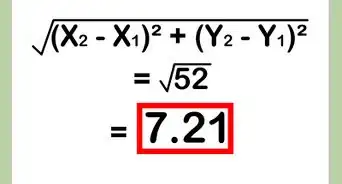
4Solve for . To reach your final answer, find the square root of the sum under the radical sign.
- Since you are finding a square root, you may have to round your answer.
- Since you are working on a coordinate plane, your answer will be in generic “units,” not in centimeters, meters, or another metric unit.
- For example:
units


Community Q&A
-
QuestionWhat do we call points that are on same line?
 DonaganTop AnswererPoints on the same straight line are said to be "collinear" or "colinear."
 -
QuestionHow do I simplify the square root?DonaganTop AnswererLook for a perfect square inside the radical sign, find its square root, and put that square root out in front of the radical sign, indicating that it's to be multiplied by the radical. For example: √50 = √(2 x 25) = 5√2.
-
QuestionThe rise is 4 inches. The angle is 90 degrees from the height to the base. What is the slope?DonaganTop AnswererTo find the slope, you have to know the horizontal distance over which the rise occurs. The 90° angle is not relevant.
-
QuestionHow do I find the distance of a line if I don't know the end points?DonaganTop AnswererAssuming you don't have a measuring tool (tape measure, ruler, etc.), you cannot use the distance formula outlined above without knowing the end points. However, if the line is given as part of a geometrical figure, there are various geometrical and trigonometrical methods to find the length (too numerous and complicated to treat here).
-
QuestionHow would I find the length of each segment?
 Community AnswerFor a line segment, you should create a right triangle by making two more lines. If this line segment is on a dot grid, every line between two dots is one unit. If the line segment is on a coordinate plane, then you can do the same or use the distance formula for a line.
 -
QuestionA square table has an area of 16 sq cm. How do I find the length of its side?DonaganTop Answerer√16 = 4 cm.
-
QuestionOn a number line, the length of line segment joining 3 and -3 is what?DonaganTop AnswererOn a number line 3 and -3 are each 3 units from zero (in opposite directions). So the total distance between them is 3 + 3 = 6.
-
QuestionWould line AB be the same as line BA?DonaganTop AnswererYes.
-
QuestionI don’t understand the distance formula. Can you help?DonaganTop AnswererIt's simply the Pythagorean theorem. Find the vertical change (between endpoints of the line). Square it. Find the horizontal change. Square that, too. Add together the two squares. Then find the square root of that sum. This gives you the line length you're looking for.
-
QuestionIf I know the length of the line and one of the endpoints, how do I find the other endpoint?DonaganTop AnswererYou can't do it unless you also know the slope of the line.
References
- ↑ http://www.purplemath.com/modules/distform.htm
- ↑ http://mathworld.wolfram.com/Distance.html
- ↑ https://www.mathsisfun.com/algebra/distance-2-points.html
- ↑ https://www.mathsisfun.com/algebra/distance-2-points.html
- ↑ https://www.mathsisfun.com/operation-order-pemdas.html
- ↑ https://www.mathsisfun.com/operation-order-pemdas.html
About This Article

To use the distance formula to find the length of a line, start by finding the coordinates of the line segment's endpoints. Then, plug the coordinates into the distance formula. Next, subtract the numbers in parenthesis and then square the differences. Once you've done that, just add the numbers that are under the radical sign and solve for d. To learn how to set up the distance formula, keep reading!