This article was co-authored by wikiHow staff writer, Madeleine Criglow. Madeleine Criglow is a wikiHow Staff writer based in the Pacific Northwest. She has over six years of experience working in copywriting, editing, and journalism. In addition to her work for wikiHow, she writes a monthly film column for Tigard Life and Tualatin Life newspaper. Madeleine graduated from the University of Puget Sound with a BA in English with an emphasis in Creative Writing.
There are 13 references cited in this article, which can be found at the bottom of the page.
This article has been viewed 6,518 times.
Learn more...
Nobody wants to think about an impending earthquake. It can be a little scary to even entertain the thought, but it’s best to approach the subject head on in order to be prepared. This article takes a look at the questions you may have regarding the early warning signs of an earthquake, like what early warning systems are, how they work, and what you can do when an earthquake is about to strike.
Steps
Question 1
Question 1 of 8:How do earthquake early warnings (EEW) work?
-
1Early warning systems work through detecting P-waves and S-waves. Earthquakes create both types of waves, with less-damaging P-waves coming first. Early warning systems detect these P-waves and notify residents, businesses, and transportation systems in the area of the oncoming S-waves, which cause the ground to shake.[1]
- The farther away residents are from the epicenter of the earthquake, the more time they will have to prepare. Even those close to the epicenter can benefit, as the alert can give people enough time to find shelter away from potential falling hazards.[2]
Advertisement

Question 2
Question 2 of 8:How will I receive a notification if there’s an impending earthquake?
-
1That depends on where you live. There are early warning systems available or in development in countries all over the world. At the dawn of an impending earthquake, these alert systems let residents and businesses know in advance through personal cell phones and alarms.[3]
- In Japan, earthquake early warnings work through using seismographs across the country. These seismographs detect earthquake tremors, determine the epicenter of the quake, and notify those in the area through their cell phones, television, and radios.[4]
- Currently, residents of California and Oregon have access to the MyShake app, which alerts those in the area to an impending earthquake through their phone. In May 2021, residents of Washington will also have access to the app as well.[5]
- Residents of Mexico, South Korea, and Taiwan are notified of impending earthquakes through a public alert system.[6]
- To find more information about earthquake early warning systems in your area, visit https://seismo.berkeley.edu/research/eew_around_the_world.html.

Question 3
Question 3 of 8:Are there any limitations when it comes to early warning systems?
-
1Not all countries currently have early warning systems. While some countries, like Japan and Mexico, have had solid early warning systems in place for some time now, other countries such as Chile, Costa Rica, and Switzerland are still researching and developing their own systems.[7]
-
2Early warning systems may not always give you enough time in advance. Though early warning systems can detect shaking and immediately notify those in the area, that still may not provide enough time to prepare for the potential risks and damage of a massive earthquake. Early warning systems work best for small to moderate earthquakes.[8]Advertisement


Question 4
Question 4 of 8:What should I do if an earthquake is about to strike?
-
1If you are inside, take cover and hold on. Drop to the floor and find the nearest covered structure, such as a desk or chair. Hold onto whatever you can so that you can remain as steady as possible. If you are seated in a wheelchair, keep your wheels locked and cover the top of your head with your hands until the shaking ceases.[9]
-
2If outside, stay away from buildings, electrical wires, and fuel or gas lines. Try as best you can to find an open area and drop low to the ground until the shaking stops.[10]Advertisement


Question 5
Question 5 of 8:What should I do if I am driving when early warning signs of an earthquake begin?
-
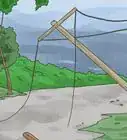
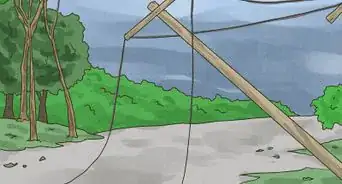
1Pull over and try to avoid nearby wires or utility poles. Remain in the car and put the car in park. Wait there until the shaking stops.[11]
-
2Watch out for potential dangers before you start driving again. Once it is safe to begin driving, be on the lookout for fallen trees and powerlines, collapsed roads, and rising water levels.[12]Advertisement


Question 6
Question 6 of 8:How does an earthquake early warning affect public transportation?

Question 7
Question 7 of 8:Do small earthquakes mean a big one is coming?
-
1Potentially. Studies show that oftentimes larger earthquakes are preceded by foreshocks or smaller earthquakes. For example, a study of earthquakes in Southern California of a magnitude of 4 or above between 2008 and 2017 revealed that 72% were preceded by smaller earthquakes.[15]
-
2Not always. It’s important to understand that though it may be possible, a smaller earthquake does not guarantee a larger earthquake is on its way. Seismologists are still trying to determine the connection between smaller earthquakes or foreshocks and massive earthquakes.[16]Advertisement


Question 8
Question 8 of 8:Can you evacuate before an earthquake strikes?
-
1You may not have enough time to evacuate before an earthquake. In fact, it is most likely safest to stop what you are doing and take cover where you are. You may, however, need to evacuate once the earthquake is over if the area becomes unsafe due to fallen buildings or other debris.[17]
- To prepare for a potential earthquake, consider creating an evacuation plan with those in your household. Add details including the multiple ways to exit each room in your home and the location of an emergency outdoor meeting spot.[18]
- If you live by the beach or a large body of water, know the most efficient means to reach higher ground from your home[19]




-Step-17.webp)





References
- ↑ https://seismo.berkeley.edu/research/eew_basics.html
- ↑ https://seismo.berkeley.edu/research/eew_around_the_world.html
- ↑ https://www.usgs.gov/natural-hazards/earthquake-hazards/early-warning?qt-science_support_page_related_con=0#qt-science_support_page_related_con
- ↑ http://content.time.com/time/world/article/0,8599,2059780,00.html
- ↑ https://earthquake.ca.gov/get-alerts/
- ↑ https://seismo.berkeley.edu/research/eew_around_the_world.html
- ↑ https://seismo.berkeley.edu/research/eew_around_the_world.html
- ↑ https://advances.sciencemag.org/content/4/3/eaaq0504
- ↑ https://www.ready.gov/earthquakes
- ↑ https://www.ready.gov/earthquakes
- ↑ https://www.usgs.gov/faqs/what-should-i-do-during-earthquake?qt-news_science_products=0#qt-news_science_products
- ↑ https://www.cdc.gov/disasters/earthquakes/during.html
- ↑ https://www.usgs.gov/news/earthquake-early-warning-vital-city-transit
- ↑ https://transweb.sjsu.edu/press/us-high-speed-rail-can-learn-japan%E2%80%99s-successful-earthquake-early-warning-system
- ↑ https://phys.org/news/2019-08-scientists-big-earthquakes-smaller.html
- ↑ https://phys.org/news/2019-08-scientists-big-earthquakes-smaller.html
- ↑ https://www.cdc.gov/disasters/earthquakes/prepared.html
- ↑ https://www.cdc.gov/disasters/earthquakes/prepared.html
- ↑ https://www.cdc.gov/disasters/earthquakes/prepared.html
About This Article