This article was co-authored by Ryan Corrigan, LVT, VTS-EVN. Ryan Corrigan is a Licensed Veterinary Technician in California. She received her Bachelor of Science in Veterinary Technology from Purdue University in 2010. She is also a Member of the Academy of Equine Veterinary Nursing Technicians since 2011.
This article has been viewed 2,226 times.
A big part of caring for your horse's health is caring for the health of its skin. Horses can get a variety of skin disorders. Learn how to identify common ones, and check your horse's hide regularly. Treat any suspected skin disorder immediately. Follow up with a vet if the condition doesn't improve with at-home care.
Steps
Method 1
Method 1 of 3:Treating Rain Rot
-
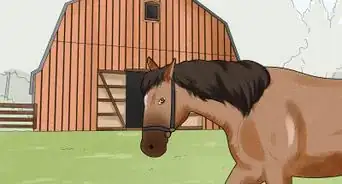
1Identify a problem with rain rot. Rain rot, also known as rain scald or dermatophilosis, is a bacterial skin disease that is common on horses. You can identify it by looking for crusty scabs on the horse's skin that cause the hair to fall out and bald patches to develop. These bald patches tend to appear in areas that are exposed to rain, such as the top of the head, the top of the neck, and the top of the back.[1]
- The bacteria that causes rain rot tends to flourish in areas with warm temperatures, high humidity, lots of insects, and lots of rainfall.
- Rain rot develops where there has been a break in the skin, whether it be from a bug bite or a laceration. Once the skin is opened up, the bacteria can get into the horse's skin and begin spreading.
-
2Help your horse stay dry. Most horses are able to recover from rain rot without medication if they are kept clean and dry. Their immune systems are able to eliminate the bacteria on their own, as long as you give the animal a place to stay out of the rain and you keep it groomed.[2]
- For example, if you keep your horse in a pasture, make sure that it has a sheltered area where it can get out of the rain.
- If you wash your horse, be sure to dry it off thoroughly afterwards, as excess moisture can promote rain rot.
Advertisement -
3Apply insect repellent on the horse. Because insect bites allow the rain rot bacteria to enter the skin, it's important to prevent additional bites. Purchase an insect repellent that is made for horses and apply it as directed.[3]
- Talk to your veterinarian about what insect repellent to use on your horse. They may have suggestions that take your specific climate and your specific horse into consideration.
- It is especially important to apply insect repellent at times of the year when the insects are really bad, such as during hot, humid summer days.
- Use a fly sheet to protect your horse from insect bites. Available in various designs, fly sheets hang low and help protect your horse’s legs and neck.
-
4Take a break from riding your horse. If your horse has sores on its back or neck that will be rubbed during riding, it's best to allow them to heal before riding it again. Riding will only irritate the affected areas and will also create moisture that can exacerbate the horse's condition even further.[4]
- If you are continually reopening wounds and irritating the affected areas, your horse's immune system will have a harder time eliminating the infection.
-
5Seek veterinary care if the condition persists. If you have eliminated the problems causing the infection and your horse still doesn't recover, then it is time to seek out veterinary care. To treat rain rot, your veterinarian will likely prescribe a medicated shampoo that you can use on the horse.[5]
- Medicated shampoos for horses, such as those containing benzoyl peroxide, will remove the scabby and peeling tissue and will keep other infections at bay while the area regenerates.
Advertisement


Method 2
Method 2 of 3:Treating Ringworm
-
1Identify a ringworm infection. Ringworm is a contagious fungal infection that commonly occurs on horse's skin. When the infection begins you will usually notice areas of hair and skin that are raised up and are discolored. Eventually the hair on the raised areas falls out and the skin will turn grey and raw.[6]
- Even though this disease is called "ringworm," it is not caused by worms and does not always appear in rings.
- This infection can be anywhere on a horse's body but it is most often located somewhere that is rubbed by horse tack, such as where the bridle, saddle, or girth contact the body.
-
2Isolate the horse. If you suspect that your horse has ringworm, you should keep it away from all other horses. This is a very contagious disease, so isolating your horse is an important step towards ensuring the disease doesn't spread.
- Your horse should be kept away from other horses for 2 to 3 weeks while it is being treated.
-
3Get a veterinary diagnosis. If you suspect that your horse has ringworm, then you should have it seen by a veterinarian. The vet will look at the affected areas, take a medical history for the horse, and give you a diagnosis and treatment plan.
- To confirm a diagnosis your vet will likely take skin samples from the affected area and look at them under a microscope.
- In some cases a horse can eventually eliminate the ringworm infection on its own. However, this can take anywhere from 6 to 12 weeks. However, in that time the horse can infect any other horse it comes into contact with and it will continue to be physically uncomfortable.
-
4Clean the area before applying medication. In order for the medication to get down into the infection, you will have to remove any scabbing or flaking skin on the surface. To do this, wash the horse with a mild detergent so the scabs are softened. Then very gently scrub the scabby areas with a toothbrush or other small, soft brush.
- Be very gentle as you clean off the affected areas, as this process can be painful for the horse.
-
5Apply the medication prescribed by your veterinarian. Your veterinarian will likely have you apply an anti-fungal solution to the affected areas. This will be applied several times over the course of a week or 2. As the infection is treated, you should notice the skin healing itself and the horse's hair growing back quickly.
- Follow your veterinarian's suggestions for treatment, including how much to apply, when to apply it, and how often to apply it.
- If the lesions keep growing even while being treated, then you should contact your veterinarian and ask for a different topical medication to try.
Advertisement


Method 3
Method 3 of 3:Treating Sarcoids
-
1Identify a sarcoid tumor. Sarcoids are a type of skin tumor that shows up on horses. It can vary in appearance but typically looks like irregularly shaped lumps that have a rough, discolored surface. It can be located anywhere on a horse's body but often shows up on a horse's belly, legs, chest, and near the eyes or ears.[7]
- Sarcoid tumors often emerge on the site of old scars on a horse.
- These tumors can be mistaken for ringworm, as they have a similar appearance. However, they do not disappear on their own the way that ringworm can.
- Sarcoids are most common on young or middle-aged horses.
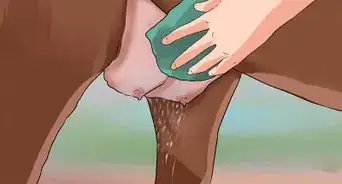
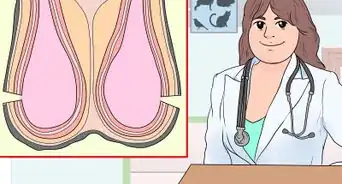
- Sarcoids are often found in the sheath and on the penis of male horses. Make sure to check for them when you clean your gelding’s sheath.
-
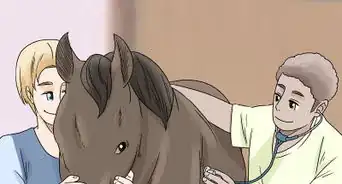
2Have your veterinarian look at the condition. While sarcoids will not kill your horse, they are a medical condition that needs veterinary treatment because they can impact your horse's quality of life and ability to work. If you spot even a single sarcoid you should have it looked at by a veterinarian so that it can be treated and prevented from spreading.[8]
- Since sarcoids can be mistaken for ringworm, you should get a veterinary diagnosis so that you can figure out the correct diagnosis and treatment for your horse.[9]
-
3Discuss treatment options with your veterinarian. When it comes to sarcoids there are a variety of treatment options. However, none of them are guaranteed to eliminate your horse's tumors. Talk to your veterinarian about what the best treatment option is for your specific horse and its specific disorder. Some common treatments that may be suggested and may be used in combination include:[10]
- Surgical removal of the tumor.
- Ligation, which entails placing a band around the base of the tumor and gradually tightening the band.
- Cryotherapy, which uses liquid nitrogen to freeze off the sarcoid. It will usually take several sessions to fully remove the sarcoid.
- Boosting the immune system so that the horse's body gets rid of small sarcoids.
- Topical creams.
- Radiation therapy at a specialized center.
- Laser removal.
-
4Begin treatment quickly. It is important to start treatment of your horse's sarcoids quickly, as delaying treatment could lead to the condition spreading to other parts of the horse's body. Discuss the treatment plan with your veterinarian and schedule treatment for as soon as possible.[11]
- If you will be giving your horse treatment, for instance if you will be applying a cream to the tumors, then you should begin treatment right away.
- While it is important to start treatment as soon as possible, waiting a few days for surgical or laser treatment is fine in order to find a time that works for you and your veterinarian's schedule. You should not, however, wait weeks to begin treatment.
-
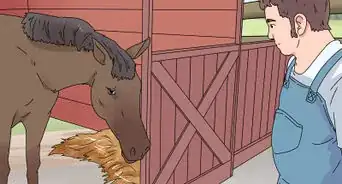
5Try another treatment if one fails to work. Since there are a variety of treatment options for your horse, you should try a different treatment if the first one doesn't work. It is important for your horse's health to get sarcoids under control, so don't give up until your horse's sarcoids are gone.[12]
- There is a high rate of sarcoids returning after treatment, so you may have to start treatment again at some point even after you have gotten rid of them.
Advertisement




References
- ↑ https://practicalhorsemanmag.com/health-archive/prevent-and-treat-rain-rot
- ↑ https://practicalhorsemanmag.com/health-archive/prevent-and-treat-rain-rot
- ↑ https://practicalhorsemanmag.com/health-archive/prevent-and-treat-rain-rot
- ↑ https://practicalhorsemanmag.com/health-archive/prevent-and-treat-rain-rot
- ↑ https://practicalhorsemanmag.com/health-archive/prevent-and-treat-rain-rot
- ↑ http://www.horseandhound.co.uk/horse-care/vet-advice/equine-ringworm-in-horses-39758
- ↑ http://www.horseandhound.co.uk/tag/sarcoids
- ↑ http://www.merckvetmanual.com/horse-owners/skin-disorders-of-horses/diagnosis-of-skin-disorders-in-horses
- ↑ http://www.horseandhound.co.uk/tag/sarcoids
About This Article

To treat skin disorders in horses, check your horse for crusty scabs or bald patches on its skin, as these are signs of rain rot, which is also known as dermatophilosis. If your horse has them, make sure to give it a sheltered area where it can stay dry during rain and to dry it thoroughly after washing it so it can recover from the rain rot. You should also take a break from riding your horse so sores on its back or neck don’t get irritated. While most horses can recover from the skin infection without medication, you may need to see a vet to get prescription medicated shampoo if the condition persists. For more help from our Veterinary co-author, including how to treat ringworm in your horse, scroll down!