This article was co-authored by wikiHow Staff. Our trained team of editors and researchers validate articles for accuracy and comprehensiveness. wikiHow's Content Management Team carefully monitors the work from our editorial staff to ensure that each article is backed by trusted research and meets our high quality standards.
There are 8 references cited in this article, which can be found at the bottom of the page.
Learn more...
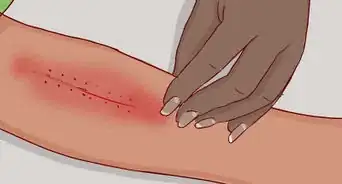
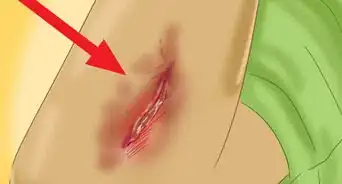
Granulation tissue naturally forms when a wound is healing, but too much of this tissue results in a condition known as "hypergranulation." Hypergranulated tissue is usually swollen or bumpy, red, and painful. You might also notice that it has a wet appearance or bleeds easily. Hypergranulation can be irritating and slow the wound healing process, but it's usually relatively easy to treat.[1] Here, we've gathered answers to some of your most common questions about treating hypergranulation.
Steps
Question 1
Question 1 of 8:What causes hypergranulation?
-
1Doctors aren't really sure what causes hypergranulation. An allergic reaction, trauma to the wound site, or an infection frequently happens before hypergranulation starts. Doctors believe hypergranulation might be a response to these factors but aren't sure why some people's bodies react that way.[2]
- Typically, when a wound fails to heal, the problem is a lack of granulated tissue—not too much of it. Because hypergranulation is relatively rare, it hasn't really been studied that much.
Advertisement

Question 2
Question 2 of 8:How is hypergranulation diagnosed?
-
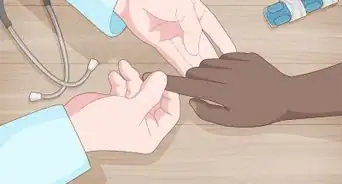
1Your doctor will examine the wound and look for signs of hypergranulation. Because hypergranulated tissue has a particular appearance, your doctor can typically diagnose the problem by sight. They might also probe the tissue to see how it feels or if it is painful.[3]
- Your doctor might also order a biopsy of the tissue just to be sure that something else isn't causing the problem. This is relatively routine if you've been dealing with hypergranulation over the course of several months, or if the condition keeps recurring.

Question 3
Question 3 of 8:Can hypergranulated tissue heal on its own?
-
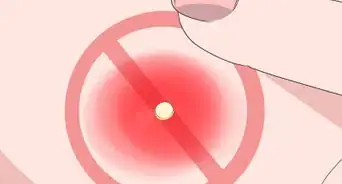
1Yes, hypergranulated tissue often doesn't require any treatment to heal. While you want to seek treatment if the hypergranulated tissue is keeping the wound from healing properly or causing you discomfort, the condition often resolves on its own. If it's not giving you any trouble, leave it alone for a few days and see if it goes away.[4]
- If the condition doesn't go away on its own or appears to get worse, you can always seek treatment at that point. Hypergranulated tissue isn't life-threatening so there's no harm in taking a "wait and see" approach.
Advertisement

Question 4
Question 4 of 8:How can I treat hypergranulation at home?
-
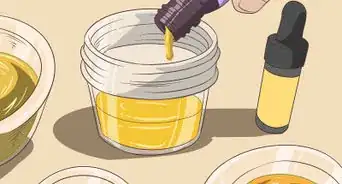
1Salt water soaks and hydrocortisone cream might heal hypergranulated tissue. Soak a piece of gauze in hypertonic salt water, which you can make by mixing 2 teaspoons (12 grams) of salt in 1 cup (237 mL) of warm water. Don't use saline solution because it's not salty enough. Remove the gauze as soon as it's cooled.[5]
- After the wound is dry, dab on a layer of hydrocortisone cream and cover the wound to protect it. Wash and change the dressing on the wound at least once every 4 hours.[6]
- Only use hydrocortisone cream if there is no sign of infection. If you're not sure whether the wound is infected, have a healthcare provider look at it.[7]
- If hypergranulation persists after a week of salt water soaks and hydrocortisone cream, see your healthcare provider to discuss additional treatments.

Question 5
Question 5 of 8:What dressing is used for hypergranulated tissue?
-
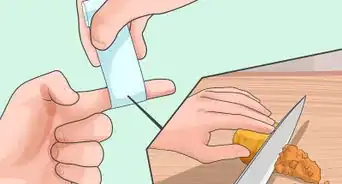
1Treat with hypertonic dressing and follow up with foam dressing. Foam dressing won't adhere to the wound, provides cushioning, and reduces pressure to speed the healing process. Buy this type of dressing online, at your local pharmacy, or wherever else healthcare and first aid products are sold.[8]
- Clean the wound site carefully and dry it before applying the dressing. Change your dressing every 2 hours, unless your doctor tells you differently.[9]
- Only leave hypertonic dressing on the wound for about 5-10 minutes or until it has cooled. If you wait until it has dried out, it can pull on the wound and interfere with the healing process.[10]
Advertisement

Question 6
Question 6 of 8:How does silver nitrate help hypergranulation?
-
1Silver nitrate causes the hypergranulated tissue to die. Your doctor might use silver nitrate to get rid of the hypergranulated tissue. While it does eliminate the problem, it also causes additional inflammation which can be painful as the wound continues to heal.[11]
- Silver nitrate doesn't keep hypergranulation from happening again, so if this is a recurring problem for you, silver nitrate might not be the most effective treatment option.
- This treatment is typically used as a last resort if other treatments, including dressing and hydrocortisone cream, haven't cleared up the problem.

Question 7
Question 7 of 8:Will I need surgery to remove hypergranulated tissue?
-
1Laser surgery is sometimes used to remove hypergranulated tissue. Laser surgery completely removes the hypergranulated tissue and promotes the healing of the original wound. You don't have to "go under" for this type of surgery—doctors typically don't even need to use local anesthesia.[12]
- Laser surgery is typically recommended only if other treatment methods fail to eliminate the hypergranulation.
- If you have hypergranulation surrounding the insertion point for a gastrostomy tube, laser surgery is usually not recommended.[13]
Advertisement

Question 8
Question 8 of 8:How long does it take to heal?
-
1Expect it to take up to a week to heal depending on the treatment used. If you have the hypergranulated tissue removed, that should be the end of your problem (although the removal process might require additional healing time). If you're using hydrocortisone cream, it can take up to a week for the tissue to heal.[14]
- If you're still having problems with hypergranulated tissue after a week of treatment with hydrocortisone cream, go see your doctor. They might recommend other treatment options.


References
- ↑ https://www.podiatrytoday.com/blogged/keys-diagnosing-and-addressing-hypergranulation-tissue
- ↑ https://www.woundsinternational.com/uploads/resources/content_9839.pdf
- ↑ https://www.podiatrytoday.com/blogged/keys-diagnosing-and-addressing-hypergranulation-tissue
- ↑ https://www.aci.health.nsw.gov.au/__data/assets/pdf_file/0019/273700/hypergranulation.pdf
- ↑ https://www.aboutkidshealth.ca/article?contentid=2907&language=english
- ↑ https://www.aboutkidshealth.ca/article?contentid=3019&language=english
- ↑ https://www.woundsinternational.com/uploads/resources/content_9839.pdf
- ↑ https://blog.wcei.net/2016/02/warm-wound-healing-its-all-about-foam-dressings
- ↑ https://www.aci.health.nsw.gov.au/__data/assets/pdf_file/0019/273700/hypergranulation.pdf
- ↑ https://www.aboutkidshealth.ca/article?contentid=2907&language=english
- ↑ http://policyandorders.cw.bc.ca/resource-gallery/Documents/BC%20Children's%20Hospital/CC.16.15%20Topical%20Application%20of%20Silver%20Nitrate%20for%20Treatment%20of%20Hypergranulation%20Tissue%20at%20the%20Tube%20Sites.pdf
- ↑ https://pubmed.ncbi.nlm.nih.gov/18189058/
- ↑ https://www.aci.health.nsw.gov.au/__data/assets/pdf_file/0019/273700/hypergranulation.pdf
- ↑ https://www.aboutkidshealth.ca/article?contentid=3019&language=english
- ↑ http://policyandorders.cw.bc.ca/resource-gallery/Documents/BC%20Children's%20Hospital/CC.16.15%20Topical%20Application%20of%20Silver%20Nitrate%20for%20Treatment%20of%20Hypergranulation%20Tissue%20at%20the%20Tube%20Sites.pdf











































Medical Disclaimer
The content of this article is not intended to be a substitute for professional medical advice, examination, diagnosis, or treatment. You should always contact your doctor or other qualified healthcare professional before starting, changing, or stopping any kind of health treatment.
Read More...