This article was co-authored by Patrick Evan and by wikiHow staff writer, Hannah Madden. Patrick Evan is the Owner of Patrick Evan Salon, a hair salon in San Francisco, California. He has been a hairstylist for over 25 years and is a Thermal Reconditioning Specialist, dedicated to transforming difficult curls and waves into sleek, straight hair. Patrick Evan Salon was rated the Best Hair Salon in San Francisco by Allure magazine, and Patrick's work has been featured in Woman’s Day, The Examiner, and 7x7.
There are 10 references cited in this article, which can be found at the bottom of the page.
This article has been viewed 93,120 times.
Whether you’ve colored your hair one too many times or spent too much time in the sun, the problem is usually the same: you've stripped all the moisture out of your hair, leaving it frayed and prone to breakage.[1] It takes patience and the right hair care products to get your locks as soft and silky as you'd like, but that doesn't mean you're doomed to bad hair days for the foreseeable future.
Here are 14 effective ways to treat fried hair and restore its natural softness and shine.
Steps
Method 1
Method 1 of 14:Apply a hair mask.
-
1Fried hair is dehydrated, so it requires serious moisture. A hair mask contains more moisturizing ingredients than regular conditioners so it can hydrate your hair more effectively. Use the mask after you’ve washed and towel dried your hair, and leave it on for however long the package says. Rinse it out with cool water. Use a hair mask once a week.[2]
- Look for a hair mask with ingredients that can help damaged hair, such as jojoba oil, argan oil, wheat proteins, and keratin.
- If your hair is extremely fried and damaged, you may want to leave the mask on overnight. Wear a shower cap or plastic wrap over the mask so it doesn’t stain your pillowcases or sheets.
- To make your own hair mask, combine 2 tablespoons (30 mL) of coconut oil, 1 tablespoon (15 mL) of olive oil, and 1/2 cup (120 mL) of honey.

Method 2
Method 2 of 14:Try an oil treatment.
-
1Adding more oil to your hair can help lock in hydration and moisture. Apply 4 to 5 drops of oil to your palm and rub it between your hands. Work it through the length of your hair from the ears down while it’s still wet, then rinse it out after about 30 minutes. Repeat once a week.[3]
- A variety of oils work well for the hair, such as argan, coconut, jojoba, macadamia, and almond. You can also find serums that contain a blend of 2 or more oils.
- You can also apply an oil to the ends of dry, fried hair. Only use one or two drops, though, or your hair may wind up looking greasy.

Method 3
Method 3 of 14:Try a deep conditioner.
-
1Give your hair an extra moisturizing boost with a deep conditioner. After you wash your hair, apply a dime-sized amount of deep conditioner to the ends of your hair and let it sit for at least 10 minutes. Rinse it out thoroughly before you get out of the shower for hydrated, moisturized hair. You can do a deep conditioning treatment about once a week.[4]
- Deep conditioners penetrate much deeper into your hair cuticle, leading to more intense hydration.

Method 4
Method 4 of 14:Do a hair bond treatment.
-
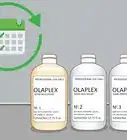
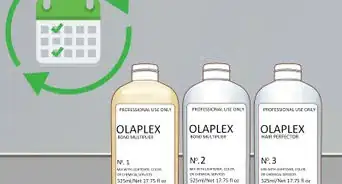
1Hair bonding treatments help protect the outer cuticle from damage. While most hair stylists use hair bond treatments alongside colors or bleach, you can use hair bond treatments on your already-damaged hair. Apply 1 tsp (4.9 mL) on your hair once a week before you wash it, then let it sit for 10 to 30 minutes before rinsing it out.[5]
- Look for hair bond treatments brands like Olaplex and Schwarzkopf at your local beauty store.

Method 5
Method 5 of 14:Strengthen your hair with a protein treatment.
-
1Protein treatments make your hair stronger so it can repair itself faster. Wash your hair and condition it, then apply the protein treatment while your hair is still wet. Leave it on for 20 to 30 minutes before rinsing and drying your hair. You can do protein treatments once or twice a month to repair your damaged hair.[6]
- Pick out a protein treatment that’s formulated for your hair type. You can usually see which hair type they’re meant for on the packaging.

Method 6
Method 6 of 14:Cut down on how often you wash your hair.
-
1Washing your hair too often can dry out your already damaged locks. Instead of washing every day, try to shampoo every 2 to 3 days to keep your hair hydrated and leave the natural oils on your scalp.[7]
- Concentrate the shampoo at your scalp when you wash and only work the lather down to the ends to avoid removing too much moisture.

Method 7
Method 7 of 14:Find products without silicones and sulfates.
-
1Silicones and sulfates strip the moisture out of your hair. Choose moisturizing products with ingredients such as olive or argan oil, or glycerin, sorbitol, or shea butter. Avoid shampoos that contain mineral oil and petrolatum, which can actually form a film that keeps moisture out of your hair.[8]
- It’s fine to use products with silicones and sulfates in them occasionally, but using them too much can make your hair feel dry.

Method 8
Method 8 of 14:Always use a conditioner after you shampoo.
-
1Give your hair some moisture with a conditioner. Look for hydrating conditioners with shea butter or argan oil in them. Every time you shampoo your hair, be sure to follow it with hydration. Apply the conditioner to your hair and let it sit for about 2 to 3 minutes before rinsing.[9]
- If you’d like to protect your hair as it dries, follow up with a leave-in conditioner for all day hydration.

Method 9
Method 9 of 14:Use a microfiber towel to dry your hair.
-
1Rough towels can dry out your hair and make it frizzy. When you get out of the shower, try gently patting your hair dry with a microfiber towel instead. If you don’t have a microfiber towel, use a cotton T-shirt to pat your hair dry and then wrap it up.[10]
- Microfiber towels are also great to help cut down on frizz if you have naturally wavy or curly hair.
- Instead of rubbing your hair dry, try wrapping it in a towel and piling it on top of your head to remove excess moisture.

Method 10
Method 10 of 14:Limit your heat styling.
-
1Heat styling tends to dry out your hair, which can damage it more. That’s why it’s an especially bad idea when your hair is fried. Try to limit your use of curling irons, flat irons, and even blow dryers as much as possible. Let your hair air dry when you wash it, and play up your hair’s natural texture rather than curling or straightening it.[11]
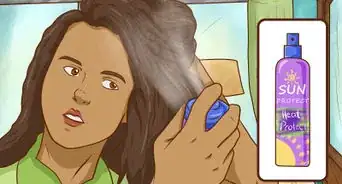
- When you do heat style your hair, always use a heat protectant first to limit the damage to your locks.[12] Cream or lotion heat protectant formulas are best for coarse or thick hair, while sprays work better for fine or thin hair.
- Use curlers or bobby pins to create fun looks without the heat.

Method 11
Method 11 of 14:Sleep on a silk pillowcase.
-
1Linen and cotton pillowcases strip the moisture from your hair as you sleep. Switch to a silk pillowcase to cut down on frizz and hydrate your locks overnight. If a silk pillowcase isn’t appealing to you, consider using a silk head wrap instead.[13]
- While silk pillowcases sound fancy, you can find good ones at most home goods stores for around $20.
- Silk pillowcases can also help preserve your natural waves or curls overnight.

Method 12
Method 12 of 14:Trim your hair every 6 to 8 weeks.
-
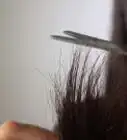
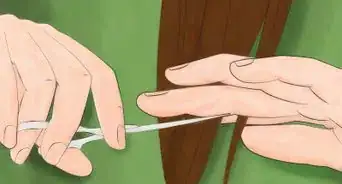
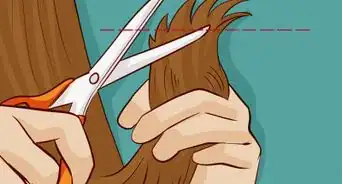
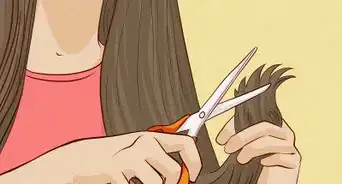
1Snip off the damaged ends of your hair for a fresher look and feel. Usually, the ends show the most damage, especially if your hair is long. Try to trim off about 1⁄2 in (1.3 cm) at minimum for the best look.[14]
- Consider getting layers to remove the damage without sacrificing length.

Method 13
Method 13 of 14:Protect your hair from the elements.
-
1Sun, saltwater, and chlorine can damage your hair further. Wear a hat if you’re going to be out in the sun all day to protect it from the UV rays. If you’re going swimming, wear a swim cap or rinse your hair out as soon as possible to limit the exposure to saltwater or chlorine.[15]
- Some leave-in conditioners and other styling products contain ingredients that contain UV-ray protectants that keep your hair safe from the sun too.
- Before you go swimming, it’s also a good idea to apply a leave-in conditioner to your hair to keep it from absorbing damaging chemicals and minerals that might be in the water.

Method 14
Method 14 of 14:Take a break from coloring your hair.
-
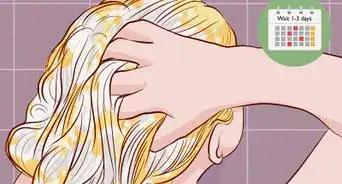
1Adding a new color or bleaching can make your hair dry. While occasional coloring treatments won't hurt, avoid using bleach as much as possible. Make changes to your color slowly by gradually adding color instead of suddenly switching to a new shade.[16]
- If you do want to color your hair, try going for a hair gloss instead of a full color. A gloss can make your hair look shiny and bright without any damage at all.

Community Q&A
Did you know you can get premium answers for this article?
Unlock premium answers by supporting wikiHow
-
QuestionHow do you treat damaged hair?
 Laura MartinLaura Martin is a Licensed Cosmetologist in Georgia. She has been a hair stylist since 2007 and a cosmetology teacher since 2013.
Licensed CosmetologistThe most important thing is to prevent additional damage so you'll need to get regular trims and avoid heat styling or rough combing. Then treat hair with a combination of protein for strength and oils for moisture.
Support wikiHow by unlocking this expert answer.
-
QuestionCan coconut oil help repair damaged hair?Laura MartinLaura Martin is a Licensed Cosmetologist in Georgia. She has been a hair stylist since 2007 and a cosmetology teacher since 2013.
Licensed CosmetologistCoconut oil both moisturizes and protects damaged hair, so it is definitely beneficial. However, you cannot truly repair hair damage.Support wikiHow by unlocking this expert answer.
-
QuestionWhat does Olaplex do for the hair?Laura MartinLaura Martin is a Licensed Cosmetologist in Georgia. She has been a hair stylist since 2007 and a cosmetology teacher since 2013.
Licensed CosmetologistOlaplex is a conditioner and an external binder. It strengthens the hair and adds shine. But, like all hair treatments, it requires consistent maintenance to work.Support wikiHow by unlocking this expert answer.
-
QuestionCan damaged hair cuticles be healed?Laura MartinLaura Martin is a Licensed Cosmetologist in Georgia. She has been a hair stylist since 2007 and a cosmetology teacher since 2013.
Licensed CosmetologistCuticles cannot be healed. The can be made less obvious with oils and shine products or even coated in a protective barrier, but damage to them is permanent.Support wikiHow by unlocking this expert answer.
-
QuestionCan I dry my hair without using heat?
 Patrick EvanPatrick Evan is the Owner of Patrick Evan Salon, a hair salon in San Francisco, California. He has been a hairstylist for over 25 years and is a Thermal Reconditioning Specialist, dedicated to transforming difficult curls and waves into sleek, straight hair. Patrick Evan Salon was rated the Best Hair Salon in San Francisco by Allure magazine, and Patrick's work has been featured in Woman’s Day, The Examiner, and 7x7.
Professional Hair StylistYou can dry your hair by gently squeezing it with a towel. Avoid being too rough when using a towel, as that can damage your hair as well.Support wikiHow by unlocking this expert answer.
-
QuestionCan damaged hair cuticles be healed?Laura MartinLaura Martin is a Licensed Cosmetologist in Georgia. She has been a hair stylist since 2007 and a cosmetology teacher since 2013.
Licensed CosmetologistNo, once hair cuticles have been broken or damaged they can't heal. But, you can get them to close which should help hair appear smoother and shinier.Support wikiHow by unlocking this expert answer.
-
QuestionWhat does Olaplex do for the hair?Laura MartinLaura Martin is a Licensed Cosmetologist in Georgia. She has been a hair stylist since 2007 and a cosmetology teacher since 2013.
Licensed CosmetologistOlaplex can hydrate and strengthen chemically treated hair. It can also lessen the damage caused by color or bleach if Part 1 is applied in the salon.Support wikiHow by unlocking this expert answer.
-
QuestionHow do you treat damaged hair?Laura MartinLaura Martin is a Licensed Cosmetologist in Georgia. She has been a hair stylist since 2007 and a cosmetology teacher since 2013.
Licensed CosmetologistApply a deep conditioner once a week. For best results use one that has both hydrating oils and strengthening proteins. Process only for as long as the bottle recommends under a plastic cap to keep it moist.Support wikiHow by unlocking this expert answer.
-
QuestionWhat are good ways to style your hair without heat?
 wikiHow Staff EditorThis answer was written by one of our trained team of researchers who validated it for accuracy and comprehensiveness.
Staff AnswerwikiHow Staff EditorStaff AnswerWhen your hair is wet, put it into a classic braid and let it dry overnight for some beachy waves. Or, pin your hair closely to your scalp with bobby pins and let it dry for fun, bouncy curls.Support wikiHow by unlocking this staff-researched answer.
-
QuestionMy bangs are severely fried and the new growing hair is also damaged. I scarcely use heat. The rest of my hair is not damaged at all. I tried all of the above and nothing worked, what should I do?wikiHow Staff EditorThis answer was written by one of our trained team of researchers who validated it for accuracy and comprehensiveness.
Staff AnswerwikiHow Staff EditorStaff AnswerIf you've tried everything and nothing is working, it may be time to see a professional. A hair stylist has access to stronger, more curated products that they can use on your hair to strengthen and repair it. Try making an appointment at a salon near you to talk about your hair needs.Support wikiHow by unlocking this staff-researched answer.





References
- ↑ Patrick Evan. Professional Hair Stylist. Expert Interview. 17 January 2019.
- ↑ https://www.thehealthy.com/beauty/hair/sun-damaged-hair/
- ↑ https://www.readersdigest.ca/health/beauty/home-remedies-damaged-hair/
- ↑ https://www.naturallycurly.com/curlreading/kinky-hair-type-4a/the-dos-and-donts-of-deep-conditioning
- ↑ https://www.glamourmagazine.co.uk/article/olaplex-hair-treatment-benefits-and-how-to-use
- ↑ https://www.ncbi.nlm.nih.gov/pmc/articles/PMC4387693/
- ↑ https://www.aad.org/tips-healthy-hair
- ↑ https://labmuffin.com/silicone-mythbusting-with-video/
- ↑ https://www.aad.org/tips-healthy-hair
- ↑ Patrick Evan. Professional Hair Stylist. Expert Interview. 17 January 2019.
- ↑ Patrick Evan. Professional Hair Stylist. Expert Interview. 17 January 2019.
- ↑ Patrick Evan. Professional Hair Stylist. Expert Interview. 17 January 2019.
- ↑ Patrick Evan. Professional Hair Stylist. Expert Interview. 17 January 2019.
- ↑ https://www.thehealthy.com/beauty/hair/sun-damaged-hair/
- ↑ https://www.aad.org/tips-healthy-hair
- ↑ https://hair.lovetoknow.com/How_to_Moisturize_Damaged_Hair
- ↑ https://www.health.harvard.edu/a_to_z/hair-loss-a-to-z
About This Article

To treat your fried hair, apply a hair mask once a week after you wash it to keep it moisturized. Look for a mask with ingredients that can help damaged hair, like jojoba oil, argan oil, and keratin. You can also apply the oils directly to your hair. Until your hair heals, only shampoo every 2-3 days to avoid stripping more moisture from it. As it’s only recommended to use a hair mask once a week, you can deep condition your hair the times you're not using a hair mask. Leave the conditioner in for 10 minutes, which will help to rehydrate it. If your hair is still damaged, you might want to consider getting a haircut to remove the damaged ends. For more tips from our Hair and Beauty co-author, including how to avoid frying your hair in the future, read on!