This article was co-authored by Ryaan Tuttle. Ryaan Tuttle is a Home Improvement Specialist and the CEO of Best Handyman Boston. With over 15 years of experience, Ryaan specializes in home improvement and property maintenance by leveraging technology and craftsmanship. Ryaan holds his Construction Supervisor and Home Improvement Contractor Licenses. Unlike most handyman contractors, Best Handyman Boston is licensed and insured. Boston Magazine and LocalBest.com have named Best Handyman Boston the Best Handyman in Boston.
There are 7 references cited in this article, which can be found at the bottom of the page.
This article has been viewed 19,192 times.
Dry rot is caused when the fungus Serpula lacrymans infects timber in forests, but can also destroy wood found in people's homes. If you want to avoid costly repairs, catching and treating dry rot early is really important. If you've found dry rot in your home, you may need to remove the rotted wood and fill the timber in with epoxy to prevent the rot from spreading. You can also take steps to prevent dry rot by making sure that timber in your home is dry and that the heating works.
Steps
Method 1
Method 1 of 8:Sprinkle boric acid on wood with signs of dry rot.
-
1You can stop dry rot with boric acid if you catch it early enough. Boric acid is a powerful fungicide and can eradicate the rot-causing fungi as long as they haven't penetrated more than 1⁄4 inch (0.64 cm) into the wood. Sprinkle the boric acid over the rotting portion of your wood or timber and leave it there for 2–3 days.[1]
- Dry rot typically looks like puffy, white mold growing out of timber or other wooden surfaces. The rot occasionally “blooms” and produces cobweb-like strands that hang from the rotting wood or yellow-colored lumps of fungal growth. In serious cases of dry rot, you may notice that the wood simply crumbles away.[2]
- Purchase boric acid at a large hardware store or home-improvement store. Many large grocery stores also stock boric acid. Check in the store's cleaning or household-goods aisle.
Advertisement

Method 2
Method 2 of 8:Scrape away rotted wood for a serious case of dry rot.
-
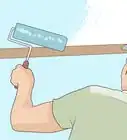
1Use a trim router to remove the damaged wood. If the dry rot extends deeper than 1⁄4 inch (0.64 cm), boric acid won't have much of an effect. You'll need to scrape away the rotted wood, which will take the rot-causing fungus with it.[3] Place a bit into the trim router, then plug it in. Hold the router vertically over the timber and turn it on. Move it smoothly back and forth over the rotted area so the router gouges out all of the rotten wood.[4]
- You can purchase a trim router at a local hardware store. The tool comes with a variety of bits, so select the one best suited to the timber you're trimming.

Method 3
Method 3 of 8:Fill in the wood with an epoxy bonding agent.
-
1Epoxy dries solid to strengthen the damaged section. Follow the manufacturer's directions and mix together the various chemical components that form the epoxy. When it's reached a thick, putty-like consistency, smear the epoxy into the gouged-out section of wood with a putty knife.[5]
- Let the epoxy dry overnight for at least 6-8 hours. Keep any curious children or wandering animals away from the epoxy as it dries.
Advertisement

Method 4
Method 4 of 8:Sand the epoxy so it's flush with the rest of the wood.
-
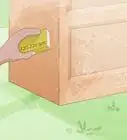
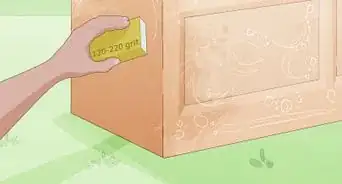
1Use coarse 80-grit sandpaper from a local hardware store. Once the epoxy has set and dried, slide the sandpaper across the dried epoxy several times until you've smoothed the material down to the same level as the surrounding wood. Work in smooth strokes and apply a consistent amount of pressure as you sand the wood.[6]
- If the timber or wood is in a part of your home where it'll be seen, you might want to go over the epoxy once more, this time with a 120-grit sandpaper. This will smooth it out further and make it look more finished.

Method 5
Method 5 of 8:
Stop any water leaks near timber in your home.
-
1Any wooden beams or supports near a leak will be susceptible to dry rot. In most homes, leaks occur near water spigots or behind appliances. If you're aware of a leak in your home, turn off the water to the specific pipe that's leaking.[7] Then contact a plumber to come to your home and fix the leak as soon as possible.[8]
- Even if you're not aware of any leaks, it's smart to check through your home on a monthly basis and make sure that pipes tucked away beneath your sink or behind your washing machine aren't leaking.
Advertisement

Method 6
Method 6 of 8:Ventilate areas where a leak has soaked wooden beams or timber.
-
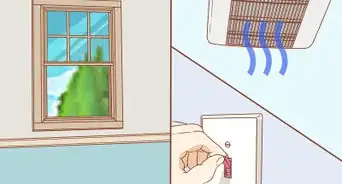
1Open the windows and doors in the room with the wet timber to encourage airflow. If you have wet wood in your home, it's crucial that you dry it out as fast as possible to prevent dry rot from infecting the wood.[9] Also set 2–3 large box fans in the room: point 1 directly at the wet wood and place 1 or 2 more blowing air past the wood and towards an open door or window.[10]
- Purchase box fans at a hardware store or a home-improvement store near you.

Method 7
Method 7 of 8:Check that heating works in all of your rooms.
-
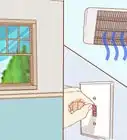
1In chilly or wet months, moisture can accumulate in rooms that aren't well heated. This leads to dry rot. So, at the beginning of your wet or cold season, check the heater in every room of your house (including the basement!) and make sure it works. If your home is centrally heated, check all of the air vents in your home at least twice per winter to make sure they're blowing out hot air and not obstructed.[11]
- If you have electrical heaters in your home and 1 isn't working, contact a local electrician. Ask them to pay a visit to your home and repair the malfunctioning heater.
Advertisement

Method 8
Method 8 of 8:Apply a borate preservative to permanently prevent dry rot.
-
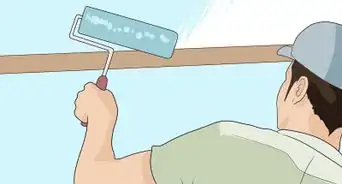
1Treating exposed timber with a borate wood preservative will ensure that it's rot-proof. If you're concerned that timber may get infected with dry rot in the future, your best bet is to coat the exposed ends of the wood with a liquid borate preservative. Dip a small 2 in (5.1 cm) paintbrush into the container of liquid borate. Use short, even strokes to paint a thick layer of the borate preservative onto whatever timber you'd like to treat.[12]
- Borate—another term used for boric acid—is a powerful fungicide that's sold at most hardware stores.

Community Q&A
-
QuestionDo you have to remove dry rot?
 Ryaan TuttleRyaan Tuttle is a Home Improvement Specialist and the CEO of Best Handyman Boston. With over 15 years of experience, Ryaan specializes in home improvement and property maintenance by leveraging technology and craftsmanship. Ryaan holds his Construction Supervisor and Home Improvement Contractor Licenses. Unlike most handyman contractors, Best Handyman Boston is licensed and insured. Boston Magazine and LocalBest.com have named Best Handyman Boston the Best Handyman in Boston.
Home Improvement SpecialistYou should definitely remove and replace dry rot if there's a lot of it in your home. If you only have a little bit, you might not have to worry. -
QuestionHow do you fix dry rot?Ryaan TuttleRyaan Tuttle is a Home Improvement Specialist and the CEO of Best Handyman Boston. With over 15 years of experience, Ryaan specializes in home improvement and property maintenance by leveraging technology and craftsmanship. Ryaan holds his Construction Supervisor and Home Improvement Contractor Licenses. Unlike most handyman contractors, Best Handyman Boston is licensed and insured. Boston Magazine and LocalBest.com have named Best Handyman Boston the Best Handyman in Boston.
Home Improvement SpecialistIdentify the the source of the moisture that's causing your dry rot. Then, seal away or stop this moisture so it can't seep into the wood anymore.
Things You'll Need
Getting Rid of Dry Rot
- Boric acid
- Trim router
- Epoxy
- Putty knife
- 80-grit sandpaper
- 120-grit sandpaper
Preventing Dry Rot
- Box fans
- Borate wood preservative
- 2 in (5.1 cm) paintbrush





References
- ↑ http://www.livingwithbugs.com/dry-rot.html
- ↑ https://oldbuilders.com/job_types/Dry_Rot/1_dryrot_01.htm
- ↑ Ryaan Tuttle. Home Improvement Specialist. Expert Interview. 24 September 2021.
- ↑ https://youtu.be/3l7XtxIjT40?t=216
- ↑ https://www.thisoldhouse.com/ask-toh/repairing-rotted-window-sills
- ↑ https://www.thisoldhouse.com/how-to/how-to-fix-rotted-wood-epoxy
- ↑ Ryaan Tuttle. Home Improvement Specialist. Expert Interview. 24 September 2021.
- ↑ http://www.askjeff.co.uk/dry-rot-or-not-that-is-the-question/
- ↑ Ryaan Tuttle. Home Improvement Specialist. Expert Interview. 24 September 2021.
About This Article