X
wikiHow is a “wiki,” similar to Wikipedia, which means that many of our articles are co-written by multiple authors. To create this article, 27 people, some anonymous, worked to edit and improve it over time.
This article has been viewed 326,807 times.
Learn more...
This is a general guide to test any type of heating element for failure using an multimeter to measure the resistance of the element.
Steps
Method 1
Method 1 of 2:Testing A Conventional Element
Method 1
-
1Know the resistance of the element should be this can be calculated using known values:[1]
- R = (V x V) / P [Where V is the voltage powering the element, P is the power the element uses and R is the resistance.] (An example calculation is shown in the tips section)
-
2Now we know what resistance we are looking for we can check the element.Advertisement
-
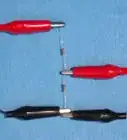
3Use a multimeter to find resistance. Set the multi-meter to the resistance setting with an appropriate measuring scale selected. Measure the resistance by disconnecting the heating element from any power source, and connecting the multimeter leads to the terminals of the heating element.[2]
- If the reading is the same or very close to that of the calculated value, then the element is OK and the fault lies elsewhere.
- If the reading is a lot higher than the calculated value, the element is failing and won't be heating fully.
- If the reading is a lot lower than the calculated value the element, it is failing and will be heating too much or not at all if part of the element has shorted or exploded.
Advertisement


Method 2
Method 2 of 2:Testing A Water Heater Heating Element
Method 2
-
1
- Disconnect the water heater from power source.[3] If it has a disconnectable plug, unplug it. If it does not have a plug, disconnect power by turning off the power breaker or removing the fuse.
-
2Drain the water from the water heater. Locate the water valve at the bottom of the water heater. Attach a garden hose to the emptying valve and turn the valve using a wrench. You will notice a relief valve near the top of the water heater, you can flip the handle up to open it. By doing this it will allow air into the tank causing the water to flow out more quickly.[4]
-
3Wait for the tank to fully empty. Locate the heating element.
-
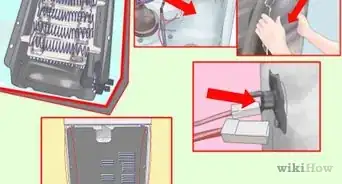
4Remove the electrical wires leading to the heating element.Advertisement


Then remove the heating element using a socket or a wrench and you can now check the element as shown in first method.
Community Q&A
-
QuestionWhy do I multiply two voltages?
 Community AnswerPower formula states that P=IV. Ohms law states that V=IR or I=V/R. Substitute V/R for I in the power formula gives us P=V/R*V or V*V/R, so resistance of the element should be the voltage squared divided by the power.
 -
QuestionHow can I tell if the switch or the element is bad?
 Community AnswerIf the resistance is higher than calculated or it's infinite (so the circuit is open), then you can assume that the heating element has gone bad. Same thing applies to the switch - if after setting the switch to the "on" position, the resistance is infinite, then it means that the switch doesn't close the circuit and it's broken.
 -
QuestionWhat would cause a microwave to not heat up food?
 Debra BishCommunity AnswerIf your microwave oven quits heating food, it's time for a new microwave oven. There is usually not much else one can do when this happens.
 -
QuestionYou are using the formulas for D/C power, but the voltage you are calculating with is Peak to Peak A/C. Don't I need to convert it to Vrms first?
 James JemimaCommunity AnswerIn the USA for example, your everyday, normal household AC Voltage does in fact equal Vrms=120V, and of course 2-phase AV Vrms=240V. The numerical conversion is already built into the standard. You can verify this easily as almost every modern multi-meter reports Vrms, as that is the more useful and informative value as opposed to peak values.
Warnings
- Take care when dealing with electricity. If you're not confident in your ability to work with electricity then don’t do it. Ask some one who is, such as an electrician or an electrical engineer.Thanks!
Advertisement
Things You'll Need
- Multimeter or Ohmmeter and Voltmeter
-Step-34.webp)


References
About This Article
Advertisement
-Step-34.webp)