This article was co-authored by Lorena Bravo, MA and by wikiHow staff writer, Janice Tieperman. Lorena Bravo is a Dance Instructor and the Founder of Bravo Dancing Ballroom Academy based in Los Angeles, California. Specializing in ballroom dancing for both American Smooth and International Standard Divisions, Lorena has over 20 years of professional dance experience. Along with running Bravo Dancing, Lorena has served on the faculty of the American Musical and Dramatic Academy and is currently on the faculty at Chapman University’s dance department. She is also the head ballroom coach for the University of Southern California (USC) Ballroom and Latin Dance Team. Lorena holds a BA in Psychology and an MA in Bilingual Education from USC and is certified in Associate American Smooth by the Imperial Society of Teachers of Dancing.
There are 9 references cited in this article, which can be found at the bottom of the page.
This article has been viewed 5,183 times.
Partner dancing spans across a variety of different genres, but it can be a bit intimidating if you don’t have a lot of dance experience. There’s no need to worry—there are plenty of ways for you to test your connection with your partner to see how comfortable and in-sync you are together. For hands-on practice, experiment with a few easy exercises to get the hang of leading and following.[1] If you’re really new to dancing, you may want to review a few ground rules before you get started.
Steps
Method 1
Method 1 of 2:Trying Simple Exercises
-
1Move back and forth with your partner to see if you’re both in sync. Stand 2 ft (0.61 m) or so away from your partner hold hands. Place your weight on the balls of your feet and rock back to your heels, and then back to the balls of your feet. Follow and react to your partner as they rock back and forth, contributing an equal amount of force as your partner as you both push and pull away from one another.[2]
- For instance, if your partner begins to lean back onto their heels, you’d react and lean back onto your heels as well.
- Both dancers need to contribute the same amount of weight and force as they push and pull back and forth.[3] If both partners aren’t providing equal amounts of support, someone could fall over and possibly hurt themselves.
-
2Place your hands on your partner’s chest to develop a comfortable rhythm. Let your partner lead the dance by stepping forward—as they do this, step backward reactively, keeping an even 1 to 2 ft (0.30 to 0.61 m) between you both at all times. As you go forward and backward, lean and direct your steps from the center of your body instead making uneven steps with your arms and legs.[4]
- This is a great exercise for dances where you’ll be in close proximity with your partner, like ballroom or swing dancing.
Advertisement -
3Move side to side with your partner to practice being in sync. Hold your partner’s hand and stand about 2 ft (0.61 m) or so apart, keeping your opposite hand free to move while you dance. Watch as your partner moves their hips back and forth, then mimic the movement and speed with your own hips. Try to keep up with your partner as they adjust, which will help you stay in sync with them throughout a future dance.[5]
- If you are unable to keep up with your partner’s adjustments, you may need to practice with them a little longer before graduating to a partner dance.
-
4Touch hands while pushing from your center as a trust exercise with your partner. Stand 2 to 3 ft (0.61 to 0.91 m) away from your partner with your feet shoulder-width apart. Extend your left hand forward and upwards, keeping your elbow bent at slightly larger than 90 degrees. Invite your partner to mirror this motion, and touch hands as though you’re both high-fiving. Stand on your toes with your partner, pushing from the center of your body to balance with your partner.[6]
- The real test is seeing if you and your partner are supporting one another equally, instead of pushing one another backward.
-
5Turn your partner to see if both of you are sturdy and balanced. Place you and your partner’s right on 1 another’s shoulders, then clasp your left hands together, bending your elbows at a firm, 90-degree angle. Guide your partner into a turn, making sure that their elbow stays at a sturdy, 90-degree angle. Complete the turn, then return to your original dancing position.[7]
- If your partner’s elbow pushes forward and loses its rigid angle, reset your dancing position and try again.
- A proper turning technique is important to maintaining a strong connection with your dance partner!
Advertisement


Method 2
Method 2 of 2:Practicing Good Habits
-
1Follow your partner’s lead instead of preparing for the next step. Wait for subtle signals that your partner gives throughout the dance, like lifting their arms or changing the step pattern.[8] Don’t try to predict when these changes will come, or you may lose the natural rhythm of your partner dance.[9]
- A good partner dance connection comes from trust. If you’re trying to guess what your partner will do, you lose that element.
- For instance, if you’re slow dancing with your partner, wait for them to extend their hand before you start turning.[10]
-
2Provide clear cues to your partner if you’re leading the dance. Make clear motions and take clear steps, depending on the type of dance that you’re doing. Keep your movements smooth and noticeable so your partner can easily follow along and transition with you through the dance.[11]
- For instance, if you’re about to tip your partner backward, move your hand to their lower back.
-
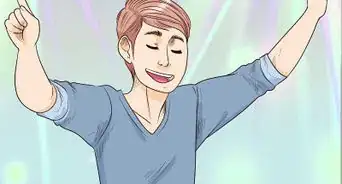
3Make friendly eye contact while you dance. Keep your eyes focused on your dance partner so the dance can go as smoothly as possible. A friendly smile and polite eye contact can go a long way in a dance, and really boost the connection between you and your partner.[12]
- If your partner is scowling or awkwardly looking away, the dance won’t feel very cohesive or connected.
-
4Avoid controlling the dance when you lead. Remember that the “lead” is simply the person in charge of the transitions of the dance, and nothing more. Don’t try to jerk your partner around or force them into a certain dance position.[13] If you want to have a great dance connection, let the dance flow naturally as your partner follows along.[14]
- For example, if you’re performing a turn with your partner, don’t use your hands to force your partner to turn—instead, let your partner turn on their own.
-
5Maintain an open-minded and flexible mindset when you lead.[15] Don’t be disappointed if your partner misses a cue or doesn’t follow your invitation within the dance. Instead, continue on with the dance as you normally would. If you have a good connection with your dance partner, you’ll be able to go with the flow regardless of what happens.[16]
- For instance, if you do a cue to dip your partner and they don’t respond, continue on with the dance as you normally would.
Advertisement


Community Q&A
Did you know you can get expert answers for this article?
Unlock expert answers by supporting wikiHow
-
QuestionHow can I get over my nervousness when dancing with a partner?
 Lorena Bravo, MALorena Bravo is a Dance Instructor and the Founder of Bravo Dancing Ballroom Academy based in Los Angeles, California. Specializing in ballroom dancing for both American Smooth and International Standard Divisions, Lorena has over 20 years of professional dance experience. Along with running Bravo Dancing, Lorena has served on the faculty of the American Musical and Dramatic Academy and is currently on the faculty at Chapman University’s dance department. She is also the head ballroom coach for the University of Southern California (USC) Ballroom and Latin Dance Team. Lorena holds a BA in Psychology and an MA in Bilingual Education from USC and is certified in Associate American Smooth by the Imperial Society of Teachers of Dancing.
Professional Dance Instructor & CompetitorI would say you need to remind yourself that no one expects you to be some champion level dancer. Try to relax, follow along, and do the best you can. Have a good time because a good dance is a fun dance.
Support wikiHow by unlocking this expert answer.
Warnings
- Don’t try any risky dance moves with your partner, like lifts or “aerial” moves. These dances demand a lot more than just a good partner connection, and require a lot of experience and practice.[18]Thanks!

-Step-19-Version-2.webp)


References
- ↑ Lorena Bravo, MA. Professional Dance Instructor & Competitor. Expert Interview. 19 May 2020.
- ↑ https://m.youtube.com/watch?v=rgwWEKlpFKU&t=0m32s
- ↑ Lorena Bravo, MA. Professional Dance Instructor & Competitor. Expert Interview. 19 May 2020.
- ↑ https://m.youtube.com/watch?v=rgwWEKlpFKU&t=1m17s
- ↑ https://m.youtube.com/watch?v=CKyb07txur4&t=0m40s
- ↑ https://m.youtube.com/watch?v=9Xwa1qzDSyw&t=2m0s
- ↑ https://m.youtube.com/watch?v=9Xwa1qzDSyw&t=4m21s
- ↑ Lorena Bravo, MA. Professional Dance Instructor & Competitor. Expert Interview. 19 May 2020.
- ↑ https://socialdance.stanford.edu/syllabi/partnering.htm
- ↑ https://m.youtube.com/watch?v=N6t0yjNBc84t=2m49s
- ↑ https://socialdance.stanford.edu/syllabi/partnering.htm
- ↑ https://personal.utdallas.edu/~aria/dance/etiquette.html
- ↑ Lorena Bravo, MA. Professional Dance Instructor & Competitor. Expert Interview. 19 May 2020.
- ↑ https://socialdance.stanford.edu/syllabi/partnering.htm
- ↑ Lorena Bravo, MA. Professional Dance Instructor & Competitor. Expert Interview. 19 May 2020.
- ↑ https://socialdance.stanford.edu/syllabi/partnering.htm
- ↑ Lorena Bravo, MA. Professional Dance Instructor & Competitor. Expert Interview. 19 May 2020.
- ↑ https://personal.utdallas.edu/~aria/dance/etiquette.html
About This Article