This article was co-authored by wikiHow Staff. Our trained team of editors and researchers validate articles for accuracy and comprehensiveness. wikiHow's Content Management Team carefully monitors the work from our editorial staff to ensure that each article is backed by trusted research and meets our high quality standards.
wikiHow marks an article as reader-approved once it receives enough positive feedback. In this case, 84% of readers who voted found the article helpful, earning it our reader-approved status.
This article has been viewed 451,787 times.
Learn more...
Replacing a timing belt is one of those things that scares most car owners because it is an in-depth job and usually quite expensive when done at a shop.[1] More often than not, it is actually the tensioner that goes bad, not always the belt (unless it is really old). Most of the time a belt will break due to a seized pulley or bad tensioner allowing it to contact the timing cover.
Steps
-
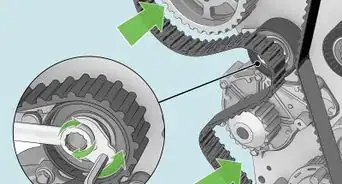
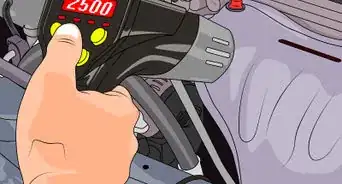
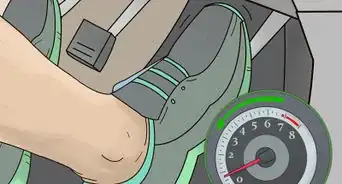
1Listen. A bad tensioner will usually be accompanied by noise.[2] This noise could be some type of squealing or rattling coming from the timing cover area. Also, when your timing belt is loose, it will cause some drivability issues usually under high load or high rpm. If your timing belt is not properly tensioned it will not keep the valves timed properly to the lower end and this will cause misfires, loss of power, bucking, and could even cause a no start condition.
-
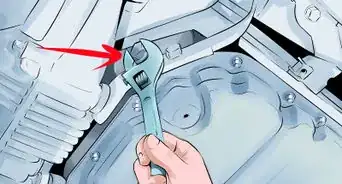
2If the car runs, then stand on the side of the car where the pulleys are and try to distinguish where the noise is coming from. If you hear the noise coming from the front of the engine and it is not coming from your accessories, you may hear the belt flapping around due to the loss of tension.[3]
-
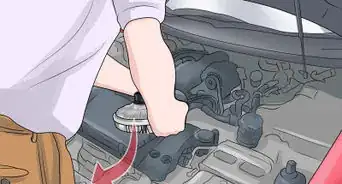
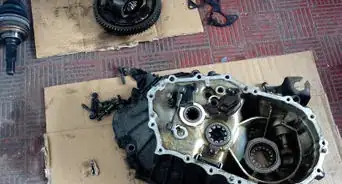
3If the car doesn't run and you are going to be the one doing the work, then remove your front accessories enough to get to the front cover. Once done, remove the front cover and check to see how loose the belt is. There should be a little slack on the opposite side of the tensioner, but not much.[4]
-
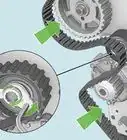
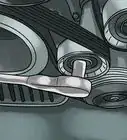
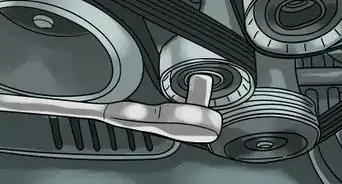
4With the cover off, check for the free movement of all the idler pulleys and the tension itself. It will be very apparent if something is broken.
-
5While you are in there, it is smart to just get a timing belt kit and replace all the pulleys and the belt.[5]
-
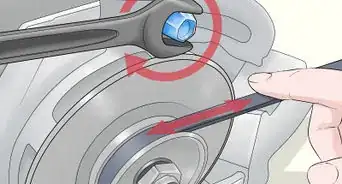
6Make sure that you line up all your marks and set the proper tension on the belt.


Community Q&A
-
QuestionI have had to change my timing belt twice within a year. What could be the cause?
 Community AnswerFirst, check that none of the teeth that the belt is riding on are worn. Worn teeth will dig into the belt and cause premature wear. Then, check each gear's bearing. The belt tensioner bearing is the most likely one to fail first, but it's usually the easiest to check and fix. With the belt off, spin the belt tensioner (which is usually the plain, smooth wheel on a spring loaded arm; the smooth side of the belt rides along it). A bad bearing will not spin as easily and/or will sound rough. Finally, check for rubbing. See if anything is rubbing against the belt, causing it to fail.
 -
QuestionHow can I know whether the mechanic has been truthful about the timing chain tensioner leaking and it costing $1000?
 Fouad Martin YousfiCommunity AnswerThe timing chain tensioner is a part that requires a lot of work to change. That's caused by the necessary time to reach the tensioner and to synchronize the chain, which is in the engine, not as a belt that is external. Sometimes, to prevent maintenance, your mechanic can change the chain, as if the tensioner was bad, the chain may have some damage too, and a good mechanic would take a profit of the removal to change everything that may need some further costly maintenance or irreversible damage. As far as the mechanic being truthful about it leaking, you could take it to another mechanic for a second opinion and quote.
 -
QuestionDo I always have to get the "kit" for replacing the timing belt, or can I just replace the belt?
 Community AnswerThe kit is only necessary if you do not have the other parts or tools that it includes. If you have these items, you may replace the belt alone.
 -
QuestionWhen I start the engine, I hear noise coming from the timing belt. It stops after a few minutes. What should I do?
 Community AnswerYou could take it to a mechanic or replace the belt tensioner yourself and see if the noise stops.
 -
QuestionWhat could be wrong if there is a rattling noise under my car when I switch off the engine?Fouad Martin YousfiCommunity AnswerThe rattling noise can come from any number of things. Check the accessory belt for any bad tension, the exhaust manifold protection, the exhaust hangers, the engine mounts, and finally the engine itself for any problems.
-
QuestionI have a 2001 Toyota Sienna. What does it mean when I start up and it squeals - a noise which goes away with pressure on the gas petal? While driving, it will squeal again coming to a stop. What could be the problem?Community AnswerIt could be your fan belt that needs replacement. In my experience, the belt is the only cause of squealing. Check for wear and replace if necessary.
-
QuestionI have a 2006 Trailblazer and I was told that my timing belt is bad. Does that mean my engine is shot?
 Community AnswerNo. As long as your engine is currently running fine, then you just need to replace the timing belt.
 -
QuestionCan a bad tensioner spring stop a car from running?Brett GilbertTop AnswererYes, it can. If the tensioner doesn't work properly, the belt can come loose and prevent the engine components from running. It can shut down the battery or cause the engine to overheat.
-
QuestionWhat do I do if my RPMs won't go past 3 after changing the timing belt?Brett GilbertTop AnswererCheck the pulley alignment inside the engine compartment. The tensioner or another belt, such as the alternator, may not be aligned properly with the belt. Replace the pulleys as needed so the belt runs smoothly. Also, make sure the belt is tight enough so it runs smoothly over the pulleys.
-
QuestionWhy do I get a strange noise when I press the accelerator in my Suzuki Liana?Brett GilbertTop AnswererThere could be a number of problems. Check the timing belt first for grinding, clicking, or other sounds. It could also be a fuel injector issue or something else entirely. Try to narrow down the source of the sound to identify the issue.


References
- ↑ https://www.carbibles.com/timing-belt-replacement/
- ↑ https://www.gatestechzone.com/en/problem-diagnosis/accessory-drive-system/tensioner-failure-signs
- ↑ https://www.carbibles.com/belt-tensioner-symptoms/
- ↑ https://jalopnik.com/heres-what-happens-when-your-timing-belt-snaps-and-how-1643804882
- ↑ https://www.popularmechanics.com/cars/how-to/a1425/4212995/
About This Article