This article was co-authored by Patrick Muñoz and by wikiHow staff writer, Hannah Madden. Patrick is an internationally recognized Voice & Speech Coach, focusing on public speaking, vocal power, accent and dialects, accent reduction, voiceover, acting and speech therapy. He has worked with clients such as Penelope Cruz, Eva Longoria, and Roselyn Sanchez. He was voted LA's Favorite Voice and Dialect Coach by BACKSTAGE, is the voice and speech coach for Disney and Turner Classic Movies, and is a member of Voice and Speech Trainers Association.
There are 8 references cited in this article, which can be found at the bottom of the page.
This article has been viewed 102,144 times.
Being a naturally quiet person isn’t a bad thing, but there may come a time that you’d like to speak up a little more to make your voice heard. As with most things, holding a conversation is a skill that you can get better at with practice. With a little patience and some hard work, you can become comfortable talking with people one-on-one or in large groups.
Steps
Method 1
Method 1 of 13:Think of topics to talk about ahead of time.
-
1Come up with 2 to 3 things you feel comfortable chatting about. You don’t have to prepare a script, but try to make a short list of fun, easy conversation topics to fall back on. You could talk about your hobbies, your job, your travel plans, or your recent projects.[1]
- Then, if you find yourself stumbling or the conversation is lulling, you can steer the topic toward something you feel comfortable talking about.
- For example, if you’re super into a new board game, you could ask the person you're talking to if they’ve ever played it.
- Or, if you just adopted a new pet, ask them if they have a dog and tell them about yours.

Method 2
Method 2 of 13:Act like you’re confident, even if you’re not.
-
1Try to fake it until you make it. If you pretend like talking to new people or a group of strangers is no big deal, eventually, it will be! Hold your head up high and tell yourself that you aren’t nervous at all (because there’s no reason to be).[2]
- Faking it until you make it takes time to work, so don’t get discouraged if it takes a few tries.

Method 3
Method 3 of 13:Maintain open body language.
-
1Make eye contact and stand up straight. Let people know that you’re ready and willing to talk, even if you haven’t said much yet. You don’t have to keep eye contact 100% of the time, but it helps to glance up at the person you’re talking to every now and then.[3]
- If you’re standing, try to plant your feet in a wide stance and roll your shoulders back to maintain good posture.

Method 4
Method 4 of 13:Smile at people to signal you’d like to talk.
-
1Starting a conversation can be tough. If you want to chat with someone but you aren’t sure how to start, try catching their eye and smiling. If they get the message, they might just come over and start talking to you![4]
- This is a great tactic for parties or large group settings where it can be hard to get a word in edgewise.

Method 5
Method 5 of 13:Say something when there’s a pause in the conversation.
-
1These lulls are your chance to get a word in. If the conversation stalls for more than a few seconds, you can say something related to the previous subject or something completely random. You can also find common ground that might provide a good opening remark, like similar interests in a certain type of music.[5]
- The other person might also ask you questions to keep the conversation going.

Method 6
Method 6 of 13:Make brief, quick commentaries.
-
1Start with small statements, noises, or exclamations. This works especially well in large group conversations where it’s tough to make extended statements anyway. Consider saying, “Yeah,” or, "You’re right," if you agree with someone. If you are not sure or are surprised, you might comment, “No way,” or, “Really?”[6]
- In a group setting, even laughing counts as contributing. It also still signals to others that you are an active listener.

Method 7
Method 7 of 13:Raise your voice during group conversations.
-
1Large, loud groups tend to be a little harder to interject yourself into. If you’re at a party or a gathering and you’re in a group setting, try to raise your voice to be heard over the other people or the music. Use gestures and open body language to make it clear that you’re speaking.[7]
- During large, loud conversations, the rules of social engagement are slightly different. You may have to interject quickly after someone finishes talking so you get a chance, or you might have to raise your voice and continue talking if you start talking at the same time as someone else.

Method 8
Method 8 of 13:Compliment the other person.
-
1Everyone likes to hear something good about themselves. A friendly compliment is a great way to start a conversation off on the right foot. You can compliment a total stranger or someone you know well. For example:[8]
- “That’s a super cute purse, can I ask where you got it?”
- “Your costume looks amazing! Did you make it yourself?”
- “You really know your way around this area. Have you lived here long?”

Method 9
Method 9 of 13:Ask questions during a conversation.
-
1Contribute by listening closely and asking follow-up questions. Try to ask open-ended questions rather than “yes” or “no” ones to keep the conversation going. Ask questions like:[9]
- “That’s so interesting. What did you do next?”
- “How long have you lived in the area?”
- “What do you do now?”

Method 10
Method 10 of 13:Expand on things you have in common.
-
1Take note of any similarities you have with your conversation partner. Ask follow-up questions or explain a little bit more about your interest in the subject. Before you know it, you’ll be having a fun, lively conversation. For example:[10]
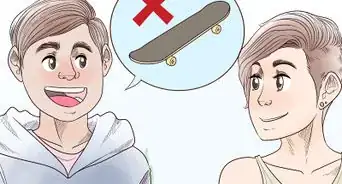
- “I didn’t know you were into skateboarding! I’ve been skateboarding since I was 14.”
- “You grew up in Florida, too? I lived there for 10 years.”
- “We live in the same neighborhood, how weird is that!”

Method 11
Method 11 of 13:Set a goal to talk every few minutes.
-
1Give yourself a general rule to follow during conversations. Try saying something every 5 minutes (or more often if you feel like it). That way, you’ll keep up with the flow of the conversation and give some input about what you think.[11]
- When you have a goal in mind, you’re less likely to get distracted by your own thoughts or daydream instead of actively listening.

Method 12
Method 12 of 13:Accept the silence if it happens occasionally.
-
1Conversation lulls are going to happen, and that’s okay. Oftentimes, if you and your conversation partner just take a brief pause, one of you will come up with something to say. Try to stick with it, even if there are a few moments of silence every now and then.[12]
- Sometimes, people will go quiet if they aren’t sure how to end the conversation. If you’ve been chatting for a few minutes and you feel like the conversation is over, feel free to wrap it up.

Method 13
Method 13 of 13:Practice talking more at home.
-
1Hold conversations with your family, friends, and loved ones. The more you talk, the better you’ll get at it! If you can’t think of anything to say, pick out your favorite book and read it aloud as you pay attention to the tone of your voice and your pronunciation.[13]

Community Q&A
-
QuestionHow can I talk more confidently?
 Patrick MuñozPatrick is an internationally recognized Voice & Speech Coach, focusing on public speaking, vocal power, accent and dialects, accent reduction, voiceover, acting and speech therapy. He has worked with clients such as Penelope Cruz, Eva Longoria, and Roselyn Sanchez. He was voted LA's Favorite Voice and Dialect Coach by BACKSTAGE, is the voice and speech coach for Disney and Turner Classic Movies, and is a member of Voice and Speech Trainers Association.
Public Speaking CoachIf you're naturally very quiet, it's important to develop your voice. For instance, you might work on tongue twisters, read poetry out loud, or take an improv class. If you're struggling to do this on your own, it can be very helpful to work with a speech coach or voice therapist. -
QuestionHow do you stay calm when doing a speech?
 wikiHow Staff EditorThis answer was written by one of our trained team of researchers who validated it for accuracy and comprehensiveness.
Staff AnswerwikiHow Staff EditorStaff AnswerTry practicing a lot at home with your friends and family members. Before you get up to do your speech, take a deep breath and remind yourself that you know what you're doing. Before you know it, you'll be up on stage receiving a round of applause! -
QuestionHow do I stop myself from regretting everything when I talk?
 Community AnswerThe best thing that you can do is to remind yourself that the past is in the past and you need to move forward. Think about what you regretted saying and decide if you need to find a way to avoid repeating the same type of thing. If it really wasn't anything inappropriate, etc., then stop blaming yourself and focus on what you did add to the conversation.
 -
QuestionHow can you improve your stuttering when speaking?
 Community AnswerIt's probably best to start off by practicing speaking as often as you can. Read aloud to yourself and others who you trust. Even singing to music aloud might help you to relax and improve your ability to speak smoothly. And, you could always consider speaking with a speech therapist for additional tips.
 -
QuestionHow do I get over the fear of saying the wrong thing when I'm quiet?Community AnswerRemember that saying the wrong thing is not the end of the world. It happens to everybody sometimes. People forget all about it almost immediately (unless you've said something really hurtful or offensive, which you probably wouldn't).













References
- ↑ https://www.businessinsider.com/how-to-keep-a-conversation-going-2011-1
- ↑ https://www.helpguide.org/articles/relationships-communication/dealing-with-loneliness-and-shyness.htm
- ↑ https://psychcentral.com/blog/7-ways-to-overcome-shyness-and-social-anxiety#3
- ↑ https://www.helpguide.org/articles/relationships-communication/dealing-with-loneliness-and-shyness.htm
- ↑ https://www.psychologytoday.com/us/blog/fulfillment-any-age/201712/10-must-know-tips-making-better-conversations
- ↑ http://www.succeedsocially.com/quiet
- ↑ https://www.succeedsocially.com/groupconversations
- ↑ https://www.helpguide.org/articles/relationships-communication/dealing-with-loneliness-and-shyness.htm
- ↑ https://www.businessinsider.com/how-to-keep-a-conversation-going-2011-1
- ↑ https://www.helpguide.org/articles/relationships-communication/dealing-with-loneliness-and-shyness.htm
- ↑ https://www.succeedsocially.com/quiet
- ↑ https://www.psychologytoday.com/us/blog/fulfillment-any-age/201712/10-must-know-tips-making-better-conversations
- ↑ https://psychcentral.com/blog/7-ways-to-overcome-shyness-and-social-anxiety#2
About This Article

Being a naturally quiet person can be challenging, especially when you want to join in the conversation, but with patience and practice, you can find your voice. When you’re speaking with other people, listen closely to what they have to say and ask follow up questions. You can also make small comments or exclamations, especially in larger group conversations. For example, if you agree with something say “Yeah” or “You’re right” instead of simply smiling or nodding your head. If the thought of saying anything at all makes you anxious, then give yourself a brief pep talk ahead of time. Remind yourself that you’re knowledgable and have something to contribute. You can even practice talking in less-stressful situations. For instance, set a goal to talk to 1 new person every day, like saying “thank you’ to a grocery clerk. You can also read out loud at home to get used to hearing your own voice. To learn how to join conversations early, keep reading!