X
wikiHow is a “wiki,” similar to Wikipedia, which means that many of our articles are co-written by multiple authors. To create this article, 9 people, some anonymous, worked to edit and improve it over time.
This article has been viewed 28,888 times.
Learn more...
This article aims to in a few simple steps show you how to take off in a Cessna 150, and climb to a cruising altitude using best rate of climb (Vy). This article in no way replaces the need for lessons from a certified instructor.
Steps
-
1Complete all safety checks including walk-around , ensuring you have sufficient fuel and oil for your planned flight.
-
2After your have followed the specific checklist to your aircraft. Taxi to the runway and hold short (come to a complete stop at the yellow line). Check that there are no other aircraft on final approach. When the way is clear make a radio call to ensure that the tower and other traffic know your intentions.
-
3When you have received clearance or provided other traffic with your intentions taxi onto the runway and align with the center line.
-
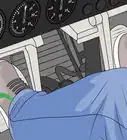
4Apply full throttle to the aircraft (push throttle all the way in), ensure that the airspeed indicator comes alive by checking that it shows an increasing reading of airspeed.
-
5When the aircraft reaches the targeted airspeed of 50 knots (no X-winds), gently apply back pressure on the control column to "Rotate" the nose gently off the runway. Be sure not to pull back too far and cause the aircraft to lose too much speed. Accelerate and maintain 65-70 knots.
-
6As the aircraft gains some altitude make adjustments to the amount of back pressure applied on the control column so the airspeed indicator reads 68 knots. This is the speed where the aircraft will gain the most altitude for the amount of time. If the aircraft is going too slow, gently lower the nose slightly until the airspeed rises to the targeted airspeed of 68knots.
-
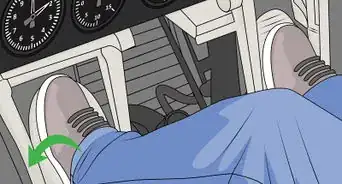
7To alleviate the need for constant back pressure on the control column in order to maintain the targeted speed you can trim the aircraft. Once the aircraft is stabilized into a climb at 68 knots trim the aircraft using the trim wheel. To trim the aircraft so the nose points more towards the ground rotate the wheel upwards, rotate the wheel downwards to raise the aircraft nose. This may take some adjustment. After you have trimmed the aircraft correctly it will maintain the targeted speed.
-
8Every 500 feet (152.4 m) of altitude you gain gently lower the nose by pushing forward on the control column so that you have a good view of what's in front of you. Perform a lookout for any conflicting aircraft or terrain that may cause a problem to your flight.
-
9Once the lookout has been performed and it is safe to continue the climb allow the aircraft to bring its nose back up. Remember that it is still trimmed so this should take little effort from you.
-
10When you have reached your desired altitude lower the nose so that the plane is no longer gaining altitude by pushing forward on the controls.
-
11When the climb has stopped decrease the amount of throttle so the RPM indicator shows between 2300-2400 rpm.
-
12Trim the aircraft using the trim wheel so that the aircraft no longer wants to climb by itself. This will most likely require you to rotate the trim wheel up so the nose of the aircraft comes down.


Warnings
- This guide does not replace an instructor.Thanks!
- Don't do this without a supervisor. An experienced one, at that.Thanks!
- Don't stress, let the machine be part of you.Thanks!
Things You'll Need
- Cessna 150
- Certified Instructor
- Appropriate licenses




-Step-15.webp)
References
- [1] Cessna Aircraft Company. 150 Commuter: Pilot's Operating Handbook, Cessna Aircraft Company, 1987.
- [2] Canada. Transport Canada. Flight Training Manual,4th edition. Ottawa: Minister of Transport, 2004.