This article was co-authored by Robert Rybarski and by wikiHow staff writer, Janice Tieperman. Robert Rybarski is an Organizational Specialist and Co-Owner of Conquering Clutter, a business that customizes closets, garages, and plantation shutters to ensure organized homes and lifestyles. Robert has over 23 years of consulting and sales experience in the organization industry. His business is based in Southern California.
There are 20 references cited in this article, which can be found at the bottom of the page.
This article has been viewed 277,593 times.
In a way, your clothes are an extension of who you are. While it feels great to slip into a stylish, comfortable outfit, sliding into a wrinkly shirt or pair of pants just doesn’t feel great. Don’t worry. While it takes a bit of extra effort, it’s easy to both improve and optimize your laundry routine. Whether you’re snuggling up on the couch for a movie night or heading out to the club with some friends, we’ve got lots of tips to help keep all your clothes in great shape.
Steps
Method 1
Method 1 of 15:Sort your clothes before washing them.
-
1Laundry is a big mixing and matching game. It may be tempting to toss all your clothes into the washer at once, but this isn’t always the best option. Instead, sort your clothes by color, as well as by how dirty they are. Also, divide certain clothes, like loose knits and delicates, into their own separate load. It may seem a bit tedious at first, but sorting your laundry helps keep your garments in great shape.[1]
- Coloring sorting prevents any unwanted dye transfer during the wash cycle. Sorting clothes by dirtiness stops any extra grime from sticking to your less-soiled clothes.
- For instance, you could divide your laundry into 4 color piles: whites, pastels and medium-toned garments, brights, and darks.
- You might also separate your really dirty clothes from your less soiled ones.
- Experts also suggest washing towels, fuzzy shirts, and fuzzy robes in their own load, since they tend to give off lots of lint.

Method 2
Method 2 of 15:Read the care labels.
-
1Care labels walk you through the best laundry options for your clothes. Check for a soft tag along the inside of your garment—it’ll probably have a series of different symbols on it. These shapes suggest the best wash temperature and cycle to use, as well as any other precautions you should take.[2]
- The bucket of water symbol lets you know if and how you can wash your garment.
- An open triangle means you can bleach the garment, while a solid, crossed out triangle means you shouldn’t use bleach.
- A square with a circle inside represents specific tumble drying instructions.
- A symbol of an iron means that the garment is safe to iron.

Method 3
Method 3 of 15:Treat stains right away.
-
1Stains are easier to remove when they haven’t set into the fabric. Experts advise blotting the stain with a clean sponge instead of rubbing it in, since rubbing a stain will only force it deeper into the fabric. Laundry experts also suggest pretreating the stain before tossing it into the wash.[3]
- If you spilled coffee on your favorite shirt, soak the stained fabric in cold water and pretreat it with detergent or stain remover. Then, wash the garment with sodium hypochlorite bleach, if the care label allows it.[4]
- To treat ink stains, dip a clean sponge in rubbing alcohol and dab it around and over the stain. Flip the garment over, setting the stain face-down on a sheet of clean paper towels. Dab more rubbing alcohol along the back of the stain, replacing the paper towels as needed. Then, rinse out the stain as best as you can, and wash the garment as you normally would.
- For fresh blood stains, soak the clothing item in a container of cold water, and wash it as usual. For dried blood stains, soak the garment in a basin of warm water mixed with an enzyme-rich product. Then, launder the clothing item as usual.
- To care for light mud stains, spread a powder detergent paste over the soiled area and wash it as you normally would. For heavier mud stains, pretreat the garment in a basin of water mixed with a detergent or enzyme-rich product. Then, add it to your next load of laundry.

Method 4
Method 4 of 15:Launder T-shirts in cold water.
-
1T-shirts are safe to toss in both your washer and dryer. Experts recommend a cold water cycle in the washer, along with a permanent press cycle in the tumble dryer. If your shirts have obvious pit stains, wash them with an oxygen-based bleach.[5]
- In general, cold water is better for your clothes, and may keep them from shrinking and fading over time.[6]

Method 5
Method 5 of 15:Wash jeans infrequently and inside-out.

Method 6
Method 6 of 15:Hand-wash delicates in cool water and let them air-dry.
-
1Delicates don’t hold up well in the washing machine. Unfortunately, a run through your washer may damage the elastic, if your garment has an elastic band.[9] Instead, hand-wash your garments in a basin of cool water with 1 tsp (4.9 mL) of gentle detergent.[10] Then, delicately wring out any leftover water, and drape the clothing item on a drying rack.[11]
- “Delicates” include garments like your intimates, swimsuits, and underwear.

Method 7
Method 7 of 15:Press or air-dry dress shirts after washing them.
-
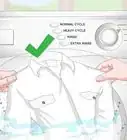
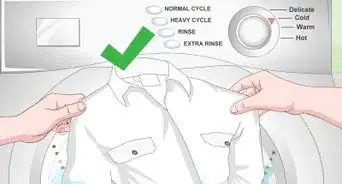
1It’s safe to wash dress shirts at home, but don’t tumble dry them. Treat any stains ahead of time, and toss your shirt into a cold water cycle. Once the wash cycle is done, shake out the shirt to get rid of any wrinkles. Then, press your shirt or air-dry it on a hanger.[12]
- Unfortunately, tumble dryers will shrink and damage your shirt over time.
- Experts recommend ironing dress shirts straight out of the washer. In general, iron the collar first, then the cuffs, and then the body of the shirt.

Method 8
Method 8 of 15:Clean delicate fabrics carefully so they don’t get ruined.
-
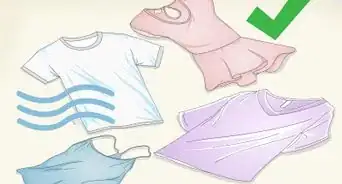
1Delicate fabrics don’t fare well in a standard laundry load. Materials like rayon, lycra, silk, wool, nylon, thin knits, and spandex all qualify as delicate materials, along with hand-knitted and hand-crocheted garments. Try not to wash these clothing items unless they’re really dirty, and always check the care label before cleaning them. Once these garments are all clean, stash them in a cool, roomy area.[13]
- For instance, you can hang delicate jackets, dresses, and shawls on padded hangers, while knitwear can be folded and stored flat.
- Always take extra-fine silk, leather, furs, feathers, and suede to a professional cleaner.

Method 9
Method 9 of 15:Avoid overloading your dryer.
-
1Big loads take a lot longer to dry all the way. Also, larger laundry loads tend to look wrinklier once you pull them out. To prevent any extra complications, dry a small amount of clothes that can move and tumble easily in the dryer.[14]
- Air drying is a great alternative to traditional tumble drying. It’s a lot less hard on your clothes, and it’s better for the environment, too!

Method 10
Method 10 of 15:Iron specific fabrics at their recommended temperatures.
-
1There isn’t a universal temperature that works for all fabrics. Instead, check your care label to see which fabric your garment is made out of. Then, use the designated fabric setting on your iron, if it has one.[15]
- For instance, silk and cotton need to be ironed while the garment is damp, while nylon or polyester should be ironed mostly dry.
- Some irons might come with basic temperature settings, like “cool,” “low,” “warm,” or “hot.” For example, fabrics like acetate, nylon, polyester, and acrylic need a cool iron, wool and silk need a warm iron, and cotton needs a hot iron.
- Ironing your clothes correctly helps keep them in great shape.[16]

Method 11
Method 11 of 15:Hang up your clothing with wooden and padded hangers.
-
1Wooden and padded hangers are much better than wire ones. Wooden hangers work well with coats, pants, jackets, and shirts, while padded hangers provide extra support to garments made with delicate materials, such as silk.[17] Unfortunately, wire hangers don’t provide a lot of support, and may change the shape of your garment eventually.[18]
- Suit hangers are a great option for both suits and certain jackets.
- Hangers with clips are great for skirts.
- Always hang up garments that tend to get wrinkly, like dresses, nice shirts, and suits.
- Felt hangers are another sturdy, safe option for your clothes.[19]

Method 12
Method 12 of 15:Stick with plastic for long-term storage.
-
1Cardboard and wood boxes might damage your clothes over time. Instead, slip your out-of-season garments into plastic boxes, keeping them in a cool, dark, and dry spot.[20]
- If you’re storing garments made with wool or other natural fibers, don’t seal the plastic bin completely. Instead, give your clothes a little room to breathe.

Method 13
Method 13 of 15:Mend your clothes as needed.
-
1Purchase a sewing kit for any last-minute repairs. Tears, snags, and rips can pop up when you least expect them, but they don’t have to be a death sentence for your favorite garments. Shop for a sewing kit online, or pick one up from a big-name retail store. When the time comes, mend your clothes with a sewing needle and a spool of thread that matches your garment.[21]
- Sewing kits usually come with small spools of thread, sewing needles, a small pair of scissors, and other odds and ends. You can pick up a basic sewing kit for less than $10.
- If you aren’t a fan of sewing, fix up your tears and snags with mending glue or iron-on mending fabric instead.[22]

Method 14
Method 14 of 15:Clean your jewelry gently.
-
1Fill a bowl with sudsy, lukewarm water. Soak your jewelry in the mixture, lightly scrubbing away any dirt and grime with a soft brush. Don’t use really hot or cold water—extreme temperatures can damage certain gemstones. Also, try not to soak any porous gemstones, like opals, turquoise, or pearls.[23]
- If any of your jewelry is damaged or broken, take it to a jeweler instead of trying to fix it at home.

Method 15
Method 15 of 15:Clean and store your shoes properly.
-
1Inspect your nice shoes each time you wear them. Before putting them away, clean off your leather shoes with a clean cloth, and wipe away any dust collecting on your suede shoes. Once you’re done wearing them, experts suggest sliding shoe trees into your footwear, so they keep their shape.[24]
- Shoe trees are adjustable, and fit snugly between a shoe’s toe and heel.

Community Q&A
Did you know you can get expert answers for this article?
Unlock expert answers by supporting wikiHow
-
QuestionWhat's the best way to store underwear?
 Robert RybarskiRobert Rybarski is an Organizational Specialist and Co-Owner of Conquering Clutter, a business that customizes closets, garages, and plantation shutters to ensure organized homes and lifestyles. Robert has over 23 years of consulting and sales experience in the organization industry. His business is based in Southern California.
Organizational SpecialistThere are drawer dividers that you can get that would separate your drawer into sections. Then you can put your underwear into the different sections, and maybe categorize them or organize them by color. There are also dividers you can get that expand. You pull a center partition out and it opens up that square area for larger items, like socks.
Support wikiHow by unlocking this expert answer.
-
QuestionWhat's the best way to store shirts on shelves?Robert RybarskiRobert Rybarski is an Organizational Specialist and Co-Owner of Conquering Clutter, a business that customizes closets, garages, and plantation shutters to ensure organized homes and lifestyles. Robert has over 23 years of consulting and sales experience in the organization industry. His business is based in Southern California.
Organizational SpecialistA lot of shelving sections don't have enough space in them height-wise, so if you have to stack five to eight shirts on top of each other, it's always a problem pulling the bottom one out because it tends to take the other ones with them. The best thing to do would be to get more adjustable shelves or some smaller cubbies that would fit the shirts and then you can stack up to 3-4 per shelf or cubbie at the most.Support wikiHow by unlocking this expert answer.
-
QuestionHow should I store my ties in my closet?Robert RybarskiRobert Rybarski is an Organizational Specialist and Co-Owner of Conquering Clutter, a business that customizes closets, garages, and plantation shutters to ensure organized homes and lifestyles. Robert has over 23 years of consulting and sales experience in the organization industry. His business is based in Southern California.
Organizational SpecialistYou can get a tie rack to drape your ties on. Another option is to dedicate a small drawer with dividers in it to your ties. You can roll your ties up and put them in the dividers.Support wikiHow by unlocking this expert answer.
-
QuestionWhy do I need to repair my clothes?
 Community AnswerRepairing your clothes is a cost-effective alternative to replacing them, which many people cannot afford to do.
 -
QuestionHow can store many clothes in a small space?Community AnswerYou could just fold your clothes into rolls like a roll-up sandwich. Maybe you could even put the clothes in an organizer labeled with the types of clothing they are.
-
QuestionWhat can I use to remove chewing gum from clothes?
 Community AnswerUse an ice cube to freeze the gum and a butter knife to scrape it off.
 -
QuestionDoes mixing two different stain removal products together result in better results?Community AnswerIt might, but check the labels of your products first, many will warn you not to mix with other products. The combination of certain chemicals can produce dangerous reactions.
-
QuestionWhy do we need to sort our clothes?
 Community AnswerIt is possible that the dye used to color darker clothes will bleed onto lighter clothes. Also, using bleach to whiten whites will damage clothes with colors.
 -
QuestionWhat's the importance of clothing maintenance?Community AnswerIf you maintain your clothes properly, they will last longer, and you will not have to buy new clothes as frequently.




References
- ↑ https://www.cleaninginstitute.org/cleaning-tips/clothes/laundry-basics
- ↑ https://www.cleaninginstitute.org/cleaning-tips/clothes/laundry-basics
- ↑ https://www.cleaninginstitute.org/cleaning-tips/clothes/laundry-basics
- ↑ https://www.cleaninginstitute.org/cleaning-tips/clothes/stain-removal-guide
- ↑ https://www.nytimes.com/guides/tmagazine/how-to-take-care-of-your-clothes
- ↑ https://www.bhg.com/homekeeping/laundry-linens/tips-checklists/cold-water-laundry/
- ↑ https://www.cleaninginstitute.org/cleaning-tips/clothes/laundry-basics/do-i-need-wash
- ↑ https://www.masterclass.com/articles/how-to-clean-your-jeans-in-a-washing-machine
- ↑ https://www.nytimes.com/guides/tmagazine/how-to-take-care-of-your-clothes
- ↑ https://www.bhg.com/homekeeping/laundry-linens/clothes/how-to-wash-clothes-by-hand/
- ↑ https://www.nytimes.com/guides/tmagazine/how-to-take-care-of-your-clothes
- ↑ https://www.esquire.com/style/mens-fashion/news/a52671/wash-dress-shirts-at-home/
- ↑ https://sewguide.com/wash-care-delicate-fabrics/
- ↑ https://www.bhg.com/homekeeping/laundry-linens/clothes/dry-clothes/
- ↑ https://www.persil.com/uk/laundry/laundry-tips/washing-tips/ironing-tips.html
- ↑ https://sewguide.com/how-to-iron-clothes/
- ↑ https://www.forbes.com/sites/houzz/2016/03/22/how-to-store-clothes-to-make-them-last/?sh=66b2f84057c0
- ↑ https://www.cosmopolitan.com/style-beauty/fashion/advice/a35576/surprising-ways-you-ruin-your-clothes/
- ↑ https://www.cosmopolitan.com/style-beauty/fashion/advice/a35576/surprising-ways-you-ruin-your-clothes/
- ↑ https://www.goodhousekeeping.com/uk/house-and-home/household-advice/a667255/tips-to-storing-away-your-summer-wardrobe-away/
- ↑ https://www.nytimes.com/guides/tmagazine/how-to-take-care-of-your-clothes
- ↑ https://sewguide.com/clothing-repair-mending-tears/
- ↑ https://www.nytimes.com/guides/tmagazine/how-to-take-care-of-your-clothes
- ↑ https://www.nytimes.com/guides/tmagazine/how-to-take-care-of-your-clothes
- ↑ https://www.harpersbazaar.com/uk/fashion/fashion-news/news/a36982/how-to-care-for-your-clothes/
- ↑ https://www.today.com/shop/laundry-room-organization-products-keep-your-space-clean-t177304
- ↑ https://www.apartmenttherapy.com/close-zippers-before-you-do-laundry-261264
- ↑ https://www.consumerreports.org/video/view/appliances/laundry/991542146001/laundry-color-catchers/
About This Article

To take care of your clothes, wear an apron when you’re cooking so you don’t get them soiled or stained. If you do drop or spill things on your clothes, treat the stain immediately by dabbing ice water or seltzer water on it so it doesn’t set. Additionally, remove your clothes from the dryer as soon as it stops, and hang them or fold them right away to prevent wrinkles. You should also watch for loose strings or threads on your clothes, and snip them so they don’t accidentally pull or snag, which can lead to more pulled-out stitches. To learn how to wash and dry your clothes so they’ll last longer, keep reading!