This article was co-authored by Stephanie Anders. Stephanie Anders is the Owner and Head Piercer at Royal Heritage Tattoo and Piercing, a tattoo and piercing studio located in Los Angeles, California. Stephanie has over 10 years of piercing experience and her client list includes such stars as Jennifer Aniston, Jessica Alba, Cameron Diaz, Nicole Richie, Gwyneth Paltrow, and Sharon Osbourne.
This article has been viewed 239,939 times.
Infection is a minor risk with virtually every ear piercing, but one that can increase with unsanitary piercing practices and/or improper care following the piercing. Luckily, the vast majority of infections caused by an ear piercing can be treated with easy home remedies. See Step 1 below to start learning how to deal with an infection in your pierced ear and to prevent future infections.
Steps
Method 1
Method 1 of 2:Treating a Fresh Infection
-
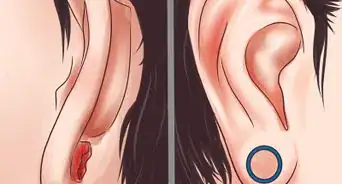
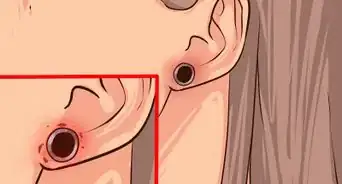
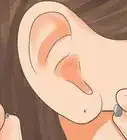
1Identify an infection by looking for redness and swelling. Most ear piercing infections are uncomfortable, but, provided action is taken, are never a serious problem. While newly-pierced ears can have a lingering tender feeling for days or weeks, an actual infection usually comes with redness, swelling, and irritation. If your piercing is exhibiting these symptoms, you probably have a minor infection. Not to worry - most piercing infections go away with a few days of treatment at home.
-
2Wash your hands. Most piercing infections are the result of bacteria being introduced into the piercing. This can be from a variety of sources, though dirty piercing equipment, dirty earrings, and dirty hands are among the most common. The next few steps will require you to touch your ears and earrings with your hands, so, before beginning, be sure to carefully wash with an antibacterial soap them to make them as clean and sterile as possible.[1]
- If you're extra-worried about the germs on your hands, you may even wear a pair of sterile gloves as you work.
-
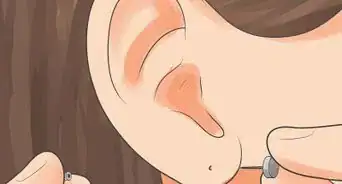
3Remove the earring(s) and clean the infected piercing(s). When your hands are cleaned, carefully remove the earring from the infected piercing. Use a clean cotton swab or Q-tip to apply an anti-bacterial cleaning solution to both sides of the piercing.
- In terms of cleaning solutions, you may have several options. Some earrings come with a solutions specifically-designed for this purpose. If yours did not, most commercial antiseptic solutions (especially ones containing benzalkonium chloride) intended for similar uses will work well.
- Some medical sources recommend rubbing alcohol,[2] while others recommend against it.
- In terms of cleaning solutions, you may have several options. Some earrings come with a solutions specifically-designed for this purpose. If yours did not, most commercial antiseptic solutions (especially ones containing benzalkonium chloride) intended for similar uses will work well.
-
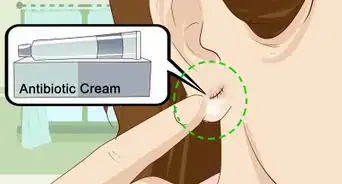
4Clean the earring post and reinsert the earring. Next, clean your earring's post (the part that sits in the piercing) with the same antiseptic solution you cleaned your ear with. After doing this, apply a thin coating of antibiotic ointment or cream to the post. This will help to kill bacteria inside the piercing when the earring is re-inserted. Finally, put the earring back in.
-
5Repeat this cleaning process three times each day. Perform this routine - removing the earring, cleaning the outside of the piercing, cleaning and applying antibiotic ointment to the post, and re-inserting the earring - three times per day. Maintain this routine for two days after the symptoms of the infection disappear.
- This last point is important. When fighting bacterial infections, it's crucial to ensure that the infection has been completely wiped out before stopping treatment. If a small amount of bacteria remain, the infection may return.
-
6Use over-the counter pain medications properly. While you're waiting for your infection to disappear, you can treat the pain and inflammation resulting from it by taking most commercially-available painkillers. Acetaminophen, Ibuprofen, Aspirin, Naproxen Sodium, and most other cheap, common medicines will work fine.
- Even when dealing with these relatively weak drugs, never take more than the recommended dosage or mix drugs carelessly. This is especially true with Non-Steroidal Anti-Inflammatory Drugs (NSAIDs), a class of drugs including Ibuprofen and Aspirin, which have been linked to a variety of serious side effects at high doses.[3]
-
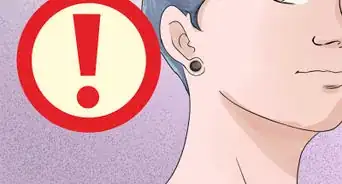
7Don't hesitate to see a doctor if the infection worsens. Though most infections caused by ear piercings are superficial and temporary, some can develop into serious issues. Left untreated, these infections can cause lasting discomfort, permanent damage to the ear, or even worse outcomes. If your infection leads to any of the following symptoms, it's a wise idea to see a doctor as soon as possible to gain access to antibiotics or other forms of treatment:[4]
- Swelling and redness that worsen or do not improve after two days of treatment
- Fluid draining from the site of the infection
- Swelling that becomes so pronounced that it is difficult to see either side of the earring
- Fever over 100.4 °F (38.0 °C)





Method 2
Method 2 of 2:Preventing Future Infections
-
1Avoid touching your earrings, especially with dirty hands. As noted above, one common cause of infection following an ear piercing is the introduction of bacteria into the piercing via the wearer's hands. Though it's easy to absent-mindedly fool with your earrings while you're bored or daydreaming, try to avoid this type of behavior, especially if your hands haven't been recently washed. Doing so lessens the likelihood that you'll accidentally re-infect your piercing.
-
2Clean your earrings and earlobes before inserting your earrings. If you're prone to piercing infections, you may want continue performing the cleaning routine above, albeit less frequently. When you're able to, clean the posts of your earrings and the area around each piercing with an antiseptic fluid before inserting your earrings to kill any bacteria that may be introduced into the piercing.
-
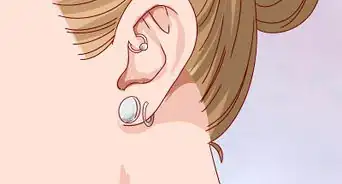
3Wear your earrings with a loose clasp. Believe it or not, one of the causes of ear piercing infection is earrings worn too tightly! If the earring's clasp is applied too tightly, it can cut off the flow of air to the piercing, which, over time, can increase the risk of infection. To prevent this, simply wear your earrings loosely so that air can reach both sides of the piercing.
-
4Remove the earrings before bed once the piercing has become permanent. For the same reason as above, you'll want to periodically give your piercings a chance to "rest" from wearing your earrings. Once the piercings have healed (for piercings in the lobe, this is usually about six weeks), take your earrings out every night before you sleep. Doing so ensures that air is able to reach your piercing, reducing the risk of infection.
-
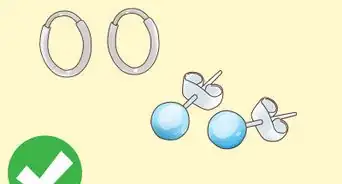
5Use earrings made from a non-irritating material. Certain types of metal used for earrings can irritate the skin or cause an allergic reaction in the skin. These problems can develop into full-blown infections if not addressed. For most people, irritation can be avoided by wearing earrings with posts made from neutral metals like 14-karat gold and stainless steel, which are unlikely to cause problems.
- Avoid earrings made from nickel, which are notorious for causing allergic reactions.


Community Q&A
-
QuestionIf I have a dry ear and there is crust under my earring, does this mean I have an infection?
 Community AnswerNo, it just means it is healing.
 -
QuestionMy ears are red and swollen with a crust around my new piercings. Does this indicate infection?Community AnswerYes, this means you have an minor infection -- it's easily treated and nothing to worry about. Keep twisting the earrings to prevent them getting stuck and don't take them out unless you absolutely need to.
-
QuestionDo I have to remove my postal earrings before going to bed?Community AnswerNo. It is recommended not to remove the earrings from newly pierced ears at all for at least a few weeks.
-
QuestionMy earring is hard to twist, and there is crunchy stuff in the area. It hurts to rotate my earrings. Is this an infection?
 Community AnswerThat's pretty much normal if you recently got your ears pierced. It's your ear healing up. If the pain worsens, or if your piercing starts to swell, then you should see a doctor.
 -
QuestionI got my ears pierced a few weeks ago and took them out two days ago. My ear is now red, blue and swollen. Should I see a doctor?Community AnswerYes. You may have an infection, and you should see a doctor about this.
-
QuestionIs it effective to use salt water to clean a newly pierced ear and also to clean the earring before putting it back in my ear?
 Community AnswerYes, you can clean a newly pierced ear with saltwater. If the infection gets bad, try a moist warm compression. Make sure to use some sort of antibiotic as well.
 -
QuestionMy ears are swollen with crust around my piercings. Should I get new earrings and clean the area with an antiseptic solution?
 Community AnswerYou should take a cotton swab and use it to clean the piercing really well with your favorite solution. Keep the earrings in, just make sure when you clean them that you push the earring forward and backward slightly so the piercing gets completely clean.
 -
QuestionThere is a thick yellow liquid coming from my earlobe piercing. What is it?Community AnswerThis is pus. Some people get it after a piercing; it's normal. If it gets worse or continues, see a doctor.
-
QuestionDo I need to take my earring out to clean it?Community AnswerYes.
-
QuestionWhy does my pierced ear always crust over, even after several years?Community AnswerCrust is the ear's way of trying to heal. If its still trying to heal after all those years, you should go see a professional.
Warnings
- Do not allow an infected piercing to close as it will trap the infection and cause more problems.Thanks!
- Always get the piercing done by a professional piercer. Some people advocate piercers who use needles as the best bet. Others have no issues at all with piercing guns.Thanks!
Things You'll Need
- Sea salt soak (1 cup warm distilled water with 1/4 tsp of non-iodized sea salt) or H2Ocean spray
- Clean hands
- A piercer's number to call in case of a problem




References
- ↑ Stephanie Anders. Piercing Specialist. Expert Interview. 4 December 2019.
- ↑ http://www.uofmmedicalcenter.org/healthlibrary/Article/116410EN
- ↑ http://www.health.harvard.edu/blog/the-safety-of-painkillers-20101220915
- ↑ http://www.uofmmedicalcenter.org/healthlibrary/Article/116410EN
About This Article
If your new ear piercing has gotten infected, you’ll need to clean it daily to help it heal. Always wash your hands before touching your piercing, and only touch your ear when you’re cleaning it so you don't transfer bacteria to it. 3 times a day, carefully remove the piercing and swab both sides of the hole with a Q-tip soaked in antibacterial cleaning solution. Wipe the earring post before you put it back in to make sure it’s sterile too. Keep cleaning your ear this way until 2 days after your infection has cleared up to make sure it heals properly. If you don’t see any improvement after a couple of days, see your doctor, who can prescribe you antibiotics to help fight the infection. For more advice, including how to prevent future piercing infections, read on.















































Medical Disclaimer
The content of this article is not intended to be a substitute for professional medical advice, examination, diagnosis, or treatment. You should always contact your doctor or other qualified healthcare professional before starting, changing, or stopping any kind of health treatment.
Read More...