This article was co-authored by Courtney Copriviza. Courtney Copriviza is an Elementary School Teacher based in Maui, HI. Courtney specializes in elementary education, classroom management, and social and emotional development. She holds a BA in Communication with a minor in Urban Education and an MA in Teaching from Santa Clara University. Courtney has also taught high school in Madrid, Spain. She is a member of Kappa Delta Pi International Honors Society in Education.
There are 24 references cited in this article, which can be found at the bottom of the page.
This article has been viewed 3,045 times.
Sometimes, promising learners meet with difficulties at school or home that can leave them feeling inadequate. As an educator, part of your role is to turn your students’ struggles into success by learning to recognize the areas where they need help. By identifying a student’s weaknesses, you can begin working with them to improve critical learning skills and offer encouragement or special accommodations that make them feel supported in the classroom.
Steps
Method 1
Method 1 of 3:Identifying Struggling or Vulnerable Students
-
1Gauge your students’ existing knowledge with an ungraded quiz. Give the quiz early on in the term before you begin assigning work that will affect their grades. The results will give you a clear indication of each student’s understanding of a given subject, which can help you put together lesson plans that are more appropriate for the class’s average level of learning.[1]
- Grade school-aged children can be tested on their knowledge of basic math, spelling, and problem-solving skills like pattern recognition.
- If you have a student who demonstrates a total lack of understanding, they may benefit from being placed in a remedial program, where they can develop the skills needed to succeed in a more challenging environment.[2]
-
2Look for clues in graded assignments. When scoring your student’s exams or daily work, pay close attention to the items they get wrong. Graded papers are like a roadmap of a student’s strengths and weaknesses. By finding out where they’re lacking, you’ll know what information to focus on in future lessons.[3]
- Rather than simply marking off the missed answers, include helpful notes on where the student went wrong so they’ll know what to do the next time they encounter a similar problem.[4]
- If you have enough time, go over the assignment with the whole class question-by-question to address common mistakes.
-
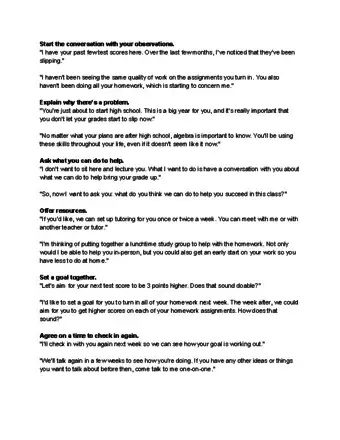
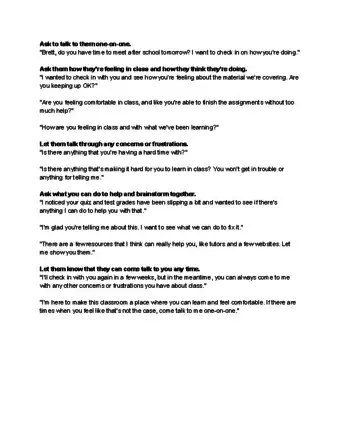
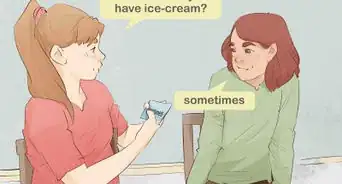
3Talk to your students directly about their performance. Schedule some time every few weeks to meet with each of your students in a one-on-one setting. Ask them how they feel like they’re doing in class, and invite them to share any concerns or frustrations they may have about the material they’re studying.[5]
- Letting your students know that they always have someone to talk to can encourage them to speak up.[6]
- Students in lower grade levels may not always tell you that they're having trouble. If you teach younger kids, check in with them regularly while they're working on their daily assignments.
-
4Request written feedback from the class. As the term draws to a close, hand out questionnaires asking your students to rate the effectiveness of your lessons and the quality of the class as a whole. Instruct them to be as detailed as they like. Provide a space where they can mention specific practices or resources that they feel would have helped them learn better.[7]
- Have your students complete the questionnaires anonymously so they don’t feel pressured to respond dishonestly.
- If possible, set up a way for your class to submit their feedback online so they’ll have more time to consider their responses. Online forms also eliminate the worry that you might recognize a student’s handwriting.[8]
- Ask younger students to write and illustrate a short story about a few of the things they've learned throughout the year.
-
5Learn to recognize students who are in distress. Common warning signs include continued decline in academic performance, frequent absences, and an unwillingness to engage or participate in class activities. Struggling students may also stop turning in homework or react indifferently to attempts to motivate them.[9]
- Listen for statements that indicate school-related feelings of depression or hopelessness, such as “I’m never going to understand this,” or “What difference does it make? I’m just going to fail the exam anyway.”[10]
- If you believe that a student may be in need of serious help, contact the school counselor or therapist, or call their parents and refer them to an academic support specialist outside the school.
-
6Be prepared to accommodate special needs students. Make arrangements to provide students with disabilities whatever resources they need to enjoy the same quality of education as their peers. Deaf students, for instance, may require a sign language interpreter, while those who are visually impaired should have access to braille textbooks and other touch-assistive learning materials.[11]
- It may be necessary to discuss wheelchair access and similar considerations with your school’s administrators if you have a student with mobility issues.
- Make sure you follow the guidelines laid out in the student’s individual education program (IEP) closely. All students in the US who are in need of special education services are required to have an IEP.[12]


Method 2
Method 2 of 3:Helping Students with Academic Struggles
-
1Give guidance for complicated assignments. Provide a clear set of standards explaining what your students should aim to accomplish, along with advice for how to do their best work. Take the time to cover these points in class, or give them a written assignment sheet that they can refer back to as often as needed.[13]
- You might even devote an entire class period to outlining hefty assignments, like midterms and final projects.
- As part of the assignment sheet for an analytical paper, you could include a brief preface saying something like “it will help to respond to each of the author’s major arguments using your own interpretation of the source reading.”
- If you teach younger children, go over the instructions together and have them repeat the most important steps back to you to make sure they understand what they're supposed to do.
-
2Provide struggling students with alternative assignments. Create special assignments for students who have fallen behind the rest of the class. Seeing the material presented in a different way may help refine their understanding of key concepts. If possible, tailor alternative assignments to the student’s preferred learning style to make it easier for them to understand.[14]
- If you have a student that’s more of a visual learner, you might have them explain a series of charts and graphs rather than asking them to write an essay on the information they convey.
- Limit the amount of work you give the student on top of their regular assignments so they don’t feel like they’re being punished.
-
3Find ways to make difficult lessons more engaging. Come up with projects and assignments that have an interactive element. You might have the class exchange small trinkets to demonstrate economic theory, or interview someone who served in World War II rather than assigning a research paper about it.[15] Hands-on learning is more likely to keep your students interested.[16]
- Taking the time to learn a little bit about your students can also make them feel more involved. If you know one of your students is a film buff, for instance, try drawing parallels between a complicated subject and one of their favorite movies.[17]
-
4Reinforce the skills needed for future success. Introduce specialized assignments early to prepare your students for the demands they’ll be expected to meet later on in school. That way, they won’t be overwhelmed when they encounter assignments with unfamiliar formats.[18]
- Incorporate these materials into your regular lesson plans, or give them periodically as ungraded practice on the side.
- Give younger children multiple-choice worksheets to acquaint them with standardized tests, which they’ll encounter throughout primary school.
- High school curricula should begin putting an emphasis on the kind of long-form essays and multi-stage projects that are often found in college courses.
-
5Offer useful feedback of your own. Emphasize the positive aspects of the student’s performance while presenting their shortcomings in a constructive light. The goal is not just to highlight the things they’ve done well, but to gently point out what they can do better. It’s important that your students view mistakes as valuable learning opportunities, not something to be ashamed of.[19]
- Whenever possible, balance out your criticism with praise. Rather than saying "Please read the instructions more carefully next time," for instance, try something more encouraging, such as "There are a few mistakes here, but overall you've shown a lot of progress."[20]
- This approach is always the most affirming, whether you’re handing back a graded test or having a casual chat with a student after class.
-
6Recommend that the student meet with a tutor. If none of your other efforts are working, it may be a good idea to bring up the possibility of after-school tutoring. A qualified tutor will be able to spend more time on subjects that have proven to be an obstacle for the student. Tutors also tend to be closer in age to the students they work with, which means they may be able to present information in a more relatable way.[21]
- Most public and private schools welcome volunteer tutors so that students or their families don’t have to deal with the cost of hiring one independently.
- Outside tutoring can even benefit high-performing students by giving them a chance to study advanced materials and learn skills that the rest of class isn’t quite ready for.[22]


Method 3
Method 3 of 3:Providing Emotional Support to Students in Need
-
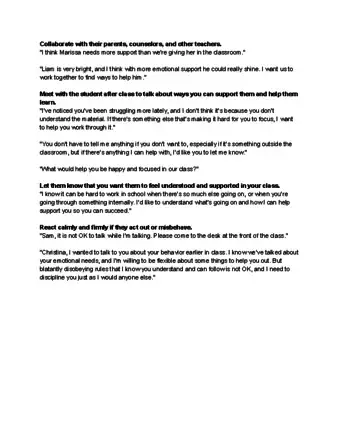
1Take extenuating circumstances into account. Your students are people too, and between school, jobs, family, and social life, they have a lot on their plates. Try to be understanding of this fact and show sympathy when you can. If you’re too quick to label someone as a bad student, you could be missing out on a chance to help them improve the circumstances that are interfering with their academic career.[23]
- Flagging grades aren’t always the result of poor study habits or a lack of motivation. Sometimes, they’re due to sick relatives, a disruptive home life, or the inability to deal with stress in a healthy way.
- Young children can be especially vulnerable, as they often lack the ability to deal with stressors like bullying or a disruptive home life in a healthy way.
-
2Praise your students for exceptional work. Make sure your students feel acknowledged for doing their best. When grading exams, make it a point to congratulate the students with the highest scores, or send a note home to the parents of students who have made an improvement in class. A little positive reinforcement can go a long way in bolstering motivation.[24]
- Consider giving extra credit for students who go above and beyond the basic requirements of an assignment.[25]
- Even the simplest form of congratulation will show your students that you’ve noticed how hard they’ve been working.
-
3Show sensitivity to students with mental health conditions. Mental disorders can be tricky to handle because they’re not always as easily documented as other health issues. As a general rule, you should take the word of a student who tells you they suffer from a mental health condition. From there, you can devise specific strategies to support their education without making them feel marginalized.[26]
- Mental health conditions can be very limiting. Never require a student with a mental disorder to do something that you wouldn’t ask of a student with a more obvious disability.
- Be sure to inform the student about any resources that are available to them, such as in-school counseling or wellness assessment programs.
-
4Communicate with troubled students’ counselors or social workers. If you have a student who suffers from trauma or emotional issues related to a past experience, don’t hesitate to reach out to their mental health professional. They’ll be able to tell you more about the student’s condition and how you can help them overcome the unique challenges it presents.[27]
- Mental health professionals are typically prohibited from sharing sensitive information about their patients, but they may be able to offer more general advice.
- Consider listing the counselor as an emergency contact in case your student becomes overwhelmed while at school.


Communicating with Students

Community Q&A
-
QuestionWhat should I do if I want my students to respond well?
 Courtney CoprivizaCourtney Copriviza is an Elementary School Teacher based in Maui, HI. Courtney specializes in elementary education, classroom management, and social and emotional development. She holds a BA in Communication with a minor in Urban Education and an MA in Teaching from Santa Clara University. Courtney has also taught high school in Madrid, Spain. She is a member of Kappa Delta Pi International Honors Society in Education.
Elementary School TeacherIf you want your students to respond well, form a relationship with them. Speak to them and show genuine interest in knowing about them. If you like, you can have morning meetings with them every day. -
QuestionHow can I use a behavior chart to encourage good behavior?Courtney CoprivizaCourtney Copriviza is an Elementary School Teacher based in Maui, HI. Courtney specializes in elementary education, classroom management, and social and emotional development. She holds a BA in Communication with a minor in Urban Education and an MA in Teaching from Santa Clara University. Courtney has also taught high school in Madrid, Spain. She is a member of Kappa Delta Pi International Honors Society in Education.
Elementary School TeacherHave a behavior chart with specific, measurable, attainable, relatable, and time-specific goals. Give a sticker or reward to the students who improve their behavior within a fixed time. -
QuestionHow can I show due respect to my students?Courtney CoprivizaCourtney Copriviza is an Elementary School Teacher based in Maui, HI. Courtney specializes in elementary education, classroom management, and social and emotional development. She holds a BA in Communication with a minor in Urban Education and an MA in Teaching from Santa Clara University. Courtney has also taught high school in Madrid, Spain. She is a member of Kappa Delta Pi International Honors Society in Education.
Elementary School TeacherGet down close to the students when you are near their desks. Do not stand towering above them or make them feel small. You need not treat them as adults. But show them that you respect their opinions.




-Step-15.webp)


References
- ↑ https://teachingcommons.stanford.edu/resources/teaching-resources/interacting-students/supporting-vulnerable-students
- ↑ https://www.understood.org/en/learning-attention-issues/treatments-approaches/educational-strategies/remedial-programs-what-you-need-to-know
- ↑ https://www.facultyfocus.com/articles/educational-assessment/ten-tips-efficient-effective-grading/
- ↑ http://gsi.berkeley.edu/gsi-guide-contents/grading-intro/grading-efficiently/
- ↑ https://www.bakersfieldcollege.edu/sites/bakersfieldcollege.edu/files/4GFaculty_0.pdf
- ↑ Courtney Copriviza. Elementary School Teacher. Expert Interview. 18 June 2021.
- ↑ https://www.cultofpedagogy.com/student-feedback/
- ↑ https://cft.vanderbilt.edu/guides-sub-pages/student-feedback/
- ↑ https://cmhc.utexas.edu/studentindistress.html
- ↑ http://www.uq.edu.au/student-services/counselling/how-to-support
- ↑ https://phdinspecialeducation.com/how-to-support-special-needs-students/
- ↑ https://kidshealth.org/en/parents/iep.html
- ↑ https://www.facultyfocus.com/articles/educational-assessment/ten-tips-efficient-effective-grading/
- ↑ https://www.understood.org/en/learning-attention-issues/treatments-approaches/educational-strategies/differentiated-instruction-what-you-need-to-know
- ↑ http://www.teachhub.com/5-teaching-strategies-keep-class-interesting
- ↑ Courtney Copriviza. Elementary School Teacher. Expert Interview. 18 June 2021.
- ↑ http://www.apa.org/education/k12/relationships.aspx
- ↑ http://psychlearningcurve.org/these-psychological-principles-will-help-your-students-learn-more-effectively/
- ↑ https://www.teachthought.com/technology/20-ways-to-provide-effective-feedback-for-learning/
- ↑ https://www.edutopia.org/blog/tips-providing-students-meaningful-feedback-marianne-stenger
- ↑ https://www.teachthought.com/pedagogy/diagnostic-teaching-why-students-struggle/
- ↑ https://gradepowerlearning.com/benefits-of-tutoring/
- ↑ https://teachingcommons.stanford.edu/resources/teaching-resources/interacting-students/supporting-vulnerable-students
- ↑ https://cehdvision2020.umn.edu/blog/positive-reinforcement-teacher-tips/
- ↑ https://www.insidehighered.com/advice/2018/01/16/professor-explains-why-she-offers-extra-credit-her-classes-opinion
- ↑ https://dynamicecology.wordpress.com/2018/01/29/how-to-support-undergraduate-students-experiencing-mental-health-concerns/comment-page-1/
- ↑ https://www.edutopia.org/discussion/8-ways-support-students-who-experience-trauma
About This Article