This article was co-authored by wikiHow staff writer, Janice Tieperman. Janice is a professional and creative writer who has worked at wikiHow since 2019. With both a B.A. and M.A. in English from East Stroudsburg University, she has a passion for writing a wide variety of content for anyone and everyone. In her free time, you can find her working on a new crochet pattern, listening to true crime podcasts, or tackling a new creative writing project.
There are 16 references cited in this article, which can be found at the bottom of the page.
Learn more...
Originally created in 1994, PHP is a computer scripting language that is still used on many websites and web applications today.[1] This language is a helpful building block for web development and can be a useful skillset in your future tech career. If you’re not sure how to start studying PHP, we’ve got you covered—keep scrolling to get the answers to all your frequently asked questions about this handy language.[2]
Steps
Question 1
Question 1 of 14:What is PHP?
-
1PHP is a free-to-use digital scripting language. “PHP” actually stands for “PHP: Hypertext Preprocessor,” and helps you generate Hypertext Markup Language (HTML) onto your digital projects easily. PHP also offers you a lot of privacy, since clients can only see what the PHP code generates, instead of the actual code you wrote.[3] PHP is often used to develop websites and applications.[4]
- PHP is considered “open-source,” and can be used by anyone.
- PHP is compatible on every main operating system, like Windows, Mac, and Linux.[5]

Question 2
Question 2 of 14:How is PHP different from other coding languages?
-
1PHP is especially user-friendly. This language gives you more autonomy in your project, and lets you create your website, as opposed to the coding language. Additionally, PHP is a scripting language, not a programming language—in other words, PHP doesn’t need a compiler to process and convert the code.[6]
- Many coding languages, like Java, C++, and Scala need a compiler to help process the code. A compiler helps translate the original code into a language that your computer will understand.[7]

Question 3
Question 3 of 14:Which sites use PHP?
-
1Facebook and Wikipedia use PHP. Additionally, popular sites and applications like Tumblr, Etsy, MailChimp, and Slack all use PHP. Wordpress, a well-known content management system, also uses PHP, which helps users create and customize their own websites.[8]

Question 4
Question 4 of 14:How do you write in PHP?
-
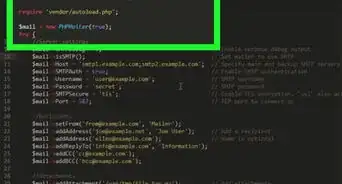
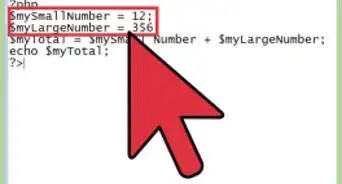
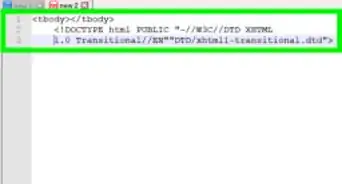
1PHP uses a special syntax. When you write in PHP, start the script with “<?php” and end it with “?>.” Your actual PHP code goes in between these tags, while the finished PHP file will include both your scripting code and HTML content.[9]

Question 5
Question 5 of 14:Is it difficult to learn PHP?
-
1No, PHP is very easy to learn. PHP is a simple but versatile scripting language. It’s easy to pick up if you don’t have a lot of coding experience, but it also has some high-level features for more advanced programmers.[10]

Question 6
Question 6 of 14:Do I need to know other coding programs before learning PHP?
-
1Study HTML before you learn PHP. HTML is considered a “markup” language; in other words, HTML states what a website will look like, but not how it functions. HTML is used in a lot of PHP projects, so it helps to have some background in it. Thankfully, you can master the basics of HTML in a few hours.[11]
- Sites like W3Schools and Learn HTML offer free HTML lessons and tutorials.

Question 7
Question 7 of 14:What is the best way to learn PHP?
-
1Reference the official PHP documentation. The PHP manual outlines everything you need to know about the language. It walks you through installation and also teaches you the language’s syntax. This guide talks about some advanced PHP features, too.[12]
- You can find the manual here: https://www.php.net/manual/en/index.php
-
2Study PHP through online classes and tutorials. W3Schools is a free, helpful resource that helps you learn and practice PHP skills. FreeCodeCamp, Codeacademy, GeeksforGeeks, and PHP: The Right Way also offer free tutorials and resources to help you learn.[13]
- If you don’t mind paying a little extra money, Udemy, Lynda, and Coursera are great resources to check out.


Question 8
Question 8 of 14:How can I learn PHP fast?
-
1Study other PHP applications. Take a deep dive into the coding on a blog, image gallery, e-commerce platform, or other web application powered by PHP. Look over the coding for these applications, so you can figure out how they tick. This process helps you learn what kinds of features different PHP applications have, and how they look and run the way that they do.[14]
- WordPress and osCommerce sites are typically run in PHP.
-
2Make your own application with PHP language. When it comes to PHP, experience is the best teacher. Put your skills to the test with different types of PHP projects, which help test and apply what you’ve learned so far. Start with small tasks, and then work your way up.[15]
- For instance, you could create a barebones website with simple features.


Question 9
Question 9 of 14:How many days will it take to learn PHP?
-
1You can learn PHP in a month or less, depending on your background. If you’re familiar with coding or tend to learn new skills quickly, you might pick up PHP in a matter of weeks. If you don’t have a coding background, it’ll take a month or so before you understand the language.[16]
- You can write basic PHP scripts in a matter of hours.[17]

Question 10
Question 10 of 14:Is PHP good for my career?
-
1Yes, it can definitely be good for your career. While not as prominent as it used to be, PHP is still used in a lot of big web platforms, like Drupal and Wordpress. Although created in 1994, PHP continues to grow and evolve as a language, and is still very practical and useful in today’s web environment.[18]

Question 11
Question 11 of 14:Is PHP better than Java?
-
1Java is actually better than PHP in a lot of ways. Research shows that Java runs faster than PHP. Java is also preferred for developing mobile apps, and the language itself is much more secure than PHP. However, PHP is better for small applications, while Java is the best option for large-scale applications.[19]

Question 12
Question 12 of 14:What is the salary of a PHP developer?
-
1The average PHP developer makes about $65,000 per year. On the lower end, developers make as little as $44,000; however, higher-paid professionals can make as much as $98,000. If you’re an entry-level developer, your salary will be somewhere around $50,000. Then, your salary will increase as you gain more experience in the field.[20]
- For reference, a person with 1-4 years of experience makes around $61,000, while someone with 20 years of experience makes at least $87,000.

Question 13
Question 13 of 14:Are PHP developers in demand?
-
1Yes, though not as much as they used to be. To put things in perspective, there are at least 75 million sites that operate with WordPress, which uses PHP. While PHP isn’t as in demand as it used to be, there are still job opportunities available.[21]

Question 14
Question 14 of 14:Is PHP a dead language?
-
1No, it’s not dead. Research shows that over 75% of all websites use PHP. While the language isn’t as hyped up as newer scripting languages, like JavaScript and Node.js, PHP is definitely still alive and well.[22]
- PHP helps run major social media sites, like Facebook and Pinterest.

References
- ↑ https://www.php.net/manual/en/history.php.php
- ↑ https://www.w3schools.com/php/php_intro.asp
- ↑ https://www.php.net/manual/en/intro-whatis.php
- ↑ https://www.php.net/manual/en/intro-whatcando.php
- ↑ https://www.php.net/manual/en/intro-whatcando.php
- ↑ https://medium.com/@developer45/what-makes-php-different-from-a-programming-language-a04843eb9db4
- ↑ https://medium.com/jay-tillu/difference-between-scripting-language-and-programming-language-4d520ebf36ef
- ↑ https://trio.dev/blog/companies-using-php
- ↑ https://www.w3schools.com/php/php_syntax.asp
- ↑ https://www.php.net/manual/en/intro-whatis.php
- ↑ https://www.bitdegree.org/tutorials/learn-php/#tip-3-ndash-learn-html-first
- ↑ https://kinsta.com/blog/php-tutorials/
- ↑ https://kinsta.com/blog/php-tutorials/
- ↑ https://www.binarytides.com/tips-learn-php-fast-effectively/
- ↑ https://www.binarytides.com/tips-learn-php-fast-effectively/
- ↑ https://www.phparea.com/php/how-long-does-it-take-to-learn-php
- ↑ https://www.php.net/manual/en/intro-whatis.php
- ↑ https://insights.dice.com/2020/08/20/5-reasons-php-still-a-great-language/
- ↑ https://medium.com/javarevisited/java-or-php-which-is-the-best-choice-for-web-development-in-2020-66da2c63661c
- ↑ https://www.payscale.com/research/US/Job=PHP_Developer/Salary
- ↑ https://www.darwinrecruitment.com/blog/2019/03/future-php-dying-language
- ↑ https://www.darwinrecruitment.com/blog/2019/03/future-php-dying-language
About This Article