This article was co-authored by wikiHow Staff. Our trained team of editors and researchers validate articles for accuracy and comprehensiveness. wikiHow's Content Management Team carefully monitors the work from our editorial staff to ensure that each article is backed by trusted research and meets our high quality standards.
This article has been viewed 1,948 times.
Learn more...
A falling temperature is the joyous first indicator that lawn care season is coming to an end, and many people will begin to put their equipment in storage. While putting your lawn mower away for the winter is simple, keeping it shielded from the changing elements takes some extra care and consideration. By taking the additional initiative to protect your mower, it will stay safe and be ready to tackle your lawn again in the spring.
Steps
Part 1
Part 1 of 2:Emptying out Your Mower
-
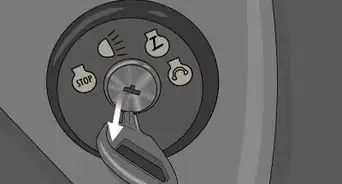
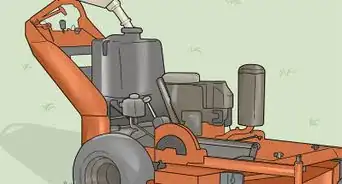
1Run your mower out of fuel. Condensation inside the fuel tank can seriously damage the mower's engine: if moisture develops, it can cause corrosion, clogs, and other problems. Having an empty tank before your mower is put into storage lowers the risk of condensation forming. Start up your mower, and let it run until it no longer starts back up, and the fuel lines are empty.
- Keeping fuel inside the mower is also a fire hazard. Do not jeopardize the safety of yourself, your property, and others.[1]
-
2Disconnect the spark plug. Disconnecting the spark plug should be high priority when working on your mower. As long as the spark plug is connected, there is a risk of the mower accidentally kick-starting. To avoid this possibility and prevent serious injury, it is strongly recommended to remove the spark plug or the spark plug lead wire.[2]
- Remove the spark plug only after thoroughly draining your mower of fuel. This greatly reduces the possibility of an accidental start.
-
3Remove the battery from the mower. Doing this will prevent the mower from unnecessarily draining power from the battery while in storage. Upon removal, clean the battery with a cloth, and store it in a cool, dry place.[3]
- To lower the risk of an accidental fire, always keep the mower's battery away from fuel, sources of heat, and anything that has a pilot light.[4]
-
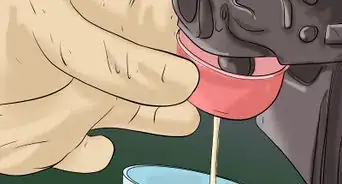
4Drain your mower of oil. The mower should be empty of oil before being placed into storage. Remove the oil reservoir plug, then tilt the mower slowly and carefully until the oil begins to drain. Use a pan to catch the oil, and place a tarp down underneath the mower to stop any spatter.[5]


Part 2
Part 2 of 2:Cleaning and Storing Your Mower
-
1Clean your mower thoroughly. A spray from a garden hose may be enough to remove any clippings and debris, and a tool designed for scrubbing or scraping will address anything dried-on to the bottom of your mower.
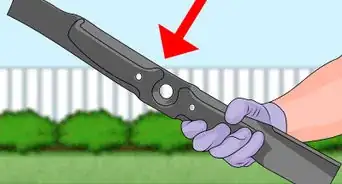
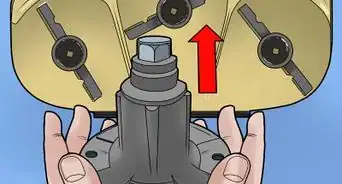
- Remove the blades on the mower before attempting to clean the underside. Trying to maneuver around the blades during this step is very dangerous.[6]
-
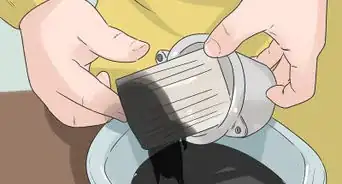
2Change out the air filter. A clean air filter burns gas efficiently. Replacing the filter with a new one before the mower goes into storage is good preparation for future yard work. Remove the filter, clean out the cooling fins carefully with a screwdriver or pipe cleaner, and put in a new one.[7]
-
3Wipe down your mower. Using a cloth, remove any plant material lingering on the surface, and clean off any messes made during the previous steps of preparation. Your mower should be as clean as possible before putting it in storage for an extended period.
-
4Cover your lawn mower. Keeping a breathable cover on your mower will help prevent cosmetic damages and encourage air circulation while in storage. In addition, putting a plastic or cardboard tarp under your mower protects the blades and will catch any fluid drips.
- For mower covers, one made of canvas is recommended: it's a durable material that won't stifle air underneath it.[8]
-
5Store your mower somewhere dry. Condensation is more likely to form in colder weather, and it can cause serious damage to the tanks inside your mower. Wherever you've chosen to store your mower, make certain that the space is free of moisture, and that it will consistently maintain a cooler temperature.


Warnings
- Use work gloves when handling any part of your mower, and do not touch the blades directly with your bare hands. Regardless of how dull your mower blades have become, there is still a risk of injury due to carelessness.Thanks!




References
- ↑ https://www.consumerreports.org/lawn-mowers-tractors/how-to-winterize-your-lawn-mower/
- ↑ https://www.thisoldhouse.com/how-to/how-to-store-your-lawn-mower-cold-season
- ↑ https://www.ezstorage.com/blog/7-tips-storing-lawn-mower-winter/
- ↑ https://www.briggsandstratton.com/na/en_us/support/maintenance-how-to/browse/putting-your-lawn-mower-to-rest-for-winter.html
- ↑ https://www.thisoldhouse.com/how-to/how-to-store-your-lawn-mower-cold-season
- ↑ https://www.consumerreports.org/lawn-mowers-tractors/how-to-winterize-your-lawn-mower/
- ↑ https://www.thisoldhouse.com/how-to/how-to-store-your-lawn-mower-cold-season
- ↑ https://www.ezstorage.com/blog/7-tips-storing-lawn-mower-winter/
- ↑ https://www.thisoldhouse.com/how-to/how-to-store-your-lawn-mower-cold-season
About This Article