wikiHow is a “wiki,” similar to Wikipedia, which means that many of our articles are co-written by multiple authors. To create this article, 9 people, some anonymous, worked to edit and improve it over time.
This article has been viewed 88,791 times.
Learn more...
Hazardous materials, by nature, can harm children or adults if you fail to store the dangerous substances safely. Proper storage reduces the risk of accidents involving hazardous materials. If the substance is ignitable, corrosive, toxic or reactive, then it is hazardous. A majority of household chemicals and materials fit these categories, including paint, motor oil, antifreeze, insecticides, herbicides, fungicides, cleaning agents, adhesives, arts and craft materials, aerosol cans, propane cylinders, moth repellents, batteries, smoke detectors, televisions, cell phones and ammunition. Keep your family safe by properly treating, transporting, disposing of and storing all hazardous materials.
Steps
-
1Follow all the storage instructions on the product label. Storage requirements vary based on the hazardous property a material has.[1]
-
2Be sure to store all volatile products in well-ventilated areas. Fumes can be toxic to humans and animals.[2]Advertisement
-
3Make certain you store flammable products in the recommended temperature range. The containers will bulge if you store them in temperatures that are too high. Liquid materials will expand, freeze and burst if you store them in temperatures that are too low.[3]
-
4Keep all hazardous materials out of the reach of children and away from all animals.[4]
- Buy products with safety lids whenever possible.
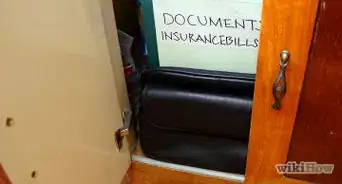
- Put all hazardous materials stored in the house, garage or basement behind locked doors.
-
5Use the original container to store the hazardous material. If the label is lifting off, use a transparent tape to secure it.[5]
-
6Reduce the amount of hazardous materials you keep in storage. Purchase only the amount necessary to complete your current job. You may find it better to discard leftover product rather than storing it. Just make sure you follow the proper process for disposing of hazardous materials.[6]
-
7Do periodic maintenance storage areas.
- Look for problems inside each storage area on a regular basis. Be sure there are no apparent fumes.
- Inspect all hazardous material containers. Make sure you can clearly see each label. The containers should be free of rust, bulges, dents or leaks.
- Use a separate broom and dustpan for chemical cleanup. Be sure to lock these tools away when you are not using them.
Advertisement


Community Q&A
-
QuestionWhere should cleaning materials be stored?
 Community AnswerIn a drawer or in a cabinet. If you have children, then you should put the supplies high up so they can't reach them, or lock them up.
 -
QuestionWhat is the importance of knowing how to tell if a product is poisonous or flammable?
 Community AnswerSo you don't put a flammable product near somewhere that could make it catch fire, or so that you don't accidentally consume or drink the poisonous product. Another good reason is so that you put it away someplace safe, so kids cannot get it or so you won't confuse it with something else.
 -
QuestionWhy always store chemicals in a designated container?
 Community AnswerThey can damage, melt through, or produce dangerous odors in incorrect containers.
 -
QuestionHow can you dispose of hazardous substances?Community AnswerYour local dump should have areas reserved for different hazardous materials. Give them a call and ask for more information.
-
QuestionHow do I handle and store hazardous substances that are medication?
 SealweaselCommunity AnswerKeep medication in the bathroom. Do not store close to where food is. If you have small children, keep the medicine locked up and/or out of reach. Keep the medicine in its original container so you always know what it is. Never take medicine in the dark or if you can't see properly, because you might take the wrong one.
Warnings
- Never put hazardous materials in food or beverage containers.Thanks!
- Never mix 2 or more chemicals together. They may react violently, producing toxins, or they may even become ineffective.Thanks!
- Do not store aerosol cans or flammable products near heat sources.Thanks!


References
- ↑ https://www.urmc.rochester.edu/encyclopedia/content.aspx?contenttypeid=1&contentid=1674
- ↑ https://www.ccohs.ca/oshanswers/prevention/flammable_general.html
- ↑ https://www.hse.gov.uk/fireandexplosion/storageflammliquids.htm
- ↑ https://blink.ucsd.edu/safety/research-lab/hazardous-waste/radioactive.html
- ↑ https://www.epa.gov/hw/household-hazardous-waste-hhw
- ↑ https://worksafe.govt.nz/topic-and-industry/hazardous-substances/managing/storage/











































Medical Disclaimer
The content of this article is not intended to be a substitute for professional medical advice, examination, diagnosis, or treatment. You should always contact your doctor or other qualified healthcare professional before starting, changing, or stopping any kind of health treatment.
Read More...