This article was co-authored by wikiHow Staff. Our trained team of editors and researchers validate articles for accuracy and comprehensiveness. wikiHow's Content Management Team carefully monitors the work from our editorial staff to ensure that each article is backed by trusted research and meets our high quality standards.
There are 9 references cited in this article, which can be found at the bottom of the page.
The wikiHow Video Team also followed the article's instructions and verified that they work.
This article has been viewed 2,165 times.
Learn more...
There is a growing movement of people who are trying to abstain from using plastic because it's damaging to the environment. If you want to be more environmentally friendly, or if you or a loved one has an allergy, life is more than possible without using plastic to store your food. With jars, tins, and eco-friendly storage alternatives, you'll be forgetting you ever needed plastic in no time.
Steps
Method 1
Method 1 of 3:Refrigerating Food Without Plastic
-
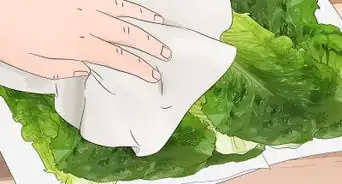
1Wrap large vegetables in damp towels. Wrap large leafy greens such as lettuce or cabbage in a ball of damp towels to keep them crispy. Once wrapped, put them in the fridge.[1]
- If you have a crisper in your fridge this would work too. However, damp towels can be more effective.
-
2Use cloth bags for smaller vegetables. If you're storing vegetables in the fridge, try to wrap them in a cloth bag before storing them away. A cloth bag will allow the vegetables to breathe, keeping them fresher when you decide to use them.[2]
- There are no special cloth bags for food, so using any cloth bag from a local supermarket will work.
Advertisement -
3Fill glasses with water to store root vegetables. Fill a glass halfway with cold water. Then, put as many root vegetables as you can fit into the glass, then place the glass into the fridge. The water will keep the vegetables fresh and crispy for when you need to use them again.[3]
- This technique is great for carrots, parsnips, spring onions or even potatoes.
- Root vegetables can be left openly exposed in a fridge as they rarely have a strong smell.
-
4Keep spare fruit or vegetables fresh with glass containers. If you have cut up more veg than you had intended, throw the rest into a jar or glass container and put it in the fridge. They will be usable for a few more days, in case you find another dish you can use them in.[4]
-
5
-
6Use glass containers to store leftovers. Glass containers are heavier than their plastic counterparts. However, they are sturdier and effective at storing leftover food. You can buy glass containers at your local supermarket. They'll come with a tight fitting lid so you don't need to use clingfilm.[5]
- Glass containers come in all different shapes and sizes, so don't be afraid to get a range of them.
Advertisement

Method 2
Method 2 of 3:Storing Food in the Freezer
-
1Store seasonal fruit in the freezer. Lay out fresh fruit on a tray with parchment paper then freeze for 24 hours. Remove the tray of frozen fruit from the freezer, then store the fruit in a jar. You can then freeze for as long as you like.[6]
- Fruit doesn't take long to defrost, so if you ever feel like a burst of summer freshness in the winter, you can defrost stored strawberries from the summer.
-
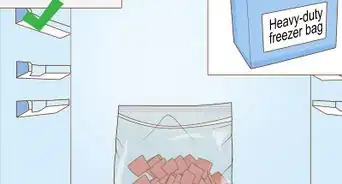
2Use airtight steel containers to store meat. Using an airtight steel container, place any meat inside then close the lid over firmly. Then place it in the freezer. The meat will stay fresh for months when frozen. The steel container will also prevent any smells from being overpowering in the freezer.
- You can even cook the meat in the container you froze it in.[7]
-
3Freeze any leftover soup. If you've made soup that hasn't been eaten, pour it into a jar, tighten the lid and put it in the freezer. Soup in the freezer will stay fresh for a year and serves as a good impromptu dinner or lunch if you've forgotten to prepare something.[8]
-
4Hideaway any baked goods in the freezer. Baked goods like cookies or traybakes are a temptation in the pantry. If you want to store them away for later, put them into a jar or glass container and put them into the freezer. Most baked goods will stay fresh in perpetuity in the freezer, especially chocolate.[9]
-
5Keep fruit or vegetable scraps fresh in the freezer. Instead of throwing orange peels, carrot tops, and vegetable leafs in the trash, store them in the freezer. These peels can be great ingredients if you decide to create a vegetable broth.[10]
-
6Freeze any of your product if you think there's a risk of infection. Consider freezing a jar if you think a pest may have made its way into it or a particular jar of produce that has been untouched for a long time. Freeze the entire jar for 24 hours to be sure it's 100% safe.[11]
- Freezing the jar will kill off any pests inside as well as any eggs they may have hatched.
Advertisement
Method 3
Method 3 of 3:Using Plastic Alternatives for the Pantry and Countertop
-
1Collect pre-used glass jars. There's no need to go out and buy more jars when you can reuse some free of charge. Search in long-forgotten cupboards for any unused jars or ask friends and family if they'd donate any to you.[12]
-
2Disinfect your new jars thoroughly. Fill every jar with hot water and leave for approximately an hour. This will remove any loose dirt that's in them. Wash all the jars out then wash each one with hot water and soap to make sure they're sterile for food.[13]
- If you can, try to hand-dry the jars and attach their lids afterward. This will minimize the chance of any more dirt finding its way into them.
-
3Remove all labels for clarity. Use hot water to peel off old labels and adhesives on the side of the jar.
- For particularly stubborn labels, try adding a drop of eucalyptus oil then scrubbing the label off.[14]
-
4Store your pantry foods in the jars. Assign large jars to produce you might have lots of such as baked goods, sugar or flour. Use smaller jars for smaller produce like seeds, herbs and lentils. Transfer the contents of your pantry into these glass jars. Some products, such as flour, may be tricky to transfer, so a funnel may be useful.
-
5Re-label your new jars. If you have a very good memory you may not have to do this. However, even if you can see what's inside a jar, you may struggle to remember what exactly it is (which is especially true for different types of flour or sugar).
- Using chalkboard tape, write the contents of the jar on the tape, peel it off then stick it on the side of the jar.[15]
-
6Store fruit in a fruit bowl. Purchase a large fruit bowl that's open to the air. Store your fruit in it, placing heavier fruit towards the bottom and lighter fruit towards the top.[16]
- An added benefit of having fruit within easy reach is that it may encourage you to eat more fruit on a day-to-day basis.
-
7Plant fresh and dried herbs in open air jars. If you have any spare jars, you can place any fresh leafy greens and dried herbs such as beetroot, parsley, cilantro, or dill in open air jars. This will allow easy access to the inventory of all your herbs.[17]
- If you're feeling particularly proactive you can line the bottom of the jar with fresh soil. Then, replant your herbs or leafy greens to try and cultivate them.
-
8Place your bread in a bread-bin. First, put the entire loaf of bread inside a fine cloth bag. This bag will absorb any excess moisture during storage. Then, put the entire cloth bag inside a bread bin. This will form a double seal preventing any air from making your bread going stale faster than it should.[18]
-
9Put baked goods and snacks inside tins. Tin boxes can come in many different shapes or sizes. Gather a collection of them and store different dry goods or baked goods inside them.[19]
- If you want, you can use the labels from the previous section to label these tins before you store them.
-
10Use plates and bowls instead of clingfilm. Clingfilm is a fixture of most kitchens despite the fact that it's quite possible to function without it. If you have food in a bowl that you'd like covered, find another plate or bowl that fits over the top of it.[20]
-
11Try beeswax wrap as a clingfilm alternative. Beeswax wrap is a natural and recyclable alternative to clingfilm found in supermarkets or local grocers. The wrap has natural beeswax melted onto it to make it sticky. Cover any plate with the beeswax wrap and it will form as tight a seal as any clingfilm.[21]
- This product is not suitable for vegans.
Advertisement



-Step-10.webp)


References
- ↑ https://treadingmyownpath.com/2016/08/04/the-definitive-guide-to-storing-food-without-plastic/
- ↑ https://zerowastechef.com/2017/01/20/store-produce-without-plastic/
- ↑ https://treadingmyownpath.com/2016/08/04/the-definitive-guide-to-storing-food-without-plastic/
- ↑ https://zerowastechef.com/2017/01/20/store-produce-without-plastic/
- ↑ https://treadingmyownpath.com/2016/08/04/the-definitive-guide-to-storing-food-without-plastic/
- ↑ https://zerowastechef.com/2016/01/06/how-to-freeze-food-without-using-plastic/
- ↑ https://myplasticfreelife.com/2016/04/buying-and-storing-meat-without-plastic/
- ↑ https://zerowastechef.com/2016/01/06/how-to-freeze-food-without-using-plastic/
- ↑ https://zerowastechef.com/2016/01/06/how-to-freeze-food-without-using-plastic/
- ↑ https://zerowastechef.com/2016/01/06/how-to-freeze-food-without-using-plastic/
- ↑ https://treadingmyownpath.com/2016/08/04/the-definitive-guide-to-storing-food-without-plastic/
- ↑ https://www.meghantelpner.com/blog/5-ways-to-store-food-without-plastic/
- ↑ https://www.cleanipedia.com/gb/kitchen-cleaning/how-to-clean-bottles
- ↑ https://treadingmyownpath.com/2016/08/04/the-definitive-guide-to-storing-food-without-plastic/
- ↑ https://sabrinasorganizing.com/labeling-mason-jars/
- ↑ https://www.thekitchn.com/good-question-best-way-to-stor-42593
- ↑ https://treadingmyownpath.com/2016/08/04/the-definitive-guide-to-storing-food-without-plastic/
- ↑ https://www.nytimes.com/2001/04/11/dining/test-kitchen-the-best-thing-since-unsliced-bread.html
- ↑ https://treadingmyownpath.com/2016/08/04/the-definitive-guide-to-storing-food-without-plastic/
- ↑ https://treadingmyownpath.com/2016/08/04/the-definitive-guide-to-storing-food-without-plastic/
- ↑ https://www.meghantelpner.com/blog/5-ways-to-store-food-without-plastic/
About This Article


-Step-10.webp)