X
wikiHow is a “wiki,” similar to Wikipedia, which means that many of our articles are co-written by multiple authors. To create this article, volunteer authors worked to edit and improve it over time.
This article has been viewed 84,274 times.
Learn more...
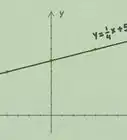
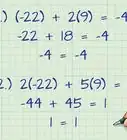
There are a few ways to solve simultaneous equations;[1] one of them is to plot the lines of the 2 equations, thus solving the equation. This article will teach you how to solve simultaneous equations graphically!
Steps
-
1Write your 2 equations clearly. Write your 2 equations in an organised, clear way. This will make it easier later.[2]
- In this guide, we are going to use equations 3x+4y=22 and x+2y=2 as an example.
-
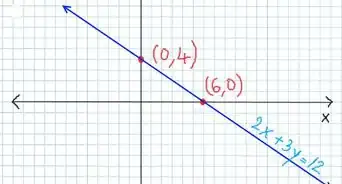
2In the first equation, let x be 0. Replace x with 0, and solve the equation. This should give you the value of y.
- Using the example before: 3*0+4y=22, which becomes 4y=22, and then y=5½
- You now have your first coordinate, (0 ; 5½)
Advertisement -
3Let y be 0. In the first equation, let y be 0 and solve the equation. This will give you the value of x.
- Using the example: 3x+4*0=22 which becomes 3x=22 which gives us the answer of x=7⅓
- You now have a set of coordinates for your first line, (0 ; 5½) and (7⅓ ; 0)
-
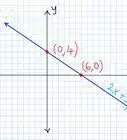
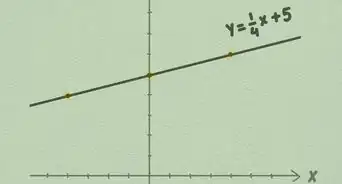
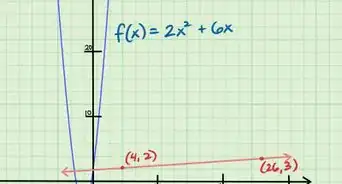
4Draw a graph with 4 quadrants. Draw the line of your first equation on it.[3]
-
5In the second equation, let x be 0. Then solve the equation, giving you the value of y.
- Using the example, it's 0+2y=2, which becomes 2y=2 and y=1
- First coordinate is now (0 ; 1)
-
6Let y be 0. Solve the equation and get the value of x.
- Example: x+2*0=2, which becomes x=2.
- Second coordinate is now (2 ; 0)
-
7Draw the line of the second equation on the same graph as before. If needed, increase the length of the 2 lines until they meet.[4]
-
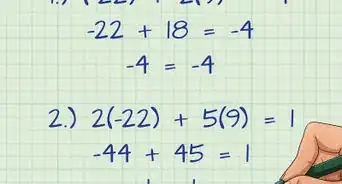
8Look at the point in which the 2 lines meet. Get it's coordinates (x ; y). The x coordinate will be the value of x in the equation, and the y coordinate will be the value of y![5]
- If you've been using the example, the lines should meet at point (18 ; -8). x will be 18, and y will be -8!
Advertisement


Community Q&A
-
QuestionWhat will be the answer if lines do not intersect?
 DonaganTop AnswererIf the graphed lines do not intersect, the system has no solution. That means there is no set of values for the variables that will work for both equations simultaneously.
 -
QuestionHow do I guess the number, like x=0 or x=1, etc.?DonaganTop AnswererYou don't guess any numbers. You simply use a low number for x (like 0, 1, 2, -1, or -2, for example) so that it's easy to calculate the corresponding value of y.
-
QuestionHow do I solve y=2x+1, y=x-5?DonaganTop AnswererPlot both equations on the same graph. The x and y values of the point where the two lines intersect are the solution of the equations.
-
QuestionWhy do we take 0 as the value of x?DonaganTop AnswererChoosing zero for the value of x simply makes it easier and quicker to find the corresponding value of y, which would be the y-intersect.
-
QuestionHow do I plot 3x + 7y = 13 graphically?DonaganTop AnswererFirst algebraically solve for y in terms of x (or vice versa). Then assign convenient values to x, and calculate corresponding values of y. Then plot some pairs of values (at least two pairs for a straight-line graph; more than two for a curved-line graph), and draw the graph. (You can graphically find the value of one variable when zero is assigned as the value of the other variable by simply noticing where the graph crosses each of the axes.)
-
QuestionIs it possible that the two lines plotted on the graph will meet, and what happens if they don't meet?DonaganTop AnswererAll non-parallel lines (in the same plane) will meet somewhere. Two lines that are parallel to each other will not meet. That means that they have the same slope. In that case the two equations are not solvable.
-
QuestionIs 2x-5y=32, 2x+3y=0 solvable using this method?
 Community AnswerYes. Any "linear" equations like these (meaning relatively simple equations) are solvable this way. The one exception occurs when the equations graph as parallel lines, in which case the lines don't intersect.
 -
QuestionIf we plot a different value of y, then find the value of x, will it be the same answer?DonaganTop AnswererYes. It doesn't matter what values are used in plotting the lines. Once plotted, they will intersect in one point only (assuming straight lines) regardless of the values used, and the point of intersection is the solution to the problem.
-
QuestionWhat is the graph answer to y=x+1, y=7-x?DonaganTop AnswererBy plotting each of those equations, you will get two straight lines which intersect at the point (3,4). That means that both equations are true when x=3 and y=4. Graphically, the solution to this system of equations is (3,4).
-
QuestionWhere did 18 and -8 come from?DonaganTop Answerer18 and -8 are the x- and y-coordinates, respectively, of the point of intersection of the two lines in the example graph.
Warnings
- Sometimes you will need a very large graphThanks!
Advertisement
Things You'll Need
- Basic knowledge on How to Solve a Simple Linear Equation
- A ruler
- Pencil/Pen
References
- ↑ http://www.mathcentre.ac.uk/resources/Engineering%20maths%20first%20aid%20kit/latexsource%20and%20diagrams/2_13.pdf
- ↑ https://www.bbc.com/bitesize/guides/z9y9jty/revision/1
- ↑ https://www.mathplanet.com/education/pre-algebra/graphing-and-functions/solve-systems-of-equations-by-graphing
- ↑ https://www.mathplanet.com/education/pre-algebra/graphing-and-functions/solve-systems-of-equations-by-graphing
- ↑ https://www.math-only-math.com/simultaneous-equations-graphically.html
About This Article
Advertisement