This article was written by Sarah Schewitz, PsyD and by wikiHow staff writer, Eric McClure. Sarah Schewitz, Psy.D. is a licensed clinical psychologist by the California Board of Psychology with over 10 years of experience. She received her Psy.D. from the Florida Institute of Technology in 2011. She is the founder of Couples Learn, an online psychology practice helping couples and individuals improve and change their patterns in love and relationships.
There are 11 references cited in this article, which can be found at the bottom of the page.
This article has been viewed 1,148 times.
Do not beat yourself up if you’re feeling a little overwhelmed by a narcissistic parent. They may feel like an intimidating opponent, but it’s an illusion; you have more power here than you might think. While you may not be able to fix a parent’s narcissistic personality for them, you can definitely remedy the impact of their behavior by setting some clear and concrete boundaries. This can seem like a daunting task, but we’ll walk you through some options and tips so that you can relieve some of the pressure they’re putting on you.
This article is based off an interview with our licensed clinical psychologist and relationship coach, Sarah Schewitz, founder of Couples Learn. Check out the full interview here.
Steps
Method 1
Method 1 of 11:Have a private heart-to-heart to see if that helps.
-
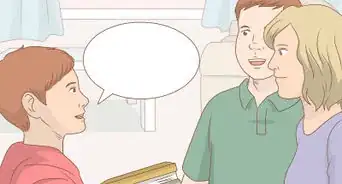
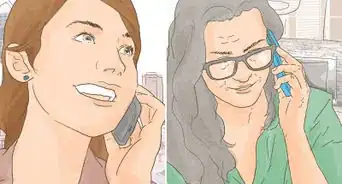
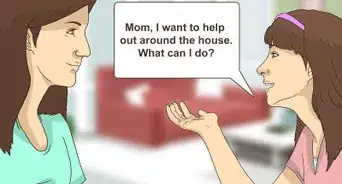
1Before you set any concrete boundaries, try to have a relaxed conversation. See if you and your parent can come to a mutual understanding here. Ask to speak to them privately at a time when the two of you are relaxed and frame the conversation in a way that demonstrates you’re approaching this in good faith.[1] Be straight up and share how you feel. If they’re capable of change, this may do it.[2]
- Use “I” language so that they don’t feel like you’re accusing or attacking them. Keep things as cool and laid back as possible.
- You might say, “Look, I know you don’t want to hurt me and you know I love you a lot. But when you’re always talking about how you were more accomplished than me at my age, it really hurts my feelings.”
- You could say something like, “You’ve always been a very caring, loving parent, but it feels like you’re always playing the victim card whenever I do something you don’t like. Do you think that’s a fair thing to do? I love you, but this is starting to grind me down.”

Method 2
Method 2 of 11:Identify a few measurable boundaries you want to enforce.
-
1The more concrete and clear your boundaries are, the easier it will be. People often talk about boundaries like they’re some kind of ethereal, abstract thing. Reflect for a little and determine what concrete, specific boundaries you want to enforce. Then, plot out how you want to frame these boundaries if—or when—you need to present them to your parent.[3]
- For example, “Be nicer to me” is pretty hard to evaluate. “I want you to stop putting me down” is better, but still difficult to call out.
- Something like, “You cannot keep bringing up how I don’t make as much money as I should—especially in front of my spouse” or, “I do not want you to interrupt me in front of others to talk about yourself” are specific, measurable, and easy to identify as they’re happening.
- If you set too many boundaries, you’ll have trouble enforcing them. It’s better to focus on the central behavior that you really want to stop, and let the minor annoyances go.[4]

Method 3
Method 3 of 11:Be explicit and clear about where the line is.
-
1If you need to put your foot down, don’t beat around the bush. If your heart-to-heart conversation is proving to be not enough and you want to set boundaries, spell it out for them. Talk to them privately, lay out your ground rules, and do not negotiate, argue, or discuss it. Make it clear that this is how it’s going to be from now on.[5]
- You might say, “I’ve tried to let it go, but I just can’t. You have to stop putting me down at family events. It’s completely unacceptable.”
- You could say, “You cannot give me unsolicited advice about raising my kids. I’m their parent, not you, and this needs to stop now.”
- Alternatively, you may say, “Stop acting like a victim when I don’t drop everything I’m doing to help you out. I’m tired of it and I’m not putting up with it anymore.”

Method 4
Method 4 of 11:Spell out the potential consequences.
-
1Explain what happens if they don’t respect your boundaries. A narcissist is unlikely to honor any boundaries if there’s nothing in it for them. Come up with a consequence for crossing each boundary you set. Keep in mind, you don’t want to choose something you aren’t willing to enforce, since bucking on the enforcement will actually make the boundary even less valid in their eyes.[6]
- You could say, “If you don’t stop putting me down in front of others, I won’t invite you to family events. That’s it. No more Thanksgiving, no more Christmas, and no more annual barbeque.”
- You might try something like, “If you keep telling me how to raise my kids, they simply won’t be visiting grandpa and grandma anymore. If you want them in your life, you have to respect my parenting decisions.”
- You can say, “If you keep playing the victim card, I simply won’t offer to help with anything. The next time you need me to give you a ride or fix your internet, you can just call someone else.”

Method 5
Method 5 of 11:Do not negotiate or give justifications.
-
1They won’t like the boundaries or consequences, but don’t let up. Do not allow them to plead, discuss, or negotiate where your lines are drawn. They’re your lines, and putting your foot down sets the precedent early that you’re not going to be pushed around here. Feel free to explain why you’re doing this, or answer questions that they have, but don’t concede anything.[7]
- Phrases like, “This is non-negotiable,” “It’s not up for discussion,” and, “I’ve made my mind up” are going to be your best friend here.
- The more info you give them regarding your reasons here, the more room they’ll have to try and argue or make you second-guess what you’re doing.

Method 6
Method 6 of 11:Ignore any fighting words and don’t let them challenge you.
-
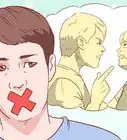
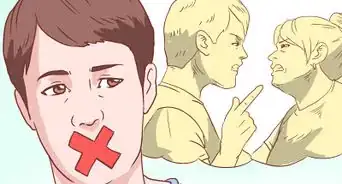
1Boundary-setting may anger them, but don’t fight fire with fire. They may try to hurt your feelings just to destabilize the situation and wrestle some control back from you. Don’t let them get to you. If they say something to ruffle your feathers, play it off, smile, laugh, or just flat out ignore it. They should stop if they don’t get the reaction they want out of you.[8]
- Narcissists often try to quarrel to gain control, so take that power away from them. The cycle often starts with a narcissist trying to provoke someone so that when the provoked person reacts, they can play the victim card.
- If they throw out counterarguments or try to intimidate you, do not get baited into responding. Remember, you aren’t negotiating here. These boundaries are concrete and you can’t let them think there’s any chance you’ll change your mind.

Method 7
Method 7 of 11:Don’t let the little violations slide.
-
1If they get close to the line, act quickly and call it out. It’s tempting to let small stuff go, and you should if that “little thing” is truly not a part of the problem. However, if you let them test the boundary, it will weaken over time. The moment you get a whiff that they’re crossing a line, call it out, tell them to stop, and remind them what’s at stake here. If you’re firm and fair, they’ll get the message.[9]
- If your boundary focuses on negative comments in front of family and they start talking about how successful they were at your age, butt in with a, “Hey. Careful.” Even a raised eyebrow can send the signal that they shouldn’t push it further.
- If you want them to stop critiquing parenting decisions and they say, “I was just thinking. Isn’t it time for Samantha to start taking swimming lessons?” Reply with, “We talked about this. I don’t need your advice or reminders—I’m perfectly capable of raising my child.”
- If they text you after midnight asking for help with something trivial, reply, “I’m going to bed. We’re not doing this.”

Method 8
Method 8 of 11:Enforce your consequences consistently.
-
1If they seriously cross the line or they keep pushing it, follow through. Enforcing a consequence is never fun, especially if you were hoping it would never come to this, but they’re never going to change if you let things slide. On top of that, if you’re inconsistent, it’s going to be difficult to actually pull the trigger in the future when you want to enforce a consequence. It may be painful, but remember, they’re the one crossing the line, not you.[10]
- If they show some actual reform in the future, you can reverse the decision. The important thing here is that they know you’ll enforce the consequence, but letting it go if they apologize or actually stop is fair.

Method 9
Method 9 of 11:Provide positive reinforcement if they improve.
-
1If they cut it out, show them kindness, love, and appreciation. You really do need to treat a narcissistic parent like a child. If they’re behaving well, reward them. Tell them that you genuinely appreciate them, show them love, and show up a little more often to spend time with them. If they’re respecting your boundary, it’s a sign that they’re respecting you and that your relationship is improving.[11]
- You can ask them to hang out more often, call them just to talk, or take them out to eat at their favorite restaurant.
- It can be hard to do this if you’ve got a lot of pent-up anger towards your narcissistic parent. If they’re genuinely making an attempt to do better, you should too. If you need help letting it go, talking to a therapist or counselor may help.

Method 10
Method 10 of 11:Take a break from them if you need one.
-
1If it reaches the point where you need to step away, do it. Let them know you need some time alone due to their boundary-crossing behavior. Alternatively, you can simply stop responding to them and slowly disengage over time until you’re ready. If it’s necessary for your mental and emotional health, it may be your best move.[12]
- Don’t beat yourself up if it gets this far. You have nothing to feel bad about if you need some space[13]
- Some people cut their narcissist parents off altogether. If you think this is the healthiest thing for you, don’t beat yourself up about it. There’s no shame in cutting toxic people out of your life, and you don’t owe them anything.[14]

Method 11
Method 11 of 11:Take care of yourself.
-
1Self-care is essential when you’re dealing with narcissists. Narcissistic parents can always find a way to get under your skin, especially when you’re trying to set boundaries. Look after yourself. Set time aside to get a massage, see friends, and pursue the things you care about. Meditate, exercise, and eat a healthy diet so that you feel your best.[15]
- Seeing a therapist can really help, especially if you find it emotionally taxing to deal with your parents. You may be surprised, but this is a very common problem, and a therapist will be able to offer insight.[16]






References
- ↑ https://www.helpguide.org/articles/mental-disorders/narcissistic-personality-disorder.htm#
- ↑ Sarah Schewitz, PsyD. Licensed Clinical Psychologist. Expert Interview. 15 April 2019.
- ↑ https://adaa.org/learn-from-us/from-the-experts/blog-posts/consumer/women-narcissistic-parents
- ↑ https://www.helpguide.org/articles/mental-disorders/narcissistic-personality-disorder.htm#
- ↑ https://www.uky.edu/hr/sites/www.uky.edu.hr/files/wellness/images/Conf14_Boundaries.pdf
- ↑ https://www.helpguide.org/articles/mental-disorders/narcissistic-personality-disorder.htm#
- ↑ https://observer.com/2016/01/how-to-deal-with-a-narcissist-5-secrets-backed-by-research/
- ↑ https://www.ncbi.nlm.nih.gov/pmc/articles/PMC5679127/
- ↑ Sarah Schewitz, PsyD. Licensed Clinical Psychologist. Expert Interview. 15 April 2019.
- ↑ https://www.helpguide.org/articles/mental-disorders/narcissistic-personality-disorder.htm#
- ↑ Sarah Schewitz, PsyD. Licensed Clinical Psychologist. Expert Interview. 15 April 2019.
- ↑ https://www.theguardian.com/lifeandstyle/2012/aug/04/daughter-of-narcissistic-mother-no-contact
- ↑ Sarah Schewitz, PsyD. Licensed Clinical Psychologist. Expert Interview. 15 April 2019.
- ↑ https://www.theguardian.com/lifeandstyle/2012/aug/04/daughter-of-narcissistic-mother-no-contact
- ↑ https://cbtpsychology.com/narcissisticmother/
- ↑ https://www.psychologytoday.com/us/blog/the-narcissist-in-your-life/202104/10-things-can-go-wrong-in-therapy-children-narcissists
- ↑ https://www.ncbi.nlm.nih.gov/pmc/articles/PMC5379216/
- ↑ https://www.urmc.rochester.edu/encyclopedia/content.aspx?contenttypeid=1&contentid=2990
About This Article