This article was co-authored by wikiHow Staff. Our trained team of editors and researchers validate articles for accuracy and comprehensiveness. wikiHow's Content Management Team carefully monitors the work from our editorial staff to ensure that each article is backed by trusted research and meets our high quality standards.
This article has been viewed 1,174 times.
Learn more...
If you choose it right, your wood flooring will last you for years to come. Decorating your home will be a lot easier as well, since beautiful floors make for an excellent base for truly outstanding interior design. By learning how to decide between different types of wood flooring and how to adjust the final touches to match your decor, make sure you choose the best option for your home.
Steps
Method 1
Method 1 of 3:Choosing the Right Type of Flooring
-
1Choose solid flooring if you want to be able to refinish it in the future. Solid flooring comes in planks made solely of wood. It’s noticeably quieter and can be refinished over and over again since it gives plenty of solid wood to work with. However, solid flooring is also prone to expansion and contraction, which can change its appearance over time.[1]
-
2Opt for engineered flooring if you want the wood to be more stable. Engineered flooring consists of multiple layers, only the top one being solid wood. The way engineered flooring is made prevents it from expanding and contracting, which means it always stays the same. However, it usually comes with a pretty thin layer of solid wood, which doesn't leave enough room for future refinishing.[2]
- If price is a big concern, engineered flooring is a better option. Not only is it cheaper, it can also be installed directly onto concrete floors, which can significantly reduce your costs.[3]
Advertisement -
3Get prefinished flooring if you prefer not taking risks. With prefinished flooring, the top coat is added before the planks leave the factory, so you know exactly what you're getting. Also, you don't need to rely on your contractor's skills when it comes to finishing touches. Once the flooring is delivered, it only needs to be installed.[4]
-
4Go with unfinished flooring if you want a higher level of control. Unfinished flooring gets delivered without the top coat and has to be finished on site. This is riskier, since you don't see the end product before it's already installed. However, choosing for the flooring to be finished on site allows you to make adjustments during the entire installation process.[5]
- When it comes to price, unfinished flooring is less affordable, since you need to pay a contractor to first install your flooring and then do the finishing touches as well.[6]
Advertisement


Method 2
Method 2 of 3:Selecting the Right Wood
-
1Select a type of wood. Different species are of different levels of durability. In general, the harder the wood, the more durable the flooring is. That's why you should look for harder species if you want your floors to last for years to come.[7]
- Janka scale measures the objective hardness of different wood species. If you want to check the ranking of your preferred type of wood, visit http://ejmas.com/tin/2009tin/tinart_goldstein_0904.html.
- It's not uncommon for wood to change color over time. Although the changes are normally subtle, it's worth keeping this in mind when deciding on a color for your flooring.[8]
-
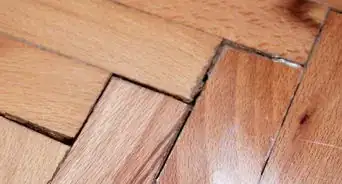
2Choose plank size. There are plenty of available sizes, but it's important to keep in mind both cost and design. Generally, the wider the planks are, the more expensive the flooring is. However, wider planks tend to make a room appear more luxurious.[9]
- Take into account that seams get more pronounced with time. If you think this could hurt the appearance of your home, consider investing in wider planks. Since they're bigger, they automatically have fewer seams.[10]
-
3Select a grain pattern. Plain-sawn wood is ideal for traditional interiors, with lines joining to form peaks known as cathedrals. Rift-sawn wood has straight lines that are fairly subtle, which makes it capable of fitting into any décor. Quarter-sawn wood also has straight lines, but they’re much more eye-catching, which makes for excellent flooring choice for modern and rustic styles.[11]
- Distressing is a finishing technique you can use to make the pattern on your flooring more prominent. Since distressing gives the wood a worn look, it's normally used in vintage and rustic interiors.[12]
Advertisement


Method 3
Method 3 of 3:Deciding on the Finish
-
1Consider staining the wood if you want it to be more eye-catching. This is a great choice if you're not going for a natural look or you're not content with the color of your preferred wood species. Wood stain comes in a wide range of shades. Depending on what shade you use, you can either pronounce the original wood color or create a completely new look.[13]
- In modern interiors, dark charcoal and similar shades are used to make wood floorings look striking.[14]
-
2Choose oil-based finish if you want to cut down on expenses. This type of finish is among the most commonly used. Apart from being affordable, oil-based finish is quite durable as well. It gives an amber glow, no matter the color of the wood itself.[15]
-
3Opt for moisture-cured finish if you want a high level of moisture resistance. Apart from being more resistant to moisture than any other type, this finish is highly durable in general. It comes in a variety of shades, so you can easily adjust it to the wood species of your choice. The shades range from completely clear to amber.[16]
-
4Go with natural oil finish if you want an extra durable top coat. Unlike most other types of finishes, which stay on the surface, natural oil finish penetrates into the wood. By doing that, it creates a protective interior layer. That’s also why it’s among the most durable finishes out there.[17]
- In general, oil finishes are easily scratched. However, those scratches are a lot less noticeable than the scratches you make on other types of finishes.[18]
-
5Choose sheen level. Unlike the type of finish, sheen only affects the appearance of wood. You can choose from matte, satin, semi-gloss, and gloss finishes. While matte reflects the least light, gloss is the shiniest.[19]Advertisement





References
- ↑ https://www.bobvila.com/articles/how-to-choose-hardwood-flooring/
- ↑ https://www.architecturaldigest.com/story/wood-floors-guide
- ↑ https://www.architecturaldigest.com/story/wood-floors-guide
- ↑ https://www.architecturaldigest.com/story/wood-floors-guide
- ↑ https://www.architecturaldigest.com/story/wood-floors-guide
- ↑ https://www.bobvila.com/articles/how-to-choose-hardwood-flooring/
- ↑ https://www.bobvila.com/articles/how-to-choose-hardwood-flooring/
- ↑ https://www.woodfloors.org/top-ten.aspx
- ↑ https://www.architecturaldigest.com/story/wood-floors-guide
- ↑ https://www.architecturaldigest.com/story/wood-floors-guide
- ↑ http://www.hardwooddistributors.org/blog/postings/what-is-the-difference-between-quarter-sawn-rift-sawn-and-plain-sawn-lumber/
- ↑ https://www.woodfloors.org/design-elements.aspx
- ↑ https://www.bobvila.com/articles/how-to-choose-hardwood-flooring/
- ↑ https://www.bobvila.com/articles/how-to-choose-hardwood-flooring/
- ↑ https://www.woodfloors.org/finishes.aspx
- ↑ https://www.woodfloors.org/finishes.aspx
- ↑ https://www.woodfloors.org/finishes.aspx
- ↑ https://www.architecturaldigest.com/story/wood-floors-guide
- ↑ https://www.woodfloors.org/finishes.aspx
About This Article