This article was co-authored by wikiHow Staff. Our trained team of editors and researchers validate articles for accuracy and comprehensiveness. wikiHow's Content Management Team carefully monitors the work from our editorial staff to ensure that each article is backed by trusted research and meets our high quality standards.
There are 9 references cited in this article, which can be found at the bottom of the page.
Learn more...
Unsure on how long to water your lawn each week? We'll walk you through sprinkler basics so you can have the greenest grass in your neighborhood. If you’re unsure how to use your sprinklers to their full potential, don’t worry—we have the answers to all your questions about how to run sprinklers long enough.
Steps
Question 1
Question 1 of 7:How long should I run my sprinklers?
-
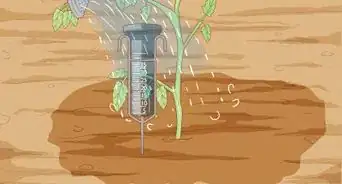
1It depends on your sprinkler output, so do a quick calculation. Start by placing 2 small containers in the range of your sprinkler. Run your sprinkler for 15 minutes, then use a ruler to measure how much water you collected in each container. Add the 2 measurements together and divide by 2 to find your sprinkler's average output. Next, divide 1 in (2.5 cm) by your sprinkler’s average output. Finally, multiply that number by 15 to find out how many minutes you need to water your lawn.[1]
- For example, let’s say you collected an average of 0.5 in (1.3 cm) of water in your containers. You’d calculate 1/0.5 in (1.3 cm) = 2. Then, multiply 2X15 minutes = 30 minutes.
- Every lawn is different, so you may need to adjust your watering schedule if you’re not getting the results you want. Talking to a master gardener can help you fine tune your watering schedule.
-
2Multiply your calculation by 1.20 if you have cold-season grass. Cold-season grasses include bermudagrass, tall fescue, Kentucky bluegrass, ryegrass, and bent grasses. Because they have shorter root systems, these grasses require more water. On average, cold-season grass typically requires 20% more water than warm-season grass, so you’ll multiply your calculation in step 1 by 1.20 to find the correct running time for cold-season grass.[2]
- For example, you’d multiply 30 minsX1.20 = 36 mins.
Advertisement


Question 2
Question 2 of 7:How often should I run my sprinklers?
-
1Run your sprinklers 1 to 2 times a week for warm-season grass. Warm-season grass grows longer roots down in the soil to help it get more water.[3] Watering your lawn less frequently encourages the roots on your plants to grow deeper. Longer roots make for hardier plants, so your yard will look lusher during the hot summer months.[4]
- As an example, you might run your sprinklers every Sunday morning for 45 minutes.
- Running the sprinklers once a week also creates less work for you. Just remember to keep track of how long the sprinklers have been running.
-
2Water your lawn 3 times a week if it’s cool-season grass. Cool-season grass naturally has shorter roots than warm-season grass. Because of this, you need to water it more often so the soil doesn’t dry out. You still want to provide the same amount of water each week, so run your sprinklers more often for shorter durations.[5]
- For example, let’s say you wanted to run your sprinklers for 45 minutes a week. You might run them for 15 minutes on Monday, Wednesday, and Friday.
-
3Skip your watering if it’s raining. You don’t need to water your lawn during rainy weather. The sky is giving your grass all the water it needs. If your sprinklers are on a timer and it starts raining, you should turn them off.[6]
- Overwatering could trigger the growth of mold or other fungi.
-
4Reduce your waterings to every 15 to 20 days during winter. Your lawn naturally needs less water during the winter months. It’s okay to let your lawn go dormant during this time, even if your grass turns brown and crunchy. Watering your lawn more often usually doesn’t make a difference during the cold months.[7]
- If it’s very cold outside, watering your lawn will just cause it to freeze.
Advertisement


Question 3
Question 3 of 7:When is the best time to run my sprinklers?
-
1Turn your sprinklers on early in the morning or late in the evening. You want to water during the cooler parts of the day so the water won’t evaporate. Not only does this save water, it also ensures your soil is getting properly drenched. Run your sprinklers before 10:00 a.m. or after 6:00 p.m. for the best results.[8] Grass that stays wet for too long can develop infectious fungi.[9]
- Hold off on watering your yard if it’s sunny and 95°F (35°C) or more outside. The sun will evaporate that water right up, leaving little, if any, for your lawn.
Question 4
Question 4 of 7:How much water does my lawn need?
-
1The average lawn needs 1 inch (2.5 cm) of water each week.[10] However, there are multiple factors that can influence the amount of water your lawn needs, including your type of grass, location, and climate. To make sure your lawn gets the right amount of water, you need to measure the water output of your sprinklers.[11]
- If you’re not sure about your lawn’s watering needs, try contacting a garden center or landscape expert.
Advertisement
Question 5
Question 5 of 7:Does water output depend on the type of sprinkler?
-
1Yes, different sprinkler heads put out different amounts of water. You may want to adjust your watering schedule depending on your sprinkler type. There are three basic types of sprinkler heads: spray, rotor, and drip.[12]
- Spray heads have a small range, but a large output: 1.5–2 inches (3.8–5.1 cm) of water per hour.
- Rotor heads have a much larger range, and spread water more uniformly across the lawn than spray heads, but have a smaller output: 0.5 inches (1.3 cm)
- Drip systems are normally intended for small beds or specific plants, not for lawns (turf). They can put out anywhere between 0.5–24 inches (1.3–61.0 cm) of water per hour.
Question 6
Question 6 of 7:What happens if my lawn doesn’t get enough water?
-
1When grass doesn’t get enough water, it goes dormant. You’ll know your lawn is dormant because it’ll be brown and crunchy. Dormant grass isn’t dead, it’s just wilted to save water. However, your lawn may die if it goes long enough without water.[13]
- Grass tends to go dormant naturally during winter or intense summers. During peak summertime, you may be able to keep your grass green with weekly watering.
Advertisement
Question 7
Question 7 of 7:Can dormant grass become healthy again?
-
1Yes, you can revive dormant grass with lawn maintenance. Start by watering your lawn 2 to 3 times a week to revive it.[14] If your lawn doesn’t bounce back after a few weeks, you can try the following:
- Dig out or pull up weeds.[15]
- Mow the lawn, but leave the clippings in the grass. The clipped grass will provide your lawn with nitrogen, which enriches the soil and makes the grass healthy.[16]
- Fertilize it. Purchase a bag of lawn fertilizer at your local hardware or lawn care store, then scatter some fertilizer across the lawn by hand or using a fertilizer spreader. Once the fertilizer is spread out, water the grass to help the fertilizer get down into the soil.[17]
- Topdress it. No, we’re not talking about clothing. Spread a layer of compost, loam, or sand about 1⁄4 inch (0.64 cm) thick across your lawn. The grass should still be sticking through when you’re done. Just like with fertilizer, you should water your lawn after applying the topdressing to help the nutrients of the topdressing soak into the roots.
Warnings
- Grass can die if you don’t water it for more than 3 weeks. Be sure to water it every week so that it doesn’t dry up, unless you get frequent rain in your area.Thanks!
- Overwatering grass may cause the growth of mildew and fungi that can endanger your health.Thanks!


References
- ↑ https://ucanr.edu/datastoreFiles/268-570.pdf
- ↑ https://ucanr.edu/datastoreFiles/268-570.pdf
- ↑ http://ipm.ucanr.edu/TOOLS/TURF/MAINTAIN/cycle.html
- ↑ https://fortbend.agrilife.org/saving-water-in-your-landscape/
- ↑ http://ipm.ucanr.edu/TOOLS/TURF/MAINTAIN/cycle.html
- ↑ https://fortbend.agrilife.org/saving-water-in-your-landscape/
- ↑ https://fortbend.agrilife.org/saving-water-in-your-landscape/
- ↑ https://fortbend.agrilife.org/saving-water-in-your-landscape/
- ↑ https://portal.ct.gov/CAES/Fact-Sheets/Plant-Pathology/Common-Diseases-and-Problems-of-Home-Lawns
- ↑ https://fortbend.agrilife.org/saving-water-in-your-landscape/
- ↑ https://ucanr.edu/datastoreFiles/268-570.pdf
- ↑ https://www.brightonco.gov/DocumentCenter/View/14962/Suggested-Irrigation-Schedule-2018?bidId=
- ↑ https://www.purdue.edu/newsroom/outreach/2012/120628PattonLawn.html
- ↑ https://www.purdue.edu/newsroom/outreach/2012/120628PattonLawn.html
- ↑ http://ipm.ucanr.edu/QT/landscapeweedscard.html
- ↑ https://extension.umn.edu/lawncare/what-do-lawn-clippings
- ↑ https://www.consumerreports.org/cro/magazine/2014/05/how-to-fix-the-5-most-common-lawn-problems/index.htm
About This Article