This article was medically reviewed by Shaune Wallace, OD. Dr. Wallace is an Optometrist in Nevada with over 14 years of optometry experience. He received his OD from the Southern California College of Optometry in 2006 and is a member of the American Optometric Association.
wikiHow marks an article as reader-approved once it receives enough positive feedback. In this case, 100% of readers who voted found the article helpful, earning it our reader-approved status.
This article has been viewed 620,838 times.
You've finally mastered putting in your contact lenses, but taking them out might be just as difficult, if not more so. Once you've removed them, it is also important to clean and store contacts properly to prevent infection. Knowing the correct process will allow you to remove your contact lenses quickly and safely.
Steps
Part 1
Part 1 of 2:Removing Your Contact Lenses
-
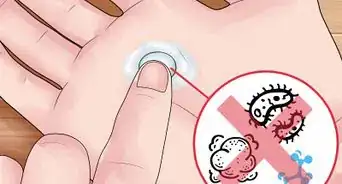
1Wash your hands. Harmful pathogens can enter the eye via the lenses and cause eye infection or conjunctivitis.[1] [2] Use antibacterial soap and warm water to wash your hands. Dry your hands thoroughly with a clean towel.
- Keeping good hand hygiene regimen not only protects your contacts from harmful pathogens, but also your eyes in general.
-
2Add drops of saline to each eye. This will hydrate and lubricate eyes as well as your contacts, making them easier to remove.[3] Ensure that you use a sterile saline solution.
-
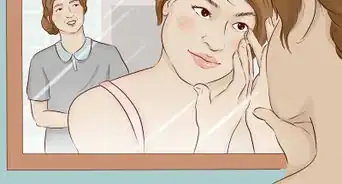
3Use a mirror. Plenty of good lighting and a mirror will help initially until you get used to the process of removing your contact lenses.
-
4Start with the same eye each time. Your contacts are not the same or interchangeable, so you don’t want to mix up the two lenses. By starting with the same eye each time, you’ll have less opportunity to mix them up by accident.[4]
-
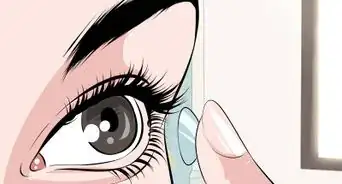
5Hold your eyelids open. Look up, and with your non-dominant hand, use your index finger to lift your top eyelid and eyelashes up and away from your eye. Then with your dominant hand, use your middle finger to pull your lower eyelid down and away from your eye.[5] [6] Make sure you keep your eyelashes out of your eyes.
-
6
-
7
-
8Place the lens in your other palm. Rather than trying to flip the lens over, you’ll have an easier time simply placing it on the palm of your opposite hand.[11] This will also make it easier to clean the lens since you’ll want to use your dominant hand to do so.


Part 2
Part 2 of 2:Cleaning and Storing Your Contacts
-
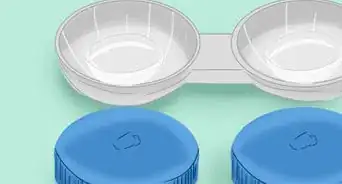
1Clean your lens case before using it. You should clean your storage case for your contact lenses each day before placing them back in the case. Use a sterile solution or hot water to clean the case and allow it to air dry before replacing your contacts.[12]
-
2Put new, clean solution in the case. Before you even remove your contact lenses, you may find it helpful to fill the case halfway with new, clean solution. This will make it easier to transfer the lenses directly into the solution rather than trying to fill the case with a lens still in the palm of your hand.
-
3Clean the lens. With the lens in the palm of your clean hand, wet the lens using the correct solution for your type of contact lenses (as suggested by your eye-care professional). Then softly use the pad of your finger to rub the solution thoroughly along the lens. This helps remove any buildup or microbes on the lens more than simply soaking it in the solution alone.[17]
-
4Place the contact in the case. Rubbing the lens can help breakdown any buildup, but you should use a little more disinfecting solution afterward to help wash it away. Then you can gently place the clean lens into the fresh, clean solution that you already have waiting in the case. Make sure you place it on the side for the corresponding eye.
- You may need to place more solution in the case after you place the contact lens inside. Make sure the case has enough solution to completely cover the lens.
-
5Repeat the process for your other eye. To avoid potentially mixing up your contact lenses, you may find it easier to do the process from beginning to end with one eye at a time. In this case, repeat the process for the opposite eye.
-
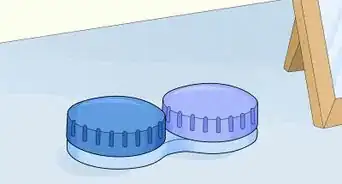
6Leave your contacts in the solution as directed. To ensure that your contact lenses are completely disinfected, they must sit in the solution for the amount of time indicated on the product. For most solutions, this will be at least four to six hours, so overnight is sufficient.[20]
- This also gives your eyes time to rest and helps to avoid eye strain.


Expert Q&A
Did you know you can get expert answers for this article?
Unlock expert answers by supporting wikiHow
-
QuestionCan you use solution in the eye while the contact is still in ?
 Shaune Wallace, ODDr. Wallace is an Optometrist in Nevada with over 14 years of optometry experience. He received his OD from the Southern California College of Optometry in 2006 and is a member of the American Optometric Association.
Doctor of Optometry, Southern California College of OptometrySoft contact lens solution can be ok to use in your eye. Use caution however — rigid contact lens solution and hydrogen peroxide cleaning solutions should never be used in the eye. Be aware and follow all warnings on the bottle's label.
Support wikiHow by unlocking this expert answer.
Warnings
- Read any directions that come with contact solutions, eye drops, or protein cleaners. Their uses vary and can be harmful if used incorrectly.Thanks!
- If you use hard lenses, be very careful they don't slide to the bottom of the eye. This is equally important with soft contacts, but it is less painful than hard ones.Thanks!
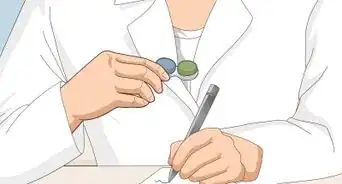
- Always replace your contacts as directed by your eye-care professional.Thanks!
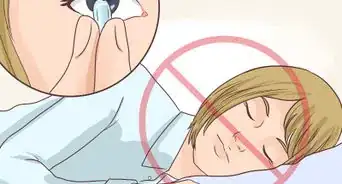
- Always remove your contacts prior to sleeping unless you are prescribed extended-wear contacts by your doctor. Sleeping with your contacts in can lead to a variety of complications.Thanks!
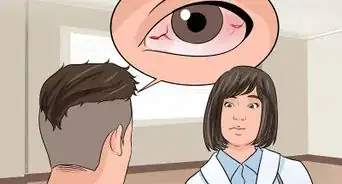
- If your contact ever feels lodged somewhere in your eye, use a sterile saline solution to flush your eye. If you still cannot remove the lens, seek medical assistance.[21]Thanks!
- Do not reuse solution.[22]Thanks!
- Never use plain water or your saliva to clean your contacts.[23]Thanks!
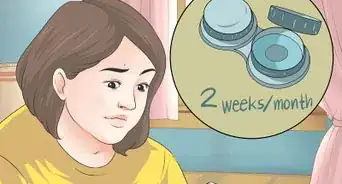
- If you have disposables, make sure to throw them out when you are done.Thanks!
Things You'll Need
- Contacts
- Contact solution
- Contact case
- Glasses (optional) in case you lose your contacts
- Clean hands

References
- ↑ http://www.cdc.gov/contactlenses/protect-your-eyes.html
- ↑ http://www.cdc.gov/contactlenses/show-me-the-science.html#habits
- ↑ http://emedicine.medscape.com/article/1413506-overview#a7
- ↑ http://coopervision.com/about-contacts/how-remove-contact-lenses
- ↑ http://emedicine.medscape.com/article/1413506-overview#a7
- ↑ http://coopervision.com/about-contacts/how-remove-contact-lenses
- ↑ http://emedicine.medscape.com/article/1413506-overview#a7
- ↑ http://coopervision.com/about-contacts/how-remove-contact-lenses
- ↑ http://emedicine.medscape.com/article/1413506-overview#a7
- ↑ http://coopervision.com/about-contacts/how-remove-contact-lenses
- ↑ http://coopervision.com/about-contacts/how-remove-contact-lenses
- ↑ http://www.webmd.com/eye-health/caring-contact-lens
- ↑ http://www.cdc.gov/contactlenses/show-me-the-science.html#habits
- ↑ http://www.aoa.org/patients-and-public/caring-for-your-vision/contact-lenses/what-you-need-to-know-about-contact-lens-hygiene-and-compliance?sso=y
- ↑ http://www.aoa.org/patients-and-public/caring-for-your-vision/contact-lenses/what-you-need-to-know-about-contact-lens-hygiene-and-compliance?sso=y
- ↑ http://www.aoa.org/patients-and-public/caring-for-your-vision/contact-lenses/what-you-need-to-know-about-contact-lens-hygiene-and-compliance?sso=y
- ↑ http://www.cdc.gov/contactlenses/show-me-the-science.html#habits
- ↑ http://emedicine.medscape.com/article/1413506-overview#a7
- ↑ http://www.cdc.gov/contactlenses/show-me-the-science.html#habits
- ↑ http://www.aoa.org/patients-and-public/caring-for-your-vision/contact-lenses/what-you-need-to-know-about-contact-lens-hygiene-and-compliance?sso=y
- ↑ http://www.aoa.org/patients-and-public/caring-for-your-vision/contact-lenses/what-you-need-to-know-about-contact-lens-hygiene-and-compliance?sso=y
- ↑ http://www.cdc.gov/contactlenses/show-me-the-science.html#habits
- ↑ http://www.cdc.gov/contactlenses/show-me-the-science.html#habits
About This Article

Removing contact lenses can be difficult at first, but with a little practice in front of a mirror, it’ll be second nature! Start by washing and drying your hands so you don’t transfer any bacteria to your eyes. Then, add a drop of saline to each eye to help lubricate your contacts. Stand or sit in front a well-lit mirror so you can see what you’re doing. Always start with the same eye, so you don’t get your lenses mixed up. With your non-dominant hand, pull your eyelids apart to make sure you don’t blink. While holding your eyelids open, gently grip the lens with the thumb and forefinger of your dominant hand. When you feel the lens start to come out, lift it away from your eye. Put your contact lens in its case and repeat the process for your other eye. For more tips from our Optometry co-author, including how to clean and store your contact lenses, read on!