This article was co-authored by wikiHow Staff. Our trained team of editors and researchers validate articles for accuracy and comprehensiveness. wikiHow's Content Management Team carefully monitors the work from our editorial staff to ensure that each article is backed by trusted research and meets our high quality standards.
This article has been viewed 1,102 times.
Learn more...
Virginia requires up-to-date registration if you live in the state and want to drive your car there. Fortunately, registering a car in the state of Virginia is a relatively straightforward process that you can usually handle with a single trip to the DMV. After your initial registration, you have more options to renew each year, including doing it online.[1]
Steps
Method 1
Method 1 of 2:New Registration
-
1Check online to find the nearest DMV office. Go to https://www.dmv.virginia.gov/DMVLocator/ and enter your street address, city, or ZIP code in the search field, then click the "Search" button. The website will display nearby locations on the map. [2]
- Click on a location you're interested in to bring up a pop-up with the phone number and address of that office. If an appointment is required at that location, click the green button to make your appointment online.
-
2Pass the safety inspection. Virginia requires safety inspections for all cars to make sure your brakes, lights, and signals are operational and your car is mechanically sound. Most garages that offer car repair services also do inspections—just look for the sign out front. As of 2021, you'll pay a maximum of $20 for your inspection. When you pass, you'll get an updated sticker to display on your windshield.[3]
- You'll need to get the work done to repair your car if it doesn't pass the inspection. If you got your inspection done at a garage, they can probably take care of the repairs as well.
- If you bought your car from a Virginia dealer, the dealer has usually already done the inspection. Check the date on the sticker, however—you might have an inspection due in less than a year.
-
3Get an emissions inspection if required by your city or county. Complete your emissions inspection either by visiting a certified emissions inspection station or driving through a RAPIDPASS roadside testing site. Results are automatically transmitted to the DMV within 24 hours and are valid for 2 years. If you don't pass, take your car to a mechanic to find out what repairs need to be made so you can pass the inspection. You need an emissions inspection if you live in any of the following:[4]
- Counties: Arlington, Fairfax, Loudoun, Prince William, Stafford
- Cities: Alexandria, Fairfax, Falls Church, Manassas, Manassas Park
-
4Complete your application for title and registration. Get an application at the DMV office or fill out a copy online on the DMV website and take it with you. Fill in your name, address, phone number, and Social Security number If you own the car jointly with someone else, such as your spouse, include their information as well. Then, provide the following information about the vehicle you want to register:[5]
- The year, make, model, body type, and vehicle identification number (VIN)
- Sales information, including the date you purchased the vehicle, the sales price, and the location of the seller
- Information about the finance company (lienholder), if the vehicle is financed
- Information about the dealer or lease company, if the vehicle is leased
- The number of miles listed on the odometer
- The name of your auto insurance company
-
5Submit your application at the nearest DMV office along with your fee. As of 2021, the registration fee for most passenger cars is $30.75 ($88.20 for electric cars). Take payment along with your application up to the clerk at the DMV. Bring something with you to prove your identity and residence. Typically your driver's license is fine as long as it shows your current address. You might also want to bring a lease, mortgage statement, or utility bill as proof of address.[6]
- Even though the information is included in your application, bring along your auto insurance card so you have proof of insurance.
-
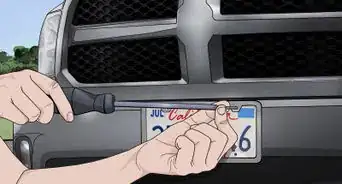
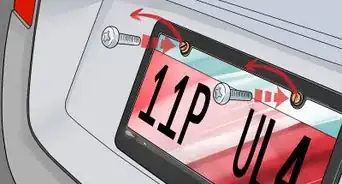
6Place the decals on your license tags. Your registration comes with 2 decals—1 for each of your license tags. Affix the decals to your tags immediately after registering your car. They show that your registration is up-to-date for the year.[7]
- If you want, you can slice an "X" through the decals with a knife after putting them on your tag. That way, you don't have to worry about the whole sticker coming off at once.
-
7Keep your registration in your car. The clerk issues your registration after you've paid your fee. Put it in your glove box or another safe spot in your car where you can easily get to it. If you get pulled over, you'll need to show the registration to the police officer.[8]
- You might also want to make a copy of your registration and keep it in your records at home. That way, you have a copy of it if something happens to your car.


Method 2
Method 2 of 2:Renewal Registration
-
1Opt for digital renewal reminders for added convenience. After your first registration, the DMV sends you a notice when your deadline for renewal is approaching. By default, they send the notice through the mail, but it's often more convenient to get email or text message reminders.[9]
- If you didn't choose digital reminders when you first registered your car, you can always go to the DMV website and update your preferences. You'll just need information from your registration card to pull up your account.
-
2Pass the safety inspection before the expiration date on your inspection sticker. The sticker you got when you first passed the safety inspection includes the date when that inspection expires. There are more than 4,200 inspection stations across the state, including many garages that perform auto repairs.[10]
- As of 2021, the maximum fee for inspection of a passenger car is $20.
- Safety inspections are separate from registration, so you don't have to show that you've passed the safety inspection before you renew your registration. At the same time, you still have to renew your safety inspection every year to legally drive the car in Virginia.
-
3Get an emissions inspection if yours is expired. Emissions inspections are valid for 2 years. If it's been 2 years since your last inspection and you still live in a city or county that requires emissions testing, you need a new one. You can renew your registration after the results of your inspection are transmitted to the DMV—usually within 24 hours of the inspection.[11]
- Driving through a RAPIDPASS roadside inspection site is the easiest way to get an emissions inspection—you don't even have to stop! Results are transmitted to the DMV within 24 hours. You can also take your car to a certified emissions inspection station. Locations are listed on the DMV's website.
- If you don't pass the inspection, take your car to a mechanic and tell them you failed the emissions inspection. They'll look at your car and tell you what needs to be repaired.
-
4Renew your registration online to receive a discount. Go to https://www.dmv.virginia.gov/apps/webtrans/Vehicle_Registration/intro.aspx and click the "continue" button to start your registration. Provide information from your registration renewal notice or your current vehicle registration card. Then, pay the registration fee online using a major credit or debit card or through direct debit from your bank account using the account and routing number. If you renew online, you'll save $1 per year of renewal.[12]
- You can renew for 2 or 3 years at a time unless you live in one of the cities or counties that requires an emissions inspection every other year.
- Print the official internet receipt and keep it in your car until your new registration and decals arrive, even if your current registration isn't expired. It could keep you from getting a ticket.[13]
-
5Mail in your renewal notice and fee if you don't want to renew online. If you don't feel comfortable renewing online, you don't have to! Check the renewal notice to see how much you need to pay, then get a personal check, cashier's check, or money order for that amount. Mail in the notice along with your payment to the address listed on the notice.[14]
- It's a bad idea to choose the mail-in option if your registration is going to expire within a week. While most people receive their new registration within 5 days, it can take up to 2 weeks. In the meantime, you won't have any proof that you've renewed your registration if you happen to get pulled over for expired tags.
-
6Visit a DMV Select office if you want to renew in person. Go to https://www.dmv.virginia.gov/DMVLocator/ and click the blue "DMV Select" button to locate the nearest DMV Select office. Typically, you don't need an appointment to renew your registration at a DMV Select office. If you still have your renewal notice, bring it with you to the office along with your renewal fee.[15]
- If you've lost your renewal notice, the clerk can look up your account based on the information on your current or expired registration card.
-
7Update your tag decals and registration card. Stick the new decals right on top of the old ones to update your tags. Then, take your old registration card out of your car and put the new one in its place. Since the old registration is no longer valid, you can go ahead and throw it away.[16]




-Step-17.webp)
References
- ↑ https://www.dmv.virginia.gov/vehicles/#vehiclereg.asp
- ↑ https://www.dmv.virginia.gov/vehicles/#vehiclereg.asp
- ↑ https://www.vsp.virginia.gov/Safety.shtm
- ↑ https://www.dmv.virginia.gov/vehicles/#emissions.asp
- ↑ https://www.dmv.virginia.gov/webdoc/pdf/vsa17a.pdf
- ↑ https://www.dmv.virginia.gov/vehicles/#vehiclereg.asp
- ↑ https://www.dmv.virginia.gov/vehicles/#vehiclereg.asp
- ↑ https://www.dmv.virginia.gov/vehicles/#vehiclereg.asp
- ↑ https://www.dmv.virginia.gov/vehicles/#vehiclereg.asp
- ↑ https://www.vsp.virginia.gov/Safety.shtm
- ↑ https://www.dmv.virginia.gov/vehicles/#emissions.asp
- ↑ https://www.dmv.virginia.gov/vehicles/#vehiclereg.asp
- ↑ https://www.dmv.virginia.gov/apps/webtrans/Vehicle_Registration/intro.aspx
- ↑ https://www.dmv.virginia.gov/vehicles/#vehiclereg.asp
- ↑ https://www.dmv.virginia.gov/vehicles/#vehiclereg.asp
- ↑ https://www.dmv.virginia.gov/vehicles/#vehiclereg.asp
- ↑ https://www.dmv.virginia.gov/vehicles/#vehiclereg.asp
About This Article